This website uses cookies to enhance your browsing experience and ensure the functionality of our site. For more detailed information about the types of cookies we use and how we protect your privacy, please visit our Privacy Information page.
×
Cookie Settings
This website uses different types of cookies to enhance your experience. Please select your preferences below:
> Blenniiformes (Blennies) > Tripterygiidae (Triplefin blennies) > Tripterygiinae
Etymology: Helcogramma:Greek, helkos, -eos, -ous = ulcer, sore + Greek, gramma = letter, mark (Ref. 45335); nesion:The specific epithet is from the Greek "nesion", meaning island. The name refers to the isolated island of scales on either side of the nape and is treated as Noun in apposition.
Environnement : milieu / zone climatique / profondeur / gamme de distribution Écologie
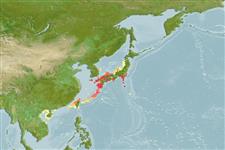
marin benthopélagique; profondeur 3 - 10 m (Ref. 52308). Tropical
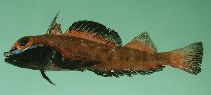
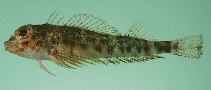
Épines dorsales (Total) : 17 - 18; Rayons mous dorsaux (Total) : 12 - 13; Épines anales: 1; Rayons mous anaux: 20 - 22. With 1-2 symphysial mandibular sensory pores, second dorsal fin spines XIV, third dorsal fin segmented rays 11, last ribs on vertebral centrum 10, vertebrae 10+28 or 29=38 or 39, pored lateral line scales typically 25 to 27, nape scales absent, small isolated patch of scales on either side of nape, each patch surrounded by naked area. Body shape (shape guide): elongated; Cross section: oval.
Female members of the Tripterygiidae have eggs that are hemispherical and covered with numerous sticky threads that anchor them in the algae on the nesting sites (Ref. 240). Larvae are planktonic which occur primarily in shallow, nearshore waters (Ref. 94114).
Cycle de vie et comportement reproducteur Maturité | Reproduction | Frai | Œufs | Fécondité | Larves
Williams, J.T. and J.C. Howe, 2003. Seven new species of the triplefin fish genus Helcogramma (Tripterygiidae) from the Indo-Pacific. aqua, J. Ichthyol. Aquat. Biol. 7(4):151-176. (Ref. 52308)
Statut dans la liste rouge de l'IUCN (Ref. 130435: Version 2025-2)
Dynamique des populations Paramètres de croissance Âges / tailles maximales Longueur-poids rel. Rel. longueur-longueur. Fréquences de longueurs Conversion de masse Recrutement Abondance
Cycle de vie Reproduction Maturité Maturité/épines rel. Fécondité Frai Agrégats de frai Œufs Développement de l'œuf Larves Dynamique des populations larvaires
Distribution Territoires Zones FAO Écosystèmes Occurrences Introductions BRUVS - Vidéos
Anatomie Surface branchiale Cerveau Otolithe
Physiologie Composition corporelle Nutriments Consommation d'oxygène Type de natation Vitesse de nage Pigments visuels Son de poisson Maladies et parasites Toxicité (CL50)
Indice de diversité phylogénétique (Réf. 82804): PD50 = 0.5000 [Uniqueness, from 0.5 = low to 2.0 = high].
Bayesian length-weight: a=0.00617 (0.00288 - 0.01322), b=3.04 (2.86 - 3.22), in cm total length, based on LWR estimates for this (Sub)family-body shape (Ref. 93245).
Niveau trophique (Réf. 69278): 3.1 ±0.3 se; based on size and trophs of closest relatives
Résilience (Réf. 120179): Haut, temps minimum de doublement de population inférieur à 15 mois (Preliminary K or Fecundity.).
Vulnérabilité de la pêche (Ref. 59153): Low vulnerability (10 of 100). 🛈