-

- À propos de cette page
- Langues
- Commentaires des utilisateurs
- Citation
- Téléchargements
-
Espèces associées
- Espèces pour
Giuris - Espèces pour
Eleotridae - - Classification -
- Eleotridae
- Gobiiformes
- Teleostei
- Chordata
- Animalia
- Espèces pour
-



Giuris margaritaceus (Valenciennes, 1837)
Snakehead gudgeon
Envoyez vos Photos et vidéos
Images | Images Google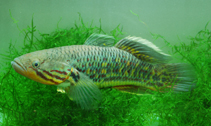 Giuris margaritaceus
Photo de Ho, H.-C.
Images | Images Google
Photo de Ho, H.-C.
Classification / Noms Noms communs | Synonymes | Catalog of Fishes(Genre, Espèce) | ITIS | CoL | WoRMS | Cloffa
Environnement : milieu / zone climatique / profondeur / gamme de distribution Écologie
marin; eau douce; saumâtre démersal; amphidrome (Ref. 46888); profondeur 0 - 5 m (Ref. 86942). Tropical; 20°C - 30°C (Ref. 2060); 18°N - 25°S
Distribution Territoires | Zones FAO | Écosystèmes | Occurrences | Carte par point | Introductions | Faunafri
Africa to Oceania: Madagascar to New Guinea, Australia and other islands of Melanesia.
Taille / Poids / Âge
Maturité: Lm ? range ? - ? cm
Max length : 29.0 cm TL mâle / non sexé; (Ref. 11344); poids max. publié: 171.00 g (Ref. 9162); poids max. publié: 171.00 g
Max length : 29.0 cm TL mâle / non sexé; (Ref. 11344); poids max. publié: 171.00 g (Ref. 9162); poids max. publié: 171.00 g
Description synthétique Clés d'identification | Morphologie | Morphométrie
Épines dorsales (Total) : 7; Rayons mous dorsaux (Total) : 8 - 9; Épines anales: 1; Rayons mous anaux: 9. Body relatively large, stout and cylindrical with a dorsally flattened head; generally greenish brown with 8-10 dark bars across sides and large black blotch at base of pectoral fins; lower half of head tan or yellowish with 3-4 dark brown to reddish stripes radiating from lower part of eye (Ref. 44894).
Body shape (shape guide): elongated.
Body shape (shape guide): elongated.
Adults occur in fresh water, estuaries and inshore (Ref. 86252). Found in a variety of habitats including rivers, swamps, coastal streams and floodplains over mud bottoms, often among dense aquatic vegetation or the cover of undercut banks. They feed mainly on aquatic insects and nymphs, but also takes lesser amount of algae, other aquatic plants and small crustaceans. Pelagic larval stage is found in marine water, but adults are always found in freshwater (Ref. 44894).
Cycle de vie et comportement reproducteur Maturité | Reproduction | Frai | Œufs | Fécondité | Larves
Plant spawner.
Référence principale
Téléchargez vos références | Références | Coordinateur | Collaborateurs
Allen, G.R., S.H. Midgley and M. Allen, 2002. Field guide to the freshwater fishes of Australia. Western Australian Museum, Perth, Western Australia. 394 p. (Ref. 44894)
Statut dans la liste rouge de l'IUCN (Ref. 130435: Version 2025-2)
Préoccupation mineure (LC) ; Date assessed: 18 March 2024
CITES
Not Evaluated
Menace pour l'homme
Harmless
Utilisations par l'homme
Pêcheries: pêcheries vivrières
FAO - Publication: search | FishSource |
Plus d'informations
Écologie trophique
Aliments (proies)
Composition du régime alimentaire
Consommation alimentaire
Rations alimentaires
Prédateurs
Aliments (proies)
Composition du régime alimentaire
Consommation alimentaire
Rations alimentaires
Prédateurs
Dynamique des populations
Paramètres de croissance
Âges / tailles maximales
Longueur-poids rel.
Rel. longueur-longueur.
Fréquences de longueurs
Conversion de masse
Recrutement
Abondance
Paramètres de croissance
Âges / tailles maximales
Longueur-poids rel.
Rel. longueur-longueur.
Fréquences de longueurs
Conversion de masse
Recrutement
Abondance
Cycle de vie
Reproduction
Maturité
Maturité/épines rel.
Fécondité
Frai
Agrégats de frai
Œufs
Développement de l'œuf
Larves
Dynamique des populations larvaires
Reproduction
Maturité
Maturité/épines rel.
Fécondité
Frai
Agrégats de frai
Œufs
Développement de l'œuf
Larves
Dynamique des populations larvaires
Physiologie
Composition corporelle
Nutriments
Consommation d'oxygène
Type de natation
Vitesse de nage
Pigments visuels
Son de poisson
Maladies et parasites
Toxicité (CL50)
Composition corporelle
Nutriments
Consommation d'oxygène
Type de natation
Vitesse de nage
Pigments visuels
Son de poisson
Maladies et parasites
Toxicité (CL50)
Génétique
génôme
Génétique
Hétérozygotie
Héritabilité
Diversité génétique
génôme
Génétique
Hétérozygotie
Héritabilité
Diversité génétique
Liées à l'homme
Systèmes d'aquaculture
Profils d'aquaculture
Souches
Cas de ciguatera
Timbres, pièces de monnaie, divers
Systèmes d'aquaculture
Profils d'aquaculture
Souches
Cas de ciguatera
Timbres, pièces de monnaie, divers
Outils
E-book | Guide de terrain | Générateur de fréquences de longueur | Outil de dynamique de population | Carte par point |
Capture-MSY |
Articles particuliers
Télécharger en XML
Sources Internet
AFORO (otoliths) | Aquatic Commons | BHL | Cloffa | Websites from users | FishWatcher | CISTI | Catalog of Fishes: Genre, Espèce | DiscoverLife | ECOTOX | FAO - Publication: search | Faunafri | Fishipedia | Fishtrace | GloBI | Google Books | Google Scholar | Google | IGFA World Record | Bases de données nationales | OneZoom | Open Tree of Life | Otolith Atlas of Taiwan Fishes | PubMed | Reef Life Survey | Socotra Atlas | TreeBase | Arbre de Vie | Wikipedia: aller à, chercher | World Records Freshwater Fishing | Zoological Record
Estimations basées sur des modèles
Température préférée (Réf. 123201): 26.6 - 29.3, mean 28.6 °C (based on 2159 cells).
Indice de diversité phylogénétique (Réf. 82804): PD50 = 1.0000 [Uniqueness, from 0.5 = low to 2.0 = high].
Bayesian length-weight: a=0.00759 (0.00424 - 0.01358), b=3.17 (3.00 - 3.34), in cm total length, based on LWR estimates for this species & (Sub)family-body (Ref. 93245).
Niveau trophique (Réf. 69278): 2.6 ±0.2 se; based on diet studies.
Résilience (Réf. 120179): Haut, temps minimum de doublement de population inférieur à 15 mois (Fec = 100,000).