-

- Über diese Seite
- Sprachen
- Rückmeldungen der Nutzer
- Zitat
- Uploads
-
Verwandte Arten
- Arten in
Salmo - Arten in
Salmonidae - - Klassifizierung -
- Salmoninae
- Salmonidae
- Salmoniformes
- Teleostei
- Chordata
- Animalia
- Arten in
-



Hochladen Photos und videos
Google Bild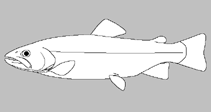 No image available for this species;
drawing shows typical species in Salmonidae.
Google Bild
drawing shows typical species in Salmonidae.
Klassifizierung / Names Namen | Synonyme | Catalog of Fishes(Gattung, Arten) | ITIS | CoL | WoRMS | Cloffa
> Salmoniformes (Salmons) > Salmonidae (Salmonids) > Salmoninae
Etymology: Salmo: Latin, salmo, Plinius = salmon (Ref. 45335).
Eponymy: Paul Maurice Pallary (1869–1942) was a French-Algerian malacologist who collected the type specimen of the barbel. [...] (Ref. 128868), visit book page.
More on author: Pellegrin.
Etymology: Salmo: Latin, salmo, Plinius = salmon (Ref. 45335).
Eponymy: Paul Maurice Pallary (1869–1942) was a French-Algerian malacologist who collected the type specimen of the barbel. [...] (Ref. 128868), visit book page.
More on author: Pellegrin.
Issue
Ref. 94558 considers the whole native Moroccan Salmo population, including S. pallaryi, as a single species: S. trutta macrostigma.
Umwelt: Milieu / Klimazone / Tiefenbereich / Verbreitungsgebiet Ökologie
; süßwasser pelagisch. Subtropical
Verbreitung Territorien | FAO Gebiete | Ökosysteme | Vorkommen | Punkt Karte | Einführungen | Faunafri
Africa: once known from Lake Aguelman de Sidi Ali in Morocco (Ref. 55619, 94553), but now extinct (Ref. 50056).
Größe / Gewicht / Alter
Geschlechtsreife: Lm ? range ? - ? cm
Max length : 28.1 cm SL Männchen/unbestimmt; (Ref. 55619); 21.4 cm SL (female); max. veröff. Gewicht: 111.00 g (Ref. 94730)
Max length : 28.1 cm SL Männchen/unbestimmt; (Ref. 55619); 21.4 cm SL (female); max. veröff. Gewicht: 111.00 g (Ref. 94730)
Kurzbeschreibung Bestimmungsschlüssel | Morphologie | Morphometrie
Rückenflossenstacheln (insgesamt) : 0; Rückenflossenweichstrahlen (insgesamt) : 12 - 16; Afterflossenstacheln: 0; Afterflossenweichstrahlen: 12 - 16; Wirbelzahl: 56 - 59. Diagnosis: Salmo pallaryi differs from all other Salmo species and archaic trouts, except for S. platycephalus, by the overall dusky brown or blackish colour pattern, without contrasting colouration on trunk and fins in adults; it is most easily distinguished from S. platycephalus by the deep and narrow, sometimes pointed snout and large orbit, 25-31% of head length vs. the broad and flat snout and small orbit, 22% of head length, and more numerous scales, usually 18-20 vs. 16, between adipose fin and lateral line; it differs further in having number of anal fin pterygiophores 12-14, other Salmo species and archaic trouts have 10-12 (Ref. 55619).
Body shape (shape guide): fusiform / normal; Cross section: oval.
Body shape (shape guide): fusiform / normal; Cross section: oval.
It feeded on amphipod crustaceans and insects (Ref. 55619). Salmo pallaryi most probably spawned during late summer or early autumn (Ref. 55619). Supposed extinction of S. pallaryi was probably caused by altering trophic condition as a result of introduction of Cyprinus carpio in 1934 to Lake Sidi Ali (Ref. 50056, 55619).
Lebenszyklus und Paarungsverhalten Geschlechtsreife | Fortpflanzung | Ablaichen | Eier | Fruchtbarkeit | Larven
Hauptreferenz
Laden Sie Ihre Referenzen hoch | Referenzen | Koordinator | Partner
Delling, B. and I. Doadrio, 2005. Systematics of the trouts endemic to Moroccan lakes, with description of a new species (Teleostei: Salmonidae). Ichthyol. Explor. Freshwat. 16(1):49-64. (Ref. 55619)
CITES
Not Evaluated
Bedrohung für Menschen
Harmless
Nutzung durch Menschen
Fischereien: kommerzielles potential
FAO - Publication: search | FishSource |
Mehr Information
Trophische Ökologie
Lebensmittel (Beutetiere)
Nahrungszusammensetzung
Nahrungsaufnahme
Lebensmittelrationen
Räuber
Lebensmittel (Beutetiere)
Nahrungszusammensetzung
Nahrungsaufnahme
Lebensmittelrationen
Räuber
Populationsdynamik
Wachstumsparameter
Max. Alter/Größen
Länge-Gewicht-Rel.
Länge-Länge-Verhältnis.
Längenhäufigkeiten
Massenkonvertierung
Rekrutierung
Dichte
Wachstumsparameter
Max. Alter/Größen
Länge-Gewicht-Rel.
Länge-Länge-Verhältnis.
Längenhäufigkeiten
Massenkonvertierung
Rekrutierung
Dichte
Anatomie
Kiemenoberfläche
Gehirn
Otolith
Kiemenoberfläche
Gehirn
Otolith
Physiologie
Körperliche Zusammensetzung
Nährstoffe
Sauerstoffverbrauch
Schwimmart
Schwimmgeschwindigkeit
Visuelle Pigmente
Fischgeräusche
Krankheiten und Parasiten
Toxizität (LC50s)
Körperliche Zusammensetzung
Nährstoffe
Sauerstoffverbrauch
Schwimmart
Schwimmgeschwindigkeit
Visuelle Pigmente
Fischgeräusche
Krankheiten und Parasiten
Toxizität (LC50s)
Genetik
Genom
Genetik
Heterozygotie
Vererbbarkeit
Genetische Vielfalt
Genom
Genetik
Heterozygotie
Vererbbarkeit
Genetische Vielfalt
Menschenbezogen
Aquakultur-Systeme
Aquakultur Profile
Zuchtlinien
Ciguatera-Fälle
Briefmarken, Münzen, Verschiedenes.
Aquakultur-Systeme
Aquakultur Profile
Zuchtlinien
Ciguatera-Fälle
Briefmarken, Münzen, Verschiedenes.
Tools
Zusatzinformationen
Download XML
Zusammenfassung | Punktdaten | Namen | Photos
Internet Quellen
AFORO (otoliths) | Aquatic Commons | BHL | Cloffa | Websites from users | FishWatcher Einträge suchen | CISTI | Catalog of Fishes: Gattung, Arten | DiscoverLife | ECOTOX | FAO - Publication: search | Faunafri | Fishipedia | Fishtrace | GloBI | Google Books | Google Scholar | Google | IGFA World Record | OneZoom | Open Tree of Life | Otolith Atlas of Taiwan Fishes | PubMed | Reef Life Survey | Socotra Atlas | TreeBase | Tree of Life | Wikipedia: Gehe zu, Suchen | World Records Freshwater Fishing | Zoobank | Zoologischer Rekord
Schätzungen auf der Grundlage von Modellen
Phylogenetischer Diversitätsindex (Ref. 82804): PD50 = 0.5000 [Uniqueness, from 0.5 = low to 2.0 = high].
Bayesian length-weight: a=0.01047 (0.00480 - 0.02286), b=3.03 (2.86 - 3.20), in cm total length, based on LWR estimates for this Genus-body shape (Ref. 93245).
Trophische Ebene (Ref. 69278): 3.5 ±0.5 se; based on size and trophs of closest relatives
Widerstandsfähigkeit (Ref. 120179): mittel, Verdopplung der Population dauert 1,4 - 4,4 Jahre. (Preliminary K or Fecundity.).