-

- Over deze pagina
- Talen
- Feedback van gebruikers
- Citatie
- Uploads
- Verwante soorten
-



Cheilobarbus capensis (Smith, 1841)
Cape whitefish
Uploaden van uw Foto's en video's
Google afbeelding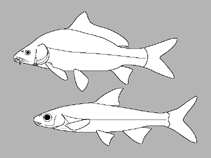 No image available for this species;
drawing shows typical species in Cyprinidae.
Google afbeelding
drawing shows typical species in Cyprinidae.
Classificatie / Namen Lokale namen | Synoniemen | Catalog of Fishes(Genus, Soort(en)) | ITIS | CoL | WoRMS | Cloffa
> Cypriniformes (Carps) > Cyprinidae (Minnows or carps) > Smiliogastrinae
Etymology: Cheilobarbus: The name Cheilobarbus is derived from the Greek ‘cheilos’ meaning a margin, lip or brim, and the Latin ‘barba’ meaning a beard and referring to the oral barbels. Smith (1841) mentioned the “lips” of these species as being “full and firm”.
Etymology: Cheilobarbus: The name Cheilobarbus is derived from the Greek ‘cheilos’ meaning a margin, lip or brim, and the Latin ‘barba’ meaning a beard and referring to the oral barbels. Smith (1841) mentioned the “lips” of these species as being “full and firm”.
Issue
Re-examination of the holotype of Barbus capensis revealed it to be a senior synonym of Pseudobarbus andrewi; the correct name for previous identifications of Barbus capensis should be Labeobarbus seeberi, the southern African clanwilliam yellowfish, while Pseudobarbus capensis is the correct name for previous identifications as Barbus andrewi (Ref. 108777).
Milieu: milieu / Klimaatzone / Diepte / verspreidingsgebied Ecologie
; zoet water benthopelagisch. Subtropical; 31°S - 34°S
Verspreiding Gebieden | FAO regio's | Ecosystemen | Voorkomen | Verspreidingskaart | Introducties | Faunafri
Africa: Berg and Breede River systems, south-western Cape Province in South Africa (Ref. 7248, 119402); also Clanwilliam Olifants River in South Africa (Ref. 111087).
Grootte / Gewicht / Leeftijd
Maturiteit: Lm ? range ? - ? cm
Max length : 60.0 cm SL mannelijk / geslacht onbekend; (Ref. 7248); max. gepubliceerd gewicht: 3.4 kg (Ref. 7248)
Max length : 60.0 cm SL mannelijk / geslacht onbekend; (Ref. 7248); max. gepubliceerd gewicht: 3.4 kg (Ref. 7248)
Prefers deep, rocky pools of larger tributaries and mainstreams and does well in dams such as Voëlvlei and Brandvlei. Feeds on bottom-dwelling invertebrates and algae. Breeds in summer, congregating at the head of large, stony pools or at the base of rapids. Eggs are laid in gravel in flowing water and hatch after about 5 days. Has been artificially bred and restocked by conservation authorities (Ref. 7248).
Levenscyclus en paargedrag Maturiteit | Voortplanting | Paaien | Eieren | Fecunditeit | Larven
Hoofdreferentie
Upload uw referenties | Referenties | Coördinator | Medewerkers
Skelton, P.H., E.R. Swartz and E.J. Vreven, 2018. The identity of Barbus capensis Smith, 1841 and the generic status of southern African tetraploid cyprinids (Teleostei, Cyprinidae). European Journal of Taxonomy 410:1-29. (Ref. 119402)
Status op de Rode Lijst van het IUCN (Ref. 130435: Version 2025-2)
Bedreigd (EN) (B1ab(iii,iv,v)+2ab(iii,iv,v)); Date assessed: 30 November 2016
CITES
Not Evaluated
Gevaar voor de mens
Harmless
Gebruik door de mens
Aquacultuur: experimenteel; sportvis: ja
FAO - Publication: search | FishSource |
Meer informatie
Trofische ecologie
Voedsel (prooien)
Dieetsamenstelling
Voedselconsumptie
Voedselrantsoenen
Predatoren
Voedsel (prooien)
Dieetsamenstelling
Voedselconsumptie
Voedselrantsoenen
Predatoren
Populatiedynamica
Groeiparameters
Max. leeftijden / maten
Lengte-gewicht rel.
Lengte-lengte rel.
Lengtefrequenties
Massaconversie
Rekrutering
Abundantie
Groeiparameters
Max. leeftijden / maten
Lengte-gewicht rel.
Lengte-lengte rel.
Lengtefrequenties
Massaconversie
Rekrutering
Abundantie
Levenscyclus
Voortplanting
Maturiteit
Rijpheid/kieuwen rel.
Fecunditeit
Paaien
Paaibestanden
Eieren
Ontwikkeling van de eieren
Larven
Larvale populatiedynamiek
Voortplanting
Maturiteit
Rijpheid/kieuwen rel.
Fecunditeit
Paaien
Paaibestanden
Eieren
Ontwikkeling van de eieren
Larven
Larvale populatiedynamiek
Anatomie
Kieuwoppervlak
Hersenen
Otoliet
Kieuwoppervlak
Hersenen
Otoliet
Fysiologie
Lichaamssamenstelling
Voedingsstoffen
Zuurstofverbruik
Type zwemmen
Zwemsnelheid
Visuele pigmenten
Vis geluid
Ziekten en parasieten
Toxiciteit (LC50)
Lichaamssamenstelling
Voedingsstoffen
Zuurstofverbruik
Type zwemmen
Zwemsnelheid
Visuele pigmenten
Vis geluid
Ziekten en parasieten
Toxiciteit (LC50)
Menselijk gerelateerd
Aquacultuursystemen
Aquacultuurprofielen
Kweeklijnen
Ciguatera gevallen
Postzegels, munten, diversen.
Aquacultuursystemen
Aquacultuurprofielen
Kweeklijnen
Ciguatera gevallen
Postzegels, munten, diversen.
Tools
E-boek | Veldgids | Determinatiesleutels | Lengtefrequentie Tool | Levenscyclus tool | Verspreidingskaart |
Vangst-MSY |
Speciale rapporten
Bekijk gegevens voor het houden in een aquarium | Bekijk Fact Sheets voor de soort | Bekijk Aquacultuur Fact Sheets
Download XML
Internetbronnen
AFORO (otoliths) | Aquatic Commons | BHL | Cloffa | Websites from users | Bekijk FishWatcher | CISTI | Catalog of Fishes: Genus, Soort(en) | DiscoverLife | ECOTOX | FAO - Publication: search | Faunafri | Fishipedia | Fishtrace | GloBI | Google Books | Google Scholar | Google | IGFA World Record | OneZoom | Open Tree of Life | Otolith Atlas of Taiwan Fishes | PubMed | Reef Life Survey | Socotra Atlas | TreeBase | Tree of Life | Wikipedia: ga naar, zoek | World Records Freshwater Fishing | Zoological Record
Schattingen op basis van modellen
Fylogenetische diversiteitsindex (Ref. 82804): PD50 = 0.7500 [Uniqueness, from 0.5 = low to 2.0 = high].
Bayesian length-weight: a=0.01175 (0.00447 - 0.03086), b=3.01 (2.78 - 3.24), in cm total length, based on LWR estimates for this (Sub)family-body shape (Ref. 93245).
Trofisch niveau (Ref. 69278): 2.8 ±0.26 se; based on food items.
Weerstandsvermogen (Ref. 120179): laag, minimale populatieverdubbelingstijd 4,5-14 jaar (Preliminary K or Fecundity.).