This website uses cookies to enhance your browsing experience and ensure the functionality of our site. For more detailed information about the types of cookies we use and how we protect your privacy, please visit our Privacy Information page.
×
Cookie Settings
This website uses different types of cookies to enhance your experience. Please select your preferences below:
> Gobiiformes (Gobies) > Gobiidae (Gobies) > Gobionellinae
Etymology: Gnatholepis:Greek, gnathos = jaw + Greek,lepis = scale (Ref. 45335); gymnocara:Named for the absence of scales on the cheek and opercle ('gymnocara' = naked head). More on authors: Randall & Greenfield.
Environnement : milieu / zone climatique / profondeur / gamme de distribution Écologie
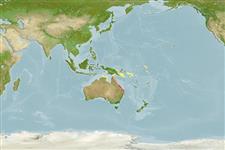
marin démersal; profondeur 0 - 1 m (Ref. 41653). Subtropical
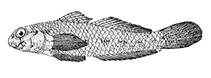
Épines dorsales (Total) : 7; Rayons mous dorsaux (Total) : 11; Épines anales: 1; Rayons mous anaux: 11 - 12. Distinguished by the following characteristics: small Gnatholepis (up to 35.4 mm SL) lacking scales on side of cheek, opercle and predorsal midline, few cycloid scales present on pectoral fin base and on breast; no distinct flap on end of lower lip (low fold may be present); no distinct canine or enlarged teeth; second dorsal fin rays I,11; anal fin rays I,11-12 (usually I,12); pectoral rays 15-19 (usually 17); lateral scales 26-28, ctenoid; predorsal scales absent from nape midline, scales on side of head reaching to nearly behind eyes; body pale with dusky speckling and mid-lateral row of six dusky blotches and horizontal row of darker spots and short streaks, an irregular cross-shaped dark mark on cheek extending down from eye, pupil-sized brown spot just above mid-point of caudal fin base, males with small black spot on rear part of first dorsal fin (Ref. 92171). Body shape (shape guide): fusiform / normal; Cross section: oval.
Occurs in shallow water, generally in less than 0.5 m; at least one lot was collected from a brackish habitat (Ref. 41653).
Cycle de vie et comportement reproducteur Maturité | Reproduction | Frai | Œufs | Fécondité | Larves
Randall, J.E. and D.W. Greenfield, 2001. A preliminary review of the Indo-Pacific gobiid fishes of the genus Gnatholepis. Ichthyological Bulletin of the J.L.B. Smith Institute of Ichthyology, 69:1-17. (Ref. 41653)
Statut dans la liste rouge de l'IUCN (Ref. 130435: Version 2025-2)
Dynamique des populations Paramètres de croissance Âges / tailles maximales Longueur-poids rel. Rel. longueur-longueur. Fréquences de longueurs Conversion de masse Recrutement Abondance
Cycle de vie Reproduction Maturité Maturité/épines rel. Fécondité Frai Agrégats de frai Œufs Développement de l'œuf Larves Dynamique des populations larvaires
Physiologie Composition corporelle Nutriments Consommation d'oxygène Type de natation Vitesse de nage Pigments visuels Son de poisson Maladies et parasites Toxicité (CL50)
Température préférée (Réf. 123201): 24.5 - 27.5, mean 26.3 °C (based on 166 cells).
Indice de diversité phylogénétique (Réf. 82804): PD50 = 0.5010 [Uniqueness, from 0.5 = low to 2.0 = high].
Bayesian length-weight: a=0.00977 (0.00444 - 0.02153), b=3.04 (2.85 - 3.23), in cm total length, based on LWR estimates for this (Sub)family-body shape (Ref. 93245).
Niveau trophique (Réf. 69278): 3.2 ±0.5 se; based on size and trophs of closest relatives
Résilience (Réf. 120179): Haut, temps minimum de doublement de population inférieur à 15 mois (Preliminary K or Fecundity.).
Vulnérabilité de la pêche (Ref. 59153): Low vulnerability (10 of 100). 🛈