-

- Om denna sida
- Språk
- Återkoppling från användare
- Referens
- Uppladdningar
-
Relaterade arter
- Arter i
Thryssa - Arter i
Engraulidae - - Klassificering -
- Coiliinae
- Engraulidae
- Clupeiformes
- Teleostei
- Chordata
- Animalia
- Arter i
-



Thryssa hamiltonii (Gray, 1835)
Hamilton's thryssa
Lägg till din observation i Fish Watcher
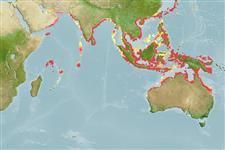
| Native range | All suitable habitat | Point map | Year 2050 |
|
| This map was computer-generated and has not yet been reviewed. |
| Thryssa hamiltonii AquaMaps Data sources: GBIF OBIS |
Ladda upp din foton och Videor
Bilder | Google image Thryssa hamiltonii
Bild av Randall, J.E.
Bilder | Google image
Bild av Randall, J.E.
Klassificering / Namn Populärnamn | synonymer | Catalog of Fishes(Släkte, Arter) | ITIS | CoL | WoRMS | Cloffa
> Clupeiformes (Herrings) > Engraulidae (Anchovies) > Coiliinae
Etymology: Thryssa: Greek, thrissa, -es = shad (Ref. 45335).
Eponymy: Dr Francis Hamilton né Buchanan (1762–1829) was an ichthyologist and botanist who qualified as a physician at Glasgow (1783) and was to have been a ship’s surgeon, but ill- health that year prevented him taking up the post. [...] (Ref. 128868), visit book page.
More on author: Gray.
Etymology: Thryssa: Greek, thrissa, -es = shad (Ref. 45335).
Eponymy: Dr Francis Hamilton né Buchanan (1762–1829) was an ichthyologist and botanist who qualified as a physician at Glasgow (1783) and was to have been a ship’s surgeon, but ill- health that year prevented him taking up the post. [...] (Ref. 128868), visit book page.
More on author: Gray.
Miljö: miljö / Klimatzon / djupintervall / distributionsområde Ekologi
marina; sötvatten; brackvatten pelagic-neritic; amfidrom (Ref. 51243); djupintervall 8 - 12 m (Ref. 127396). Tropical; 37°N - 28°S, 47°E - 154°E
Utbredning Territorier | FAO områden | Ekosystem | Förekomster | Prickkarta | Utplanteringar | Faunafri
Indo-Pacific: Persian Gulf eastward to Myanmar, Andamans and Penang; Taiwan south to Arafura Sea (Ref. 9819), the northern coasts of Australia and Papua New Guinea; Sarawak; a record from the Bonin Islands; presumably the Philippines; perhaps not eastward to Vanuatu, etc.
Längd vid första mognad / Storlek / Vikt / Ålder
Könsmognad: Lm 16.6 range ? - ? cm
Max length : 27.0 cm SL hane/ej könsbestämd; (Ref. 30691); rapporterad maxålder: 4 år (Ref. 127396)
Max length : 27.0 cm SL hane/ej könsbestämd; (Ref. 30691); rapporterad maxålder: 4 år (Ref. 127396)
Kort beskrivning Bestämningsnycklar | Morfologi | Morfometri
Taggstrålar i ryggfenan (totalt) : 0; Taggstrålar i analfenan: 0; Mjukstrålar i analfenan: 32 - 39. Belly with 23 to 26 keeled scutes from isthmus to anus. Tip of snout above level of eye center, usually about level of upper rim of eye. Maxilla short or moderate; first supra-maxilla small, oval. A dark blotch behind upper part of gill opening.
Body shape (shape guide): fusiform / normal; Cross section: compressed.
Body shape (shape guide): fusiform / normal; Cross section: compressed.
Coastal pelagic (Ref. 68964). Presumably schooling, inshore and entering estuaries. More precise data needed, based on correct identifications. If this is the species being referred to in Ref. 6841, then the principal food of the young would be prawns and copepods, supplemented by polychaetes and amphipods. Minimum depth range from Ref. 137633.
Livscykel och parningsbeteende Könsmognad | Reproduktion | Lek | Ägg | Fekunditet | Larver
Huvudreferens
Ladda upp dina referenser | referenser | Koordinator | Medarbetare
Whitehead, P.J.P., G.J. Nelson and T. Wongratana, 1988. FAO Species Catalogue. Vol. 7. Clupeoid fishes of the world (Suborder Clupeoidei). An annotated and illustrated catalogue of the herrings, sardines, pilchards, sprats, shads, anchovies and wolf-herrings. FAO Fish. Synop. 125(7/2):305-579. Rome: FAO. (Ref. 189)
Status på IUCN:s rödlista (Ref. 130435: Version 2025-2)
Least Concern (LC) ; Date assessed: 17 July 2017
CITES
Not Evaluated
Hot mot människor
Harmless
Mänskliga användningsområden
Fiskeri: kommersiell
FAO - Publication: search | FishSource |
Ytterligare information
Populationsdynamik
Tillväxtparametrar
Max. åldrar / storlekar
Längd-vikt rel.
Längd-längd rel.
Längd-frekvenser
Massakonvertering
Rekrytering
Abundans
Tillväxtparametrar
Max. åldrar / storlekar
Längd-vikt rel.
Längd-längd rel.
Längd-frekvenser
Massakonvertering
Rekrytering
Abundans
Livscykel
Reproduktion
Könsmognad
Mognad/Gills rel.
Fekunditet
Lek
Lekande aggregat
Ägg
Utveckling av ägg
Larver
Larvdynamik
Reproduktion
Könsmognad
Mognad/Gills rel.
Fekunditet
Lek
Lekande aggregat
Ägg
Utveckling av ägg
Larver
Larvdynamik
Anatomi
Gälyta
Hjärna
Otolit
Gälyta
Hjärna
Otolit
Fysiologi
Kroppssammansättning
Näringsämnen
Syreförbrukning
Typ av simning
Simhastighet
Visuella pigment
Ljud från fisk
Sjukdomar & Parasiter
Toxicitet (LC50)
Kroppssammansättning
Näringsämnen
Syreförbrukning
Typ av simning
Simhastighet
Visuella pigment
Ljud från fisk
Sjukdomar & Parasiter
Toxicitet (LC50)
Genetik
Genom
Genetik
Heterozygositet
Ärftlighet
Genetisk mångfald
Genom
Genetik
Heterozygositet
Ärftlighet
Genetisk mångfald
Människorelaterad
Vattenbrukssystem
Vattenbruksprofiler
Avelslinjer
Ciguatera-fall
Frimärken, mynt, diverse.
Vattenbrukssystem
Vattenbruksprofiler
Avelslinjer
Ciguatera-fall
Frimärken, mynt, diverse.
Verktyg
E-bok | Fälthandbok | Bestämningsnycklar | Längdfördelnings-verktyg | Livshistorie-verktyg | Prickkarta |
Fångst-MSY |
Särskilda rapporter
Kontrollera för underhåll av akvarium | Kontrollera om det finns faktablad om arter | Kontrollera om det finns faktablad om vattenbruk
Ladda ner XML
Internet-källor
AFORO (otoliths) | Aquatic Commons | BHL | Cloffa | Websites from users | Check FishWatcher | CISTI | Catalog of Fishes: Släkte, Arter | DiscoverLife | ECOTOX | FAO - Publication: search | Faunafri | Fishipedia | Fishtrace | GloBI | Google Books | Google Scholar | Google | IGFA World Record | Nationella databaser | OneZoom | Open Tree of Life | Otolith Atlas of Taiwan Fishes | PubMed | Reef Life Survey | Socotra Atlas | TreeBase | Tree of Life | Wikipedia: Go, sök | World Records Freshwater Fishing | Zoologiskt register
Uppskattningar baserade på modeller
Önskad temperatur (Ref. 123201): 25 - 29.3, mean 28.6 °C (based on 1528 cells).
Index för fylogenetisk mångfald (Ref. 82804): PD50 = 0.5000 [Uniqueness, from 0.5 = low to 2.0 = high].
Bayesian length-weight: a=0.00617 (0.00465 - 0.00817), b=3.04 (2.96 - 3.12), in cm total length, based on LWR estimates for this species (Ref. 93245).
Trofisk nivå (Ref. 69278): 3.5 ±0.51 se; based on food items.
Generation time: 1.7 ( na - na) years. Estimated as median ln(3)/K based on 2 growth studies.
Resiliens (Ref. 120179): Hög, lägsta populationsfördubblingstid mindre än 15 månader (K=0.66-1.32; tmax=4).
Näringsämnen (Ref. 124155): Calcium = 239 [134, 635] mg/100g; Iron = 2.07 [1.05, 3.62] mg/100g; Protein = 19.5 [18.0, 20.9] %; Omega3 = 0.426 [0.212, 0.919] g/100g; Selenium = 41.1 [17.6, 89.4] μg/100g; VitaminA = 9.29 [2.47, 28.51] μg/100g; Zinc = 1.89 [1.26, 2.77] mg/100g (wet weight);