This website uses cookies to enhance your browsing experience and ensure the functionality of our site. For more detailed information about the types of cookies we use and how we protect your privacy, please visit our Privacy Information page.
×
Cookie Settings
This website uses different types of cookies to enhance your experience. Please select your preferences below:
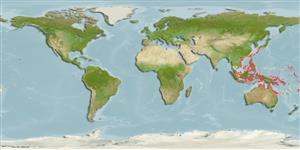
Western Pacific: southern Japan and the Ryukyu Islands, Taiwan, Philippines, Palau, Indonesia, Papua New Guinea, Solomon Islands, and the Great Barrier Reef. Reported from Vanuatu (Ref. 13300).
Storlek / Vikt / Ålder
Könsmognad: Lm? range ? - ? cm Max length : 16.0 cm TL hane/ej könsbestämd; (Ref. 9710)
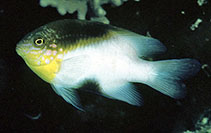
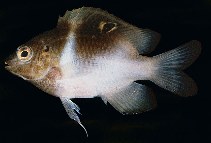
Taggstrålar i ryggfenan (totalt) : 13; Mjukstrålar i ryggfenan (totalt) : 13 - 15; Taggstrålar i analfenan: 2; Mjukstrålar i analfenan: 13 - 14. Adults have a large black patch on the abdomen reaching the anus; juveniles an ocellus over the center of the dorsal fin base (Ref. 48636). Body white, anterodorsal (or sometimes entire half of body) dark brown, opercle spots prominent pale large, belly patch dark brown. Body depth 2.0-2.1 in SL (Ref. 90102). Body shape (shape guide): short and / or deep; Cross section: compressed.
Adults occur in lagoon reefs and generally prefers small patch reefs with sand or rubble substrates (Ref. 1602). Feed on benthic algae which it aggressively guards against other herbivores (Ref. 9710). Juveniles secretive in rubble (Ref. 48636). Oviparous, distinct pairing during breeding (Ref. 205). Eggs are demersal and adhere to the substrate (Ref. 205). Males guard and aerate the eggs (Ref. 205). Diurnal species (Ref. 113699).
Oviparous, distinct pairing during breeding (Ref. 205). Eggs are demersal and adhere to the substrate (Ref. 205). Males guard and aerate the eggs (Ref. 205).
Önskad temperatur (Ref. 123201): 25.2 - 29.3, mean 28.6 °C (based on 1860 cells).
Index för fylogenetisk mångfald (Ref. 82804): PD50 = 0.5078 [Uniqueness, from 0.5 = low to 2.0 = high].
Bayesian length-weight: a=0.02818 (0.01492 - 0.05325), b=3.01 (2.84 - 3.18), in cm total length, based on LWR estimates for this species & (Sub)family-body (Ref. 93245).
Trofisk nivå (Ref. 69278): 2.0 ±0.00 se; based on food items.
Resiliens (Ref. 120179): Hög, lägsta populationsfördubblingstid mindre än 15 månader (Preliminary K or Fecundity.).
Sårbarhet i fisket (Ref. 59153): Low vulnerability (10 of 100). 🛈