-

- Om denna sida
- Språk
- Återkoppling från användare
- Referens
- Uppladdningar
- Relaterade arter
-



Lägg till din observation i Fish Watcher
| Native range | All suitable habitat | Point map | Year 2050 |

|
| This map was computer-generated and has not yet been reviewed. |
| Chromis xanthura AquaMaps Data sources: GBIF OBIS |
Ladda upp din foton och Videor
Bilder | Videor | Google image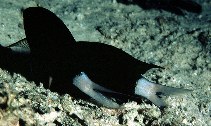 Chromis xanthura
Bild av Randall, J.E.
Bilder | Videor | Google image
Bild av Randall, J.E.
Klassificering / Namn Populärnamn | synonymer | Catalog of Fishes(Släkte, Arter) | ITIS | CoL | WoRMS | Cloffa
> Ovalentaria/misc (Various families in series Ovalentaria) > Pomacentridae (Damselfishes) > Chrominae
Etymology: Chromis: Greek, chromis = a fish, perhaps a perch (Ref. 45335).
More on author: Bleeker.
Etymology: Chromis: Greek, chromis = a fish, perhaps a perch (Ref. 45335).
More on author: Bleeker.
Miljö: miljö / Klimatzon / djupintervall / distributionsområde Ekologi
marina revassocierade; ej vandrande; djupintervall 0 - 40 m (Ref. 7247). Tropical; 35°N - 25°S
Utbredning Territorier | FAO områden | Ekosystem | Förekomster | Prickkarta | Utplanteringar | Faunafri
Western Pacific: widespread, from southern Japan to Australia and Tonga; no records from Hawaii nor French Polynesia. Replaced by Chromis opercularis in the Indian Ocean (Ref. 129596).
Storlek / Vikt / Ålder
Kort beskrivning Bestämningsnycklar | Morfologi | Morfometri
Taggstrålar i ryggfenan (totalt) : 13; Mjukstrålar i ryggfenan (totalt) : 10 - 11; Taggstrålar i analfenan: 2; Mjukstrålar i analfenan: 10 - 11. This species is distinguished by the following set of characters: D XIII,10-11(mode 11); A II,10-11 (11); pectoral-fin rays 18-20 (19); upper and lower procurrent caudal-fin rays 3; pored lateral-line scales 17-18 (18); gill rakers 6-8 (7) + 19-22 (21) = 26-30 (28); longest dorsal-fin soft ray length 24.6-36.4% (mean 29.4%) of SL; first anal-fin spine length 6.5-8.4% (7.1%) of SL; caudal-fin length 43.9-59.8% (48.6%) of SL; posterior tips of caudal-fin lobes are filamentous; broad black bands along the preopercular and opercular margins, sum width of two bands 15.3-27.9% (23.6%) of head length; distal half of soft-rayed portion of the dorsal fin is transparent in adults; upper or lower caudal-fin base no triangular black blotches; caudal peduncle and fin are tinged with yellow; soft-rayed portions of dorsal and anal fins are yellowish, with spinous portion of dorsal and pelvic fins dark blue in juveniles (Ref. 129596).
Body shape (shape guide): short and / or deep; Cross section: compressed.
Body shape (shape guide): short and / or deep; Cross section: compressed.
Adults are found in steep outer reef slopes and shallow coastal reef flats, sometimes forming large aggregations feeding on zooplankton several meters above the bottom. Juveniles remain close to shelter. Oviparous, distinct pairing during breeding (Ref. 205). Eggs are demersal and adhere to the substrate (Ref. 205). Nests are found in small patches of loose sand under ledges or at the base of slopes (Ref. 9710). Males guard and aerate the eggs (Ref. 205). Diurnal species (Ref. 54980; 113699). Minimum depth reported taken from Ref. 128797.
Livscykel och parningsbeteende Könsmognad | Reproduktion | Lek | Ägg | Fekunditet | Larver
Oviparous, distinct pairing during breeding (Ref. 205). Eggs are demersal and adhere to the substrate (Ref. 205). Males guard and aerate the eggs (Ref. 205).
Huvudreferens
Ladda upp dina referenser | referenser | Koordinator : Allen, Gerald R. | Medarbetare
Allen, G.R., 1991. Damselfishes of the world. Mergus Publishers, Melle, Germany. 271 p. (Ref. 7247)
Status på IUCN:s rödlista (Ref. 130435: Version 2025-2)
Least Concern (LC) ; Date assessed: 03 February 2021
CITES
Not Evaluated
Hot mot människor
Harmless
Mänskliga användningsområden
Fiskeri: kommersiell; Akvarium: Kommersiell
FAO - Publication: search | FishSource |
Ytterligare information
Populationsdynamik
Tillväxtparametrar
Max. åldrar / storlekar
Längd-vikt rel.
Längd-längd rel.
Längd-frekvenser
Massakonvertering
Rekrytering
Abundans
Tillväxtparametrar
Max. åldrar / storlekar
Längd-vikt rel.
Längd-längd rel.
Längd-frekvenser
Massakonvertering
Rekrytering
Abundans
Livscykel
Reproduktion
Könsmognad
Mognad/Gills rel.
Fekunditet
Lek
Lekande aggregat
Ägg
Utveckling av ägg
Larver
Larvdynamik
Reproduktion
Könsmognad
Mognad/Gills rel.
Fekunditet
Lek
Lekande aggregat
Ägg
Utveckling av ägg
Larver
Larvdynamik
Anatomi
Gälyta
Hjärna
Otolit
Gälyta
Hjärna
Otolit
Fysiologi
Kroppssammansättning
Näringsämnen
Syreförbrukning
Typ av simning
Simhastighet
Visuella pigment
Ljud från fisk
Sjukdomar & Parasiter
Toxicitet (LC50)
Kroppssammansättning
Näringsämnen
Syreförbrukning
Typ av simning
Simhastighet
Visuella pigment
Ljud från fisk
Sjukdomar & Parasiter
Toxicitet (LC50)
Genetik
Genom
Genetik
Heterozygositet
Ärftlighet
Genetisk mångfald
Genom
Genetik
Heterozygositet
Ärftlighet
Genetisk mångfald
Människorelaterad
Vattenbrukssystem
Vattenbruksprofiler
Avelslinjer
Ciguatera-fall
Frimärken, mynt, diverse.
Vattenbrukssystem
Vattenbruksprofiler
Avelslinjer
Ciguatera-fall
Frimärken, mynt, diverse.
Verktyg
Organisk frågesport | E-bok | Fälthandbok | Längdfördelnings-verktyg | Livshistorie-verktyg | Prickkarta |
Fångst-MSY |
Särskilda rapporter
Kontrollera för underhåll av akvarium | Kontrollera om det finns faktablad om arter | Kontrollera om det finns faktablad om vattenbruk
Ladda ner XML
Internet-källor
AFORO (otoliths) | Aquatic Commons | BHL | Cloffa | Websites from users | Check FishWatcher | CISTI | Catalog of Fishes: Släkte, Arter | DiscoverLife | ECOTOX | FAO - Publication: search | Faunafri | Fishipedia | Fishtrace | GloBI | Google Books | Google Scholar | Google | IGFA World Record | Nationella databaser | OneZoom | Open Tree of Life | Otolith Atlas of Taiwan Fishes | PubMed | Reef Life Survey | Socotra Atlas | TreeBase | Tree of Life | Wikipedia: Go, sök | World Records Freshwater Fishing | Zoologiskt register
Uppskattningar baserade på modeller
Önskad temperatur (Ref. 123201): 24.7 - 28.9, mean 27.7 °C (based on 424 cells).
Index för fylogenetisk mångfald (Ref. 82804): PD50 = 0.5000 [Uniqueness, from 0.5 = low to 2.0 = high].
Bayesian length-weight: a=0.01413 (0.00674 - 0.02961), b=2.94 (2.76 - 3.12), in cm total length, based on LWR estimates for this species & Genus-body shape (Ref. 93245).
Trofisk nivå (Ref. 69278): 3.4 ±0.45 se; based on food items.
Resiliens (Ref. 120179): Mellan, lägsta populationsfördubblingstid 1,4-4,4 år (Preliminary K or Fecundity.).
Näringsämnen (Ref. 124155): Calcium = 79.2 [39.4, 122.1] mg/100g; Iron = 0.721 [0.430, 1.172] mg/100g; Protein = 18.3 [17.2, 19.4] %; Omega3 = 0.116 [0.070, 0.190] g/100g; Selenium = 25.6 [13.4, 49.3] μg/100g; VitaminA = 132 [39, 433] μg/100g; Zinc = 1.25 [0.83, 1.78] mg/100g (wet weight);