This website uses cookies to enhance your browsing experience and ensure the functionality of our site. For more detailed information about the types of cookies we use and how we protect your privacy, please visit our Privacy Information page.
×
Cookie Settings
This website uses different types of cookies to enhance your experience. Please select your preferences below:
> Eupercaria/misc (Various families in series Eupercaria) > Labridae (Wrasses) > Hypsigenyinae
Etymology: Bodianus:Bodianus after Bodiano or Pudiano, from the Portuguese pudor, meaning modesty (Jordan & Evermann, 1896); anthioides:Name from the Greek masculine noun 'anthias', a common name for members of the anthiine serranid fishes, and 'oides' for having the form of, refers to the similarity of this species to various anthiine species (Ref. 75973). More on author: Bennett.
Environnement : milieu / zone climatique / profondeur / gamme de distribution Écologie
marin récifal; profondeur 6 - 80 m (Ref. 1602), usually 6 - 60 m (Ref. 27115). Tropical; 23°C - 27°C (Ref. 27115); 32°N - 28°S
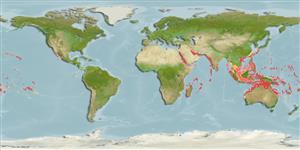
Indo-Pacific: Red Sea to South Africa (Ref. 35918) and east to the Line and Tuamoto islands, north to southern Japan, south to New Caledonia and the Austral Islands.
Taille / Poids / Âge
Maturité: Lm? range ? - ? cm Max length : 24.0 cm SL mâle / non sexé; (Ref. 1602)
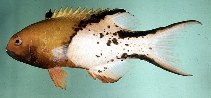
Épines dorsales (Total) : 12; Rayons mous dorsaux (Total) : 9 - 10; Épines anales: 3; Rayons mous anaux: 10 - 12. Undergoes relatively minor changes in color with growth. Easily identified by the unusual coloration and long tail (Ref. 48636). Body shape (shape guide): fusiform / normal; Cross section: compressed.
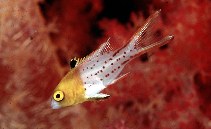
Adults inhabit seaward reefs. They occur on reefs rich with invertebrates such as gorgonians, seawhips and black corals (Ref. 48636). Common along steep outer reef slopes deeper than 25 m in Micronesia. Usually seen as lone individuals (Ref. 48636). Juveniles pose as cleaners (Ref. 8631). May be solitary or may exist in pairs (Ref. 5503). Oviparous, distinct pairing during breeding (Ref. 205). Maximum depth reported taken from Ref. 128797.
Cycle de vie et comportement reproducteur Maturité | Reproduction | Frai | Œufs | Fécondité | Larves
Oviparous, distinct pairing during breeding (Ref. 205).
Cycle de vie Reproduction Maturité Maturité/épines rel. Fécondité Frai Agrégats de frai Œufs Développement de l'œuf Larves Dynamique des populations larvaires
Physiologie Composition corporelle Nutriments Consommation d'oxygène Type de natation Vitesse de nage Pigments visuels Son de poisson Maladies et parasites Toxicité (CL50)
Température préférée (Réf. 123201): 24.4 - 28.9, mean 27.6 °C (based on 1138 cells).
Indice de diversité phylogénétique (Réf. 82804): PD50 = 0.5000 [Uniqueness, from 0.5 = low to 2.0 = high].
Bayesian length-weight: a=0.01230 (0.00569 - 0.02662), b=3.05 (2.87 - 3.23), in cm total length, based on LWR estimates for this Genus-body shape (Ref. 93245).
Niveau trophique (Réf. 69278): 3.4 ±0.44 se; based on food items.
Résilience (Réf. 120179): Milieu, temps minimum de doublement de population : 1,4 à 4,4 années (Preliminary K or Fecundity.).
Vulnérabilité de la pêche (Ref. 59153): Low vulnerability (19 of 100). 🛈