-

- À propos de cette page
- Langues
- Commentaires des utilisateurs
- Citation
- Téléchargements
-
Espèces associées
- Espèces pour
Carlarius - Espèces pour
Ariidae - - Classification -
- Ariinae
- Ariidae
- Siluriformes
- Teleostei
- Chordata
- Animalia
- Espèces pour
-



Ajouter votre observation dans Fish Watcher
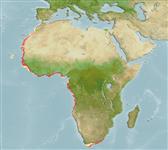
| Native range | All suitable habitat | Point map | Year 2050 |
|
| This map was computer-generated and has not yet been reviewed. |
| Carlarius parkii AquaMaps Data sources: GBIF OBIS |
Envoyez vos Photos et vidéos
Images | Images Google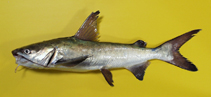 Carlarius parkii
Photo de Alvheim, O./Institute of Marine Research (IMR)
Images | Images Google
Photo de Alvheim, O./Institute of Marine Research (IMR)
Classification / Noms Noms communs | Synonymes | Catalog of Fishes(Genre, Espèce) | ITIS | CoL | WoRMS | Cloffa
> Siluriformes (Catfishes) > Ariidae (Sea catfishes) > Ariinae
Etymology: Carlarius: First part of the generic name honors Dr. Carl Ferraris, Research Associate at the California Academy of Sciences for his contribution to the knowledge of Siluriformes fishes and continuous support and encouragement throughout the development of this work; the second part is from the frequently used generic name Arius.
Eponymy: Nobody knows who Park – or perhaps, Parke – was. [...] (Ref. 128868), visit book page.
More on author: Günther.
Etymology: Carlarius: First part of the generic name honors Dr. Carl Ferraris, Research Associate at the California Academy of Sciences for his contribution to the knowledge of Siluriformes fishes and continuous support and encouragement throughout the development of this work; the second part is from the frequently used generic name Arius.
Eponymy: Nobody knows who Park – or perhaps, Parke – was. [...] (Ref. 128868), visit book page.
More on author: Günther.
Environnement : milieu / zone climatique / profondeur / gamme de distribution Écologie
marin; saumâtre démersal; profondeur 50 - 80 m (Ref. 6541). Tropical
Distribution Territoires | Zones FAO | Écosystèmes | Occurrences | Carte par point | Introductions | Faunafri
Eastern Atlantic: commonly caught in coastal sea-waters from Cap Blanc (Mauritania) to Angola (Ref. 57224). Sporadically to Spanish Sahara and Morocco; enters estuaries and freshwater of rivers (Ref. 3876).
Taille / Poids / Âge
Maturité: Lm ? range ? - ? cm
Max length : 75.0 cm TL mâle / non sexé; (Ref. 57224); common length : 40.0 cm TL mâle / non sexé; (Ref. 2683)
Max length : 75.0 cm TL mâle / non sexé; (Ref. 57224); common length : 40.0 cm TL mâle / non sexé; (Ref. 2683)
Description synthétique Clés d'identification | Morphologie | Morphométrie
Épines dorsales (Total) : 2; Rayons mous dorsaux (Total) : 7; Épines anales: 0. Diagnosis: body elongated and rounded; head broad and only slightly flattened above; snout rounded; mouth inferior; maxillary barbels reaching to pectoral fin bases, mandibular ones being shorter: osseous head shield, coarsely rugose, fairly visible through the skin (Ref. 57224). Occipital process moderately broad at base, tapering towards its distal end, with a median keel (Ref. 2683, 57224). Predorsal plate very rugose, short and crescent-shaped; premaxillary teeth villiform forming a plate slightly curved (Ref. 57224). Palatal teeth in single pair of rounded patches, well separated by a space smaller than their diameter (Ref. 57224, 81640). No gill-rakers on the posterior face of the 1st and 2nd arches (Ref. 57224). Total number of anterior gill-rakers on 1st arch: 11-14 (Ref. 57224, 81640). 11-15 gill rakers on the outer side of the entire 2nd arch (Ref. 81640). Dorsal fin short with a long, osseous serrated spine preceded by a very short one; dorsal and pectoral fins with a strong serrated, erectile spine; adipose fin well developed; caudal fin forked with long pointed lobes (Ref. 57224).
Coloration: olive brown above, belly whitish (Ref. 57224).
Body shape (shape guide): fusiform / normal.
Body shape (shape guide): fusiform / normal.
Marine species commonly found along the continental coast; often entering adjacent estuaries and freshwater rivers (Ref. 3876). Feeds on fish and shrimps (Ref. 28587). Males practise buccal incubation (Ref. 57224). Dorsal and pectoral serrated spines are venomous and can cause very painful wounds (Ref. 43448).
Cycle de vie et comportement reproducteur Maturité | Reproduction | Frai | Œufs | Fécondité | Larves
Référence principale
Téléchargez vos références | Références | Coordinateur : Ferraris, Jr., Carl J. | Collaborateurs
Schneider, W., 1990. FAO species identification sheets for fishery purposes. Field guide to the commercial marine resources of the Gulf of Guinea. Prepared and published with the support of the FAO Regional Office for Africa. Rome: FAO. 268 p. (Ref. 2683)
Statut dans la liste rouge de l'IUCN (Ref. 130435: Version 2025-2)
Préoccupation mineure (LC) ; Date assessed: 09 January 2020
CITES
Not Evaluated
Menace pour l'homme
Traumatogenic (Ref. 58010)
Utilisations par l'homme
Pêcheries: commercial
FAO - Publication: search | FishSource |
Plus d'informations
Écologie trophique
Aliments (proies)
Composition du régime alimentaire
Consommation alimentaire
Rations alimentaires
Prédateurs
Aliments (proies)
Composition du régime alimentaire
Consommation alimentaire
Rations alimentaires
Prédateurs
Dynamique des populations
Paramètres de croissance
Âges / tailles maximales
Longueur-poids rel.
Rel. longueur-longueur.
Fréquences de longueurs
Conversion de masse
Recrutement
Abondance
Paramètres de croissance
Âges / tailles maximales
Longueur-poids rel.
Rel. longueur-longueur.
Fréquences de longueurs
Conversion de masse
Recrutement
Abondance
Cycle de vie
Reproduction
Maturité
Maturité/épines rel.
Fécondité
Frai
Agrégats de frai
Œufs
Développement de l'œuf
Larves
Dynamique des populations larvaires
Reproduction
Maturité
Maturité/épines rel.
Fécondité
Frai
Agrégats de frai
Œufs
Développement de l'œuf
Larves
Dynamique des populations larvaires
Anatomie
Surface branchiale
Cerveau
Otolithe
Surface branchiale
Cerveau
Otolithe
Physiologie
Composition corporelle
Nutriments
Consommation d'oxygène
Type de natation
Vitesse de nage
Pigments visuels
Son de poisson
Maladies et parasites
Toxicité (CL50)
Composition corporelle
Nutriments
Consommation d'oxygène
Type de natation
Vitesse de nage
Pigments visuels
Son de poisson
Maladies et parasites
Toxicité (CL50)
Génétique
génôme
Génétique
Hétérozygotie
Héritabilité
Diversité génétique
génôme
Génétique
Hétérozygotie
Héritabilité
Diversité génétique
Liées à l'homme
Systèmes d'aquaculture
Profils d'aquaculture
Souches
Cas de ciguatera
Timbres, pièces de monnaie, divers
Systèmes d'aquaculture
Profils d'aquaculture
Souches
Cas de ciguatera
Timbres, pièces de monnaie, divers
Outils
E-book | Guide de terrain | Clés d'identification | Générateur de fréquences de longueur | Outil de dynamique de population | Carte par point |
Capture-MSY |
Articles particuliers
Télécharger en XML
Sources Internet
AFORO (otoliths) | Alien/Invasive Species database | Aquatic Commons | BHL | Cloffa | Websites from users | FishWatcher | CISTI | Catalog of Fishes: Genre, Espèce | DiscoverLife | ECOTOX | FAO - Publication: search | Faunafri | Fishipedia | Fishtrace | GloBI | Google Books | Google Scholar | Google | IGFA World Record | OneZoom | Open Tree of Life | Otolith Atlas of Taiwan Fishes | PubMed | Reef Life Survey | Socotra Atlas | TreeBase | Arbre de Vie | Wikipedia: aller à, chercher | World Records Freshwater Fishing | Zoological Record
Estimations basées sur des modèles
Température préférée (Réf. 123201): 17.7 - 20.4, mean 19.3 °C (based on 15 cells).
Indice de diversité phylogénétique (Réf. 82804): PD50 = 0.5625 [Uniqueness, from 0.5 = low to 2.0 = high].
Bayesian length-weight: a=0.00891 (0.00523 - 0.01518), b=3.10 (2.95 - 3.25), in cm total length, based on LWR estimates for this species & (Sub)family-body (Ref. 93245).
Niveau trophique (Réf. 69278): 4.1 ±0.70 se; based on food items.
Generation time: 6.4 ( na - na) years. Estimated as median ln(3)/K based on 1 growth studies.
Résilience (Réf. 120179): Milieu, temps minimum de doublement de population : 1,4 à 4,4 années (K=0.17).