This website uses cookies to enhance your browsing experience and ensure the functionality of our site. For more detailed information about the types of cookies we use and how we protect your privacy, please visit our Privacy Information page.
×
Cookie Settings
This website uses different types of cookies to enhance your experience. Please select your preferences below:
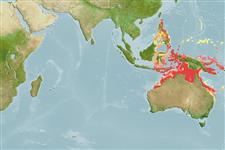
Western Pacific: Thailand, Singapore, Philippines, Indonesia, Papua New Guinea, the Arafura Sea (Ref. 9819), Solomon Islands, and Australia (from Houtman Abrolhos in Western Australia to Gladstone, Queensland) (Ref. 3150). This species was formerly listed as occurring in the western Indian Ocean based on a misidentification of Plectropomus pessuliferus.
Longueur à la première maturité / Taille / Poids / Âge
Maturité: Lm? range ? - ? cm Max length : 125 cm TL mâle / non sexé; (Ref. 90102); poids max. publié: 25.0 kg (Ref. 5222)
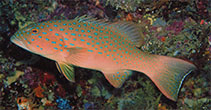
Found in protected coastal reef in mixed algae and coral habitat (Ref. 48635). Common on inshore coastal reefs but absent in clear offshore reefs (Ref. 9710). Juveniles have a demersal existence in shallow water in reef habitats, especially around coral rubble (Ref. 27259). Migrate over short distances to spawn, forming aggregations (Ref. 6390). May move into shallow water to feed (Ref. 6390). Eggs float just below the water surface (Ref. 6390). Pelagic larvae are found in habitats similar to those of the adults (Ref. 27260). Juveniles feed on small fish and invertebrates such as crustaceans and squid (Ref. 27261). Commonly used for food. Its flesh is delicate and well appreciated (Ref. 5503). Solitary (Ref 90102).
Heemstra, P.C. and J.E. Randall, 1993. FAO Species Catalogue. Vol. 16. Groupers of the world (family Serranidae, subfamily Epinephelinae). An annotated and illustrated catalogue of the grouper, rockcod, hind, coral grouper and lyretail species known to date. Rome: FAO. FAO Fish. Synop. 125(16):382 p. (Ref. 5222)
Statut dans la liste rouge de l'IUCN (Ref. 130435: Version 2025-2)
Physiologie Composition corporelle Nutriments Consommation d'oxygène Type de natation Vitesse de nage Pigments visuels Son de poisson Maladies et parasites Toxicité (CL50)
Température préférée (Réf. 123201): 26.1 - 28.8, mean 27.8 °C (based on 466 cells).
Indice de diversité phylogénétique (Réf. 82804): PD50 = 0.5039 [Uniqueness, from 0.5 = low to 2.0 = high].
Bayesian length-weight: a=0.01122 (0.00581 - 0.02169), b=3.05 (2.89 - 3.21), in cm total length, based on LWR estimates for this species & (Sub)family-body (Ref. 93245).
Niveau trophique (Réf. 69278): 4.1 ±0.70 se; based on food items.
Generation time: 5.3 ( na - na) years. Estimated as median ln(3)/K based on 1 growth studies.
Résilience (Réf. 120179): Milieu, temps minimum de doublement de population : 1,4 à 4,4 années (K=0.21; tm=2-3).
Vulnérabilité de la pêche (Ref. 59153): Moderate to high vulnerability (51 of 100). 🛈