-

- À propos de cette page
- Langues
- Commentaires des utilisateurs
- Citation
- Téléchargements
- Espèces associées
-



Wetmorella albofasciata Schultz & Marshall, 1954
Whitebanded sharpnose wrasse
Envoyez vos Photos et vidéos
Images | Images Google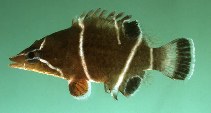 Wetmorella albofasciata
Photo de Randall, J.E.
Images | Images Google
Photo de Randall, J.E.
Classification / Noms Noms communs | Synonymes | Catalog of Fishes(Genre, Espèce) | ITIS | CoL | WoRMS | Cloffa
> Eupercaria/misc (Various families in series Eupercaria) > Labridae (Wrasses) > Cheilininae
Eponymy: Frank ‘Alexander’ Wetmore (1886–1978) was an American ornithologist and avian palaeontologist who conducted extensive fieldwork in Latin America. [...] (Ref. 128868), visit book page.
More on authors: Schultz & Marshall.
Eponymy: Frank ‘Alexander’ Wetmore (1886–1978) was an American ornithologist and avian palaeontologist who conducted extensive fieldwork in Latin America. [...] (Ref. 128868), visit book page.
More on authors: Schultz & Marshall.
Environnement : milieu / zone climatique / profondeur / gamme de distribution Écologie
marin récifal; profondeur 8 - 42 m (Ref. 1602), usually 30 - ? m. Tropical; 28°N - 24°S
Distribution Territoires | Zones FAO | Écosystèmes | Occurrences | Carte par point | Introductions | Faunafri
Indo-Pacific: East Africa to the Hawaiian and Society islands, south to the Great Barrier Reef; Pohnpei and Marshall Islands in Micronesia.
Taille / Poids / Âge
Description synthétique Clés d'identification | Morphologie | Morphométrie
Épines dorsales (Total) : 9; Rayons mous dorsaux (Total) : 10 - 11; Épines anales: 3; Rayons mous anaux: 8; Vertèbres: 23. Closely resembles juveniles of Cheilinus fasciatus and Epibulus insidiator. Since they have broadly overlapping meristics, color pattern is the only reliable distinguishing character (Ref. 1602). Body of adults when fresh grayish brown, becoming reddish brown on mid side and ventrally on some specimens. Head with narrow, diagonal pale bands radiating from the orbit; iris bluish with reddish inner rim and an upper and lower streak of pale yellow. A large black spot covering more than half of pelvic fin. One predorsal bone. Premaxilla protractile. Spinous portions of dorsal and anal fins deeply incised.
Body shape (shape guide): short and / or deep; Cross section: compressed.
Body shape (shape guide): short and / or deep; Cross section: compressed.
Inhabit caves or crevices of lagoon and seaward reefs and drop-offs (Ref. 37816). Benthic and benthopelagic (Ref. 58302). Specimens usually taken at depths of at least 30 m. Secretive (Ref. 37816).
Cycle de vie et comportement reproducteur Maturité | Reproduction | Frai | Œufs | Fécondité | Larves
Oviparous, distinct pairing during breeding (Ref. 205).
Référence principale
Téléchargez vos références | Références | Coordinateur : Westneat, Mark | Collaborateurs
Randall, J.E., 1983. Revision of the Indo-Pacific labrid fish genus Wetmorella. Copeia 1983(4):875-883. (Ref. 2138)
Statut dans la liste rouge de l'IUCN (Ref. 130435: Version 2025-2)
Préoccupation mineure (LC) ; Date assessed: 02 March 2009
CITES
Not Evaluated
Menace pour l'homme
Harmless
Utilisations par l'homme
FAO - Publication: search | FishSource |
Plus d'informations
Écologie trophique
Aliments (proies)
Composition du régime alimentaire
Consommation alimentaire
Rations alimentaires
Prédateurs
Aliments (proies)
Composition du régime alimentaire
Consommation alimentaire
Rations alimentaires
Prédateurs
Dynamique des populations
Paramètres de croissance
Âges / tailles maximales
Longueur-poids rel.
Rel. longueur-longueur.
Fréquences de longueurs
Conversion de masse
Recrutement
Abondance
Paramètres de croissance
Âges / tailles maximales
Longueur-poids rel.
Rel. longueur-longueur.
Fréquences de longueurs
Conversion de masse
Recrutement
Abondance
Cycle de vie
Reproduction
Maturité
Maturité/épines rel.
Fécondité
Frai
Agrégats de frai
Œufs
Développement de l'œuf
Larves
Dynamique des populations larvaires
Reproduction
Maturité
Maturité/épines rel.
Fécondité
Frai
Agrégats de frai
Œufs
Développement de l'œuf
Larves
Dynamique des populations larvaires
Physiologie
Composition corporelle
Nutriments
Consommation d'oxygène
Type de natation
Vitesse de nage
Pigments visuels
Son de poisson
Maladies et parasites
Toxicité (CL50)
Composition corporelle
Nutriments
Consommation d'oxygène
Type de natation
Vitesse de nage
Pigments visuels
Son de poisson
Maladies et parasites
Toxicité (CL50)
Génétique
génôme
Génétique
Hétérozygotie
Héritabilité
Diversité génétique
génôme
Génétique
Hétérozygotie
Héritabilité
Diversité génétique
Liées à l'homme
Systèmes d'aquaculture
Profils d'aquaculture
Souches
Cas de ciguatera
Timbres, pièces de monnaie, divers
Systèmes d'aquaculture
Profils d'aquaculture
Souches
Cas de ciguatera
Timbres, pièces de monnaie, divers
Outils
E-book | Guide de terrain | Générateur de fréquences de longueur | Outil de dynamique de population | Carte par point |
Capture-MSY |
Articles particuliers
Télécharger en XML
Sources Internet
AFORO (otoliths) | Aquatic Commons | BHL | Cloffa | Websites from users | FishWatcher | CISTI | Catalog of Fishes: Genre, Espèce | DiscoverLife | ECOTOX | FAO - Publication: search | Faunafri | Fishipedia | Fishtrace | GloBI | Google Books | Google Scholar | Google | IGFA World Record | Bases de données nationales | OneZoom | Open Tree of Life | Otolith Atlas of Taiwan Fishes | PubMed | Reef Life Survey | Socotra Atlas | TreeBase | Arbre de Vie | Wikipedia: aller à, chercher | World Records Freshwater Fishing | Zoobank | Zoological Record
Estimations basées sur des modèles
Température préférée (Réf. 123201): 24.2 - 28.2, mean 27 °C (based on 73 cells).
Indice de diversité phylogénétique (Réf. 82804): PD50 = 0.6250 [Uniqueness, from 0.5 = low to 2.0 = high].
Bayesian length-weight: a=0.02138 (0.00871 - 0.05249), b=2.97 (2.76 - 3.18), in cm total length, based on LWR estimates for this (Sub)family-body shape (Ref. 93245).
Niveau trophique (Réf. 69278): 3.3 ±0.4 se; based on size and trophs of closest relatives
Résilience (Réf. 120179): Haut, temps minimum de doublement de population inférieur à 15 mois (Preliminary K or Fecundity.).