-

- Over deze pagina
- Talen
- Feedback van gebruikers
- Citatie
- Uploads
- Verwante soorten
-



Eurypharynx pelecanoides Vaillant, 1882
Pelican eel
Waarneming toevoegen in Fish Watcher
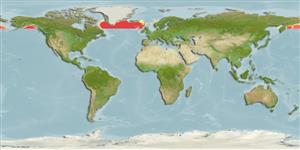
| Native range | All suitable habitat | Point map | Year 2050 |
|
| This map was computer-generated and has not yet been reviewed. |
| Eurypharynx pelecanoides AquaMaps Data sources: GBIF OBIS |
Uploaden van uw Foto's en video's
Afbeeldingen | video's | Google afbeelding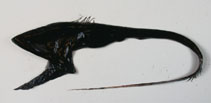 Eurypharynx pelecanoides
Afbeelding van Orlov, A.
Afbeeldingen | video's | Google afbeelding
Afbeelding van Orlov, A.
Classificatie / Namen Lokale namen | Synoniemen | Catalog of Fishes(Genus, Soort(en)) | ITIS | CoL | WoRMS | Cloffa
> Saccopharyngiformes (Swallowers and gulpers) > Eurypharyngidae (Gulpers)
Etymology: Eurypharynx: Greek, eurys = long + Greek, pharyngx = pharynx (Ref. 45335).
More on author: Vaillant.
Etymology: Eurypharynx: Greek, eurys = long + Greek, pharyngx = pharynx (Ref. 45335).
More on author: Vaillant.
Milieu: milieu / Klimaatzone / Diepte / verspreidingsgebied Ecologie
marien bathypelagisch; diepte 500 - 7625 m (Ref. 58426), usually 1200 - 1400 m (Ref. 559). Deep-water; 67°N - 56°N, 180°W - 180°E
Verspreiding Gebieden | FAO regio's | Ecosystemen | Voorkomen | Verspreidingskaart | Introducties | Faunafri
Circumglobal: In tropical to temperate waters. Eastern Pacific: ranges from northern California to Peru (Ref. 35600).
Grootte / Gewicht / Leeftijd
Maturiteit: Lm ? range ? - ? cm
Max length : 100.0 cm TL mannelijk / geslacht onbekend; (Ref. 27000); common length : 55.0 cm NG mannelijk / geslacht onbekend; (Ref. 5755)
Max length : 100.0 cm TL mannelijk / geslacht onbekend; (Ref. 27000); common length : 55.0 cm NG mannelijk / geslacht onbekend; (Ref. 5755)
Korte beschrijving Determinatiesleutels | Morfologie | Morfometrie
Dorsale stekels (totaal) : 0; Anale stekels: 0. Mouth greatly enlarged by a backward extension of jaws, gape comprising half or more of preanal length; buccal cavity greatly distensible. Tail attenuated and ending in an expanded, luminous caudal organ. Caudal fin absent; scales absent; lateral line without pores, instead with groups of elevated tubules.
Body shape (shape guide): eel-like.
Body shape (shape guide): eel-like.
Meso- to abyssopelagic (Ref. 58302) and bathypelagic (Ref. 58426). Adults feed mainly on crustaceans, but also take fishes, cephalopods, and other invertebrates (Ref. 2850, 11041). Oviparous, planktonic eggs hatch into planktonic leptocephalus larvae (Ref. 6719, 35600). Degenerative changes in males and females suggest semelparity (Ref. 35600).
Levenscyclus en paargedrag Maturiteit | Voortplanting | Paaien | Eieren | Fecunditeit | Larven
Oviparous (Ref. 35600). Degenerative changes in males and females suggest semelparity (Ref. 35600). Egg cells within each of the gonads have the same developmental stage (monocyclic ovaries) suggesting only one spawning during its lifetime or periodic spawning (Ref. 36055).
Hoofdreferentie
Upload uw referenties | Referenties | Coördinator | Medewerkers
Nielsen, J.G. and E. Bertelsen, 1990. Eurypharyngidae. p. 206. In J.C. Quero, J.C. Hureau, C. Karrer, A. Post and L. Saldanha (eds.) Check-list of the fishes of the eastern tropical Atlantic (CLOFETA). JNICT, Lisbon; SEI, Paris; and UNESCO, Paris. Vol. 1. (Ref. 4457)
Status op de Rode Lijst van het IUCN (Ref. 130435: Version 2025-2)
Niet bedreigd (LC) ; Date assessed: 24 May 2012
CITES
Not Evaluated
Gevaar voor de mens
Harmless
Gebruik door de mens
Visserij: van geen belang
FAO - Publication: search | FishSource |
Meer informatie
Trofische ecologie
Voedsel (prooien)
Dieetsamenstelling
Voedselconsumptie
Voedselrantsoenen
Predatoren
Voedsel (prooien)
Dieetsamenstelling
Voedselconsumptie
Voedselrantsoenen
Predatoren
Populatiedynamica
Groeiparameters
Max. leeftijden / maten
Lengte-gewicht rel.
Lengte-lengte rel.
Lengtefrequenties
Massaconversie
Rekrutering
Abundantie
Groeiparameters
Max. leeftijden / maten
Lengte-gewicht rel.
Lengte-lengte rel.
Lengtefrequenties
Massaconversie
Rekrutering
Abundantie
Levenscyclus
Voortplanting
Maturiteit
Rijpheid/kieuwen rel.
Fecunditeit
Paaien
Paaibestanden
Eieren
Ontwikkeling van de eieren
Larven
Larvale populatiedynamiek
Voortplanting
Maturiteit
Rijpheid/kieuwen rel.
Fecunditeit
Paaien
Paaibestanden
Eieren
Ontwikkeling van de eieren
Larven
Larvale populatiedynamiek
Fysiologie
Lichaamssamenstelling
Voedingsstoffen
Zuurstofverbruik
Type zwemmen
Zwemsnelheid
Visuele pigmenten
Vis geluid
Ziekten en parasieten
Toxiciteit (LC50)
Lichaamssamenstelling
Voedingsstoffen
Zuurstofverbruik
Type zwemmen
Zwemsnelheid
Visuele pigmenten
Vis geluid
Ziekten en parasieten
Toxiciteit (LC50)
Genetica
genoom
Genetica
Heterozygositeit
Erfelijkheid
Genetische diversiteit
genoom
Genetica
Heterozygositeit
Erfelijkheid
Genetische diversiteit
Menselijk gerelateerd
Aquacultuursystemen
Aquacultuurprofielen
Kweeklijnen
Ciguatera gevallen
Postzegels, munten, diversen.
Aquacultuursystemen
Aquacultuurprofielen
Kweeklijnen
Ciguatera gevallen
Postzegels, munten, diversen.
Tools
Speciale rapporten
Bekijk gegevens voor het houden in een aquarium | Bekijk Fact Sheets voor de soort | Bekijk Aquacultuur Fact Sheets
Download XML
Internetbronnen
AFORO (otoliths) | Aquatic Commons | BHL | Cloffa | Websites from users | Bekijk FishWatcher | CISTI | Catalog of Fishes: Genus, Soort(en) | DiscoverLife | ECOTOX | FAO - Publication: search | Faunafri | Fishipedia | Fishtrace | GloBI | Google Books | Google Scholar | Google | IGFA World Record | Nationale databanken | OneZoom | Open Tree of Life | Otolith Atlas of Taiwan Fishes | PubMed | Reef Life Survey | Socotra Atlas | TreeBase | Tree of Life | Wikipedia: ga naar, zoek | World Records Freshwater Fishing | Zoobank | Zoological Record
Schattingen op basis van modellen
Gewenste temperatuur (Ref. 123201): 2.3 - 5.5, mean 3.6 °C (based on 890 cells).
Fylogenetische diversiteitsindex (Ref. 82804): PD50 = 1.5000 [Uniqueness, from 0.5 = low to 2.0 = high].
Bayesian length-weight: a=0.00102 (0.00046 - 0.00225), b=3.06 (2.88 - 3.24), in cm total length, based on all LWR estimates for this body shape (Ref. 93245).
Trofisch niveau (Ref. 69278): 4.1 ±0.57 se; based on food items.
Weerstandsvermogen (Ref. 120179): Zeer laag, minimale populatieverdubbelingstijd meer dan 14 jaar (Assuming semelparity with tm>10).
Voedingsstoffen (Ref. 124155): Calcium = 15.6 [4.0, 64.6] mg/100g; Iron = 0.408 [0.125, 1.243] mg/100g; Protein = 2.94 [0.00, 6.86] %; Omega3 = 0.192 [0.063, 0.599] g/100g; Selenium = 18.7 [6.0, 72.0] μg/100g; VitaminA = 28.8 [3.8, 214.8] μg/100g; Zinc = 0.453 [0.206, 1.092] mg/100g (wet weight);