-

- À propos de cette page
- Langues
- Commentaires des utilisateurs
- Citation
- Téléchargements
- Espèces associées
-



Ajouter votre observation dans Fish Watcher
| Native range | All suitable habitat | Point map | Year 2050 |

|
| This map was computer-generated and has not yet been reviewed. |
| Neotrygon kuhlii AquaMaps Data sources: GBIF OBIS |
Envoyez vos Photos et vidéos
Images | vidéos | Images Google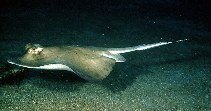 Neotrygon kuhlii
Photo de Randall, J.E.
Images | vidéos | Images Google
Photo de Randall, J.E.
Classification / Noms Noms communs | Synonymes | Catalog of Fishes(Genre, Espèce) | ITIS | CoL | WoRMS | Cloffa
Élasmobranches (requins et raies) (sharks and rays) > Myliobatiformes (Stingrays) > Dasyatidae (Stingrays) > Neotrygoninae
Eponymy: Dr Heinrich Kuhl (1797–1821) was a German naturalist and zoologist. [...] (Ref. 128868), visit book page.
More on authors: Müller & Henle.
Eponymy: Dr Heinrich Kuhl (1797–1821) was a German naturalist and zoologist. [...] (Ref. 128868), visit book page.
More on authors: Müller & Henle.
Issue
Formerly a widespread species, but forms a species complex with three other species. Information (data from references) collated undergoing modifications (in progress).
Environnement : milieu / zone climatique / profondeur / gamme de distribution Écologie
marin récifal; profondeur 0 - 170 m (Ref. 89055), usually ? - 90 m (Ref. 9840). Tropical; 6°S - 12°S, 156°E - 164°E
Distribution Territoires | Zones FAO | Écosystèmes | Occurrences | Carte par point | Introductions | Faunafri
Southwest Pacific: Solomon Islands, but probably more widespread in Oceania (limits of its distribution need to be defined).
Forms a species complex with Neotrygon australiae (Australia, New Guinea and eastern Indonesia), N. caeruleopunctata (Indian Ocean), and N. orientale (North-West Pacific).
Longueur à la première maturité / Taille / Poids / Âge
Description synthétique Clés d'identification | Morphologie | Morphométrie
This medium-sized Neotrygon of the kuhlii-complex (reaching at least 30 cm DW) is distinguished by the following set of characters: disc is broader than long, its width ca. 1.2 times length; pectoral apices are narrowly rounded; snout rather fleshy, broadly angular, its angle ca. 107°, its length 1.7-2.1 times interorbital width; maximum width is relatively well back on disc, the length from snout tip to pectoral-fin insertion 1.8-1.9 times and disc width 2.5-2.6 times horizontal distance from snout tip to maximum disc width; preoral length is 2.4-2.8 times mouth width; internasal distance is 1.5-1.8 in prenasal length; interspiracular distance is 13-15% DW; nostril length is 2.8-4.1% DW; nasal curtain width is 8-8.3% DW; mouth small, its width 6.4-6.8% DW; horizontal distance from cloaca to caudal sting base ca. 55% of disc length; nuchal region with thornlets, none from tail in all sizes; no dermal denticles; 113 pectoral-fin radials (based on new specimen); 133 total vertebral centra (including synarcual), 39 trunk centra (including synarcual); presence of blue spots that are very small and sparse, largest spot on disc 0.3-0.5 times eye width; median belt with 0-6 (mean 3.0) blue spots, largest ~2.1% DW; pronounced mask-like marking, not covered with dark peppery spots; ventral surface of disc and pelvic fins with broad dark greyish submarginal bands; when fresh, ventral tail fold and adjacent tail bluish grey (Ref. 116741).
Body shape (shape guide): other; Cross section: flattened.
Body shape (shape guide): other; Cross section: flattened.
A solitary species found on sandy bottoms near rocky or coral reefs (Ref. 12951). Usually found in deeper water but moves onto the reef flat and into shallow lagoons at high tide (Ref. 12951). Occasionally covers itself with sand, leaving only its eyes and tail visible (Ref. 37816). Feeds on crabs and shrimps (Ref. 5578). Ovoviviparous (Ref. 50449). The venomous spine can inflict a painful wound (Ref.4690). Caught in very large quantities in the bottom trawl, trammel and fish trap fisheries. Utilized for its meat but of limited value due to its small size (Ref. 58048). It is parasitised by the monogenean Dendromonocotyle kuhlii on the dorsal skin surface (Ref. 124051).
Cycle de vie et comportement reproducteur Maturité | Reproduction | Frai | Œufs | Fécondité | Larves
Exhibit ovoviparity (aplacental viviparity), with embryos feeding initially on yolk, then receiving additional nourishment from the mother by indirect absorption of uterine fluid enriched with mucus, fat or protein through specialised structures (Ref. 50449). Distinct pairing with embrace (Ref. 205). Litters size at birth 16 cm (Ref. 37816); Java form born at 11-16 cm WD, Bali form born at ~17 cm WD. Gives birth to litters of 1-2 pups; no reproductive synchronicity (Ref. 58048).
Référence principale
Téléchargez vos références | Références | Coordinateur : McEachran, John | Collaborateurs
Last, P.R., White, W.T. and B. Séret, 2016. Taxonomic status of maskrays of the Neotrygon kuhlii species complex (Myliobatoidei: Dasyatidae) with the description of three new species from the Indo-West Pacific. Zootaxa 4083(4):533-561. (Ref. 116741)
Statut dans la liste rouge de l'IUCN (Ref. 130435: Version 2025-2)
Données manquantes (DD) ; Date assessed: 22 June 2017
CITES
Not Evaluated
Menace pour l'homme
Venomous (Ref. 4690)
Utilisations par l'homme
Pêcheries: commercial; pêche sportive: oui; Aquarium: Commercial
FAO - Publication: search | FishSource | Sea Around Us
Plus d'informations
Écologie trophique
Aliments (proies)
Composition du régime alimentaire
Consommation alimentaire
Rations alimentaires
Prédateurs
Aliments (proies)
Composition du régime alimentaire
Consommation alimentaire
Rations alimentaires
Prédateurs
Dynamique des populations
Paramètres de croissance
Âges / tailles maximales
Longueur-poids rel.
Rel. longueur-longueur.
Fréquences de longueurs
Conversion de masse
Recrutement
Abondance
Paramètres de croissance
Âges / tailles maximales
Longueur-poids rel.
Rel. longueur-longueur.
Fréquences de longueurs
Conversion de masse
Recrutement
Abondance
Cycle de vie
Reproduction
Maturité
Maturité/épines rel.
Fécondité
Frai
Agrégats de frai
Œufs
Développement de l'œuf
Larves
Dynamique des populations larvaires
Reproduction
Maturité
Maturité/épines rel.
Fécondité
Frai
Agrégats de frai
Œufs
Développement de l'œuf
Larves
Dynamique des populations larvaires
Physiologie
Composition corporelle
Nutriments
Consommation d'oxygène
Type de natation
Vitesse de nage
Pigments visuels
Son de poisson
Maladies et parasites
Toxicité (CL50)
Composition corporelle
Nutriments
Consommation d'oxygène
Type de natation
Vitesse de nage
Pigments visuels
Son de poisson
Maladies et parasites
Toxicité (CL50)
Liées à l'homme
Systèmes d'aquaculture
Profils d'aquaculture
Souches
Cas de ciguatera
Timbres, pièces de monnaie, divers
Systèmes d'aquaculture
Profils d'aquaculture
Souches
Cas de ciguatera
Timbres, pièces de monnaie, divers
Outils
Quiz bio | E-book | Guide de terrain | Clés d'identification | Générateur de fréquences de longueur | Outil de dynamique de population | Carte par point |
Capture-MSY |
Articles particuliers
Télécharger en XML
Sources Internet
AFORO (otoliths) | Aquatic Commons | BHL | Cloffa | Websites from users | FishWatcher | CISTI | Catalog of Fishes: Genre, Espèce | DiscoverLife | ECOTOX | FAO - Publication: search | Faunafri | Fishipedia | Fishtrace | GloBI | Google Books | Google Scholar | Google | IGFA World Record | Bases de données nationales | OneZoom | Open Tree of Life | Otolith Atlas of Taiwan Fishes | Aquariums publics | PubMed | Reef Life Survey | Socotra Atlas | TreeBase | Arbre de Vie | Wikipedia: aller à, chercher | World Records Freshwater Fishing | Zoological Record
Estimations basées sur des modèles
Température préférée (Réf. 123201): 23.9 - 29, mean 27.8 °C (based on 2546 cells).
Indice de diversité phylogénétique (Réf. 82804): PD50 = 0.5000 [Uniqueness, from 0.5 = low to 2.0 = high].
Bayesian length-weight: a=0.01096 (0.00350 - 0.03435), b=3.12 (2.87 - 3.37), in cm total length, based on LWR estimates for this (Sub)family-body shape (Ref. 93245).
Niveau trophique (Réf. 69278): 3.3 ±0.3 se; based on diet studies.
Generation time: 8.5 ( na - na) years. Estimated as median ln(3)/K based on 2 growth studies.
Résilience (Réf. 120179): Très faible, temps minimum de doublement de population supérieur à 14 ans (Fec=1-3).
Nutriments (Ref. 124155): Calcium = 14.2 [3.0, 58.7] mg/100g; Iron = 0.446 [0.109, 1.168] mg/100g; Protein = 22.2 [19.3, 25.3] %; Omega3 = 0.117 [0.035, 0.325] g/100g; Selenium = 32.2 [8.9, 82.3] μg/100g; VitaminA = 57.4 [22.8, 143.3] μg/100g; Zinc = 0.977 [0.477, 1.924] mg/100g (wet weight);