This website uses cookies to enhance your browsing experience and ensure the functionality of our site. For more detailed information about the types of cookies we use and how we protect your privacy, please visit our Privacy Information page.
×
Cookie Settings
This website uses different types of cookies to enhance your experience. Please select your preferences below:
Indo-Pacific: Ryukyu Islands, encompassing the Indo-Malayan Archipelago, Western Australia north of Abrolhos Islands; reaching eastward along the northern margin of the tropical Indian Ocean to Sri Lanka and India.
Tamaño / Peso / Edad
Madurez: Lm? range ? - ? cm Max length : 12.0 cm SL macho / no sexado; (Ref. 7247)
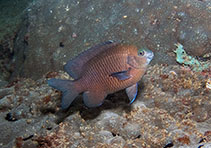
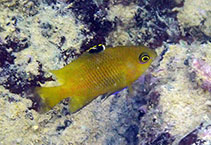
Espinas dorsales (total) : 13; Radios blandos dorsales (total) : 14 - 16; Espinas anales: 2; Radios blandos anales: 12 - 14. Diagnosis: Body and median fins generally brown to nearly black; body paler ventrally; fins grading to smoky gray distally. Margin of scales on sides with blackish streak, appearing as series of transverse bands; few small blue spots scattered on head and sides. Pelvic and anal fins bright blue anteriorly. Lips dusky brown (Ref. 510). Body depth 1.7-2.2 in SL (Ref. 90102). Body shape (shape guide): short and / or deep; Cross section: compressed.
Adults occur close to shore in rocky or dead reef areas where visibility is often reduced due to silting and wave action. Territorial, they maintain and 'weed' filamentous algae patches growing on dead coral (Ref. 9710). Oviparous, distinct pairing during breeding (Ref. 205). Eggs are demersal and adhere to the substrate (Ref. 205). Males guard and aerate the eggs (Ref. 205).
Ciclo vital y comportamiento de apareamiento Madurez | Reproducción | Puesta | Huevos | Fecundidad | Larva
Oviparous, distinct pairing during breeding (Ref. 205). Eggs are demersal and adhere to the substrate (Ref. 205). Males guard and aerate the eggs (Ref. 205).
Allen, G.R. and A.R. Emery, 1985. A review of the Pomacentrid fishes of the genus Stegastes from the Indo-Pacific, with descriptions of two new species. Indo-Pac. Fish. (3):31. (Ref. 510)
Situación en la Lista Roja de la UICN (Ref. 130435: Version 2025-2)
Fisiología Composición corporal Nutrientes Consumo del oxígeno Tipo de natación Velocidad de natación Pigmentos visuales Sonido de peces Enfermedades y parásitos Toxicidad (CL50)
Temperatura preferida (Referencia 123201): 25 - 29.3, mean 28.4 °C (based on 2607 cells).
Índice de diversidad filogenética (Referencia 82804): PD50 = 0.5000 [Uniqueness, from 0.5 = low to 2.0 = high].
Bayesian length-weight: a=0.01995 (0.00910 - 0.04376), b=2.99 (2.80 - 3.18), in cm total length, based on LWR estimates for this (Sub)family-body shape (Ref. 93245).
Nivel trófico (Referencia 69278): 2.0 ±0.00 se; based on food items.
Resiliencia (Referencia 120179): Alto, población duplicada en un tiempo mínimo inferior a 15 meses (Preliminary K or Fecundity.).
Vulnerabilidad pesquera (Ref. 59153): Low vulnerability (10 of 100). 🛈