-

- À propos de cette page
- Langues
- Commentaires des utilisateurs
- Citation
- Téléchargements
- Espèces associées
-



Fundulus heteroclitus (Linnaeus, 1766)
Mummichog
Ajouter votre observation dans Fish Watcher
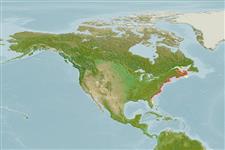
| Native range | All suitable habitat | Point map | Year 2050 |
|
| This map was computer-generated and has not yet been reviewed. |
| Fundulus heteroclitus AquaMaps Data sources: GBIF OBIS |
Envoyez vos Photos et vidéos
Images | Images Google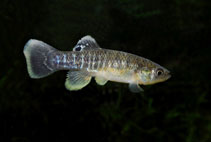 Fundulus heteroclitus
Juvenile Photo de Terceira, A.C.
Images | Images Google
Juvenile Photo de Terceira, A.C.
Classification / Noms Noms communs | Synonymes | Catalog of Fishes(Genre, Espèce) | ITIS | CoL | WoRMS | Cloffa
> Cyprinodontiformes (Rivulines, killifishes and live bearers) > Fundulidae (Topminnows and killifishes)
Etymology: Fundulus: Latin, fundus = bottom; a peculiar name for a topminnow, coined for a bottom species of Atlantic coast being "the abode of the fundulus mudfish" (Ref. 45335).
More on author: Linnaeus.
Etymology: Fundulus: Latin, fundus = bottom; a peculiar name for a topminnow, coined for a bottom species of Atlantic coast being "the abode of the fundulus mudfish" (Ref. 45335).
More on author: Linnaeus.
Environnement : milieu / zone climatique / profondeur / gamme de distribution Écologie
marin; eau douce; saumâtre benthopélagique; non migrateur. Temperate; 10°C - 24°C (Ref. 12468); 52°N - 28°N, 82°W - 55°W
Distribution Territoires | Zones FAO | Écosystèmes | Occurrences | Carte par point | Introductions | Faunafri
Western Atlantic: Gulf of St. Lawrence to northeast Florida, USA. Two subspecies were previously recognized: Fundulus heteroclitus heteroclitus and Fundulus heteroclitus macrolepidotus (Ref. 86798). Introduced to southern Portugal and southern Spain (Ref. 59043).
Longueur à la première maturité / Taille / Poids / Âge
Maturité: Lm ?, range 4 - ? cm
Max length : 15.0 cm TL mâle / non sexé; (Ref. 27139); common length : 8.9 cm TL mâle / non sexé; (Ref. 12193); âge max. reporté: 4 années (Ref. 59043)
Max length : 15.0 cm TL mâle / non sexé; (Ref. 27139); common length : 8.9 cm TL mâle / non sexé; (Ref. 12193); âge max. reporté: 4 années (Ref. 59043)
Description synthétique Clés d'identification | Morphologie | Morphométrie
Distinguished from nearly identical species Fundulus grandis by having the following characters: more convex upper profile; dark bars alternating with silvery interspaces on side; small ocellus at rear of dorsal fin of male; and each mandible with 4 pores (Ref. 86798).
Body shape (shape guide): fusiform / normal.
Body shape (shape guide): fusiform / normal.
Facultative air-breathing (Ref. 126274); Occurs in saltwater marshes, tidal creeks and nearby fresh water (Ref. 86798). A resident intertidal species with homing behavior (Ref. 32612). Adults are mainly found in saltwater marshes and in tidal creeks. They may leave tide pools if aquatic conditions become inhospitable (Ref. 31184). They also enter fresh water to a limited extent (Ref. 7251). Not a seasonal killifish. They breathe air when out of water (Ref. 31184). Difficult to maintain in aquariums (Ref. 27139). Introduction has caused the decline of native species and near extinction of Aphanius baeticus in southwestern Spain (Ref. 59043).
Cycle de vie et comportement reproducteur Maturité | Reproduction | Frai | Œufs | Fécondité | Larves
Deposits eggs in the shells of Modiolus demissus (Ref. 26281).
Référence principale
Téléchargez vos références | Références | Coordinateur : Costa, Wilson J.E.M. | Collaborateurs
Page, L.M. and B.M. Burr, 2011. A field guide to freshwater fishes of North America north of Mexico. Boston : Houghton Mifflin Harcourt, 663p. (Ref. 86798)
Statut dans la liste rouge de l'IUCN (Ref. 130435: Version 2025-2)
Préoccupation mineure (LC) ; Date assessed: 01 February 2012
CITES
Not Evaluated
Menace pour l'homme
Harmless
Utilisations par l'homme
Pêcheries: commercial; Aquarium: Commercial
FAO - Publication: search | FishSource |
Plus d'informations
Écologie trophique
Aliments (proies)
Composition du régime alimentaire
Consommation alimentaire
Rations alimentaires
Prédateurs
Aliments (proies)
Composition du régime alimentaire
Consommation alimentaire
Rations alimentaires
Prédateurs
Dynamique des populations
Paramètres de croissance
Âges / tailles maximales
Longueur-poids rel.
Rel. longueur-longueur.
Fréquences de longueurs
Conversion de masse
Recrutement
Abondance
Paramètres de croissance
Âges / tailles maximales
Longueur-poids rel.
Rel. longueur-longueur.
Fréquences de longueurs
Conversion de masse
Recrutement
Abondance
Anatomie
Surface branchiale
Cerveau
Otolithe
Surface branchiale
Cerveau
Otolithe
Physiologie
Composition corporelle
Nutriments
Consommation d'oxygène
Type de natation
Vitesse de nage
Pigments visuels
Son de poisson
Maladies et parasites
Toxicité (CL50)
Composition corporelle
Nutriments
Consommation d'oxygène
Type de natation
Vitesse de nage
Pigments visuels
Son de poisson
Maladies et parasites
Toxicité (CL50)
Liées à l'homme
Systèmes d'aquaculture
Profils d'aquaculture
Souches
Cas de ciguatera
Timbres, pièces de monnaie, divers
Systèmes d'aquaculture
Profils d'aquaculture
Souches
Cas de ciguatera
Timbres, pièces de monnaie, divers
Outils
Quiz bio | E-book | Guide de terrain | Clés d'identification | Générateur de fréquences de longueur | Outil de dynamique de population | Carte par point |
Capture-MSY |
Articles particuliers
Télécharger en XML
Sources Internet
AFORO (otoliths) | Alien/Invasive Species database | Aquatic Commons | BHL | Cloffa | Websites from users | FishWatcher | CISTI | Catalog of Fishes: Genre, Espèce | DiscoverLife | ECOTOX | FAO - Publication: search | Faunafri | Fishipedia | Fishtrace | GloBI | Google Books | Google Scholar | Google | IGFA World Record | Bases de données nationales | OneZoom | Open Tree of Life | Otolith Atlas of Taiwan Fishes | Aquariums publics | PubMed | Reef Life Survey | Socotra Atlas | TreeBase | Arbre de Vie | Wikipedia: aller à, chercher | World Records Freshwater Fishing | Zoological Record
Estimations basées sur des modèles
Température préférée (Réf. 123201): 6.1 - 23.7, mean 9.3 °C (based on 163 cells).
Indice de diversité phylogénétique (Réf. 82804): PD50 = 0.5000 [Uniqueness, from 0.5 = low to 2.0 = high].
Bayesian length-weight: a=0.00933 (0.00721 - 0.01209), b=3.17 (3.10 - 3.24), in cm total length, based on LWR estimates for this species (Ref. 93245).
Niveau trophique (Réf. 69278): 3.6 ±0.48 se; based on food items.
Generation time: 1.5 ( na - na) years. Estimated as median ln(3)/K based on 1 growth studies.
Résilience (Réf. 120179): Milieu, temps minimum de doublement de population : 1,4 à 4,4 années (tm<1; tmax=4).
Nutriments (Ref. 124155): Calcium = 82.9 [39.2, 188.9] mg/100g; Iron = 0.442 [0.225, 0.881] mg/100g; Protein = 17.9 [16.5, 19.2] %; Omega3 = 0.594 [0.249, 1.464] g/100g; Selenium = 4.78 [1.73, 11.60] μg/100g; VitaminA = 29.2 [7.9, 115.4] μg/100g; Zinc = 1.09 [0.70, 1.68] mg/100g (wet weight);