-

- Acerca de esta página
- Idiomas
- Opiniones de los usuarios
- Citación
- Carga
- Especies relacionadas
-



Barbonymus gonionotus (Bleeker, 1849)
Silver barb
Sube tu fotos y Vídeos
Imágenes | Google image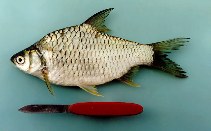 Barbonymus gonionotus
Foto de Warren, T.
Imágenes | Google image
Foto de Warren, T.
Clasificación / Nombres Nombres comunes | Sinónimos | Catalog of Fishes(Género, Especie) | ITIS | CoL | WoRMS | Cloffa
Entorno: milieu / zona climática / rango de profundidad / gama de distribución Ecología
; agua dulce bentopelágico; potamodromo (Ref. 51243); rango de profundidad 15 - ? m (Ref. 12693). Tropical; 22°C - 28°C; 24°N - 8°S
Distribución Territorios | Áreas FAO | Ecosistemas | Ocurrencias, apariciones | Mapa de puntos | Introducciones | Faunafri
Asia: Mekong and Chao Phraya basins, Malay Peninsula, Sumatra and Java (Ref. 27732). Occurs throughout the whole stretch on the Mekong, from the delta around the saline intrusion zone to Chiang Khong in Thailand (Ref. 37770).
Longitud en la primera madurez / Tamaño / Peso / Edad
Descripción breve Claves de identificación | Morfología | Morfometría
Espinas dorsales (total) : 4; Radios blandos dorsales (total) : 8; Espinas anales: 3; Radios blandos anales: 6 - 7. Body is strongly compressed. The back is elevated, its dorsal profile arched, often concave above the occiput. The head is small; the snout pointed; the mouth terminal. The barbels are very minute or rudimentary, especially the upper ones, which sometimes disappear entirely. Color when fresh is silvery white, sometimes with a golden tint. The dorsal and caudal fins are gray to gray-yellow; the anal and pelvic fins light orange, their tips reddish; the pectoral fins pale to light yellow (Ref. 4792). Very few tubercles on the snout which are not visible without magnification; snout length much less than the width of the eye socket (Ref. 37768). Anal-fin with 6-7 branches rays (Ref. 12693).
Body shape (shape guide): fusiform / normal; Cross section: oval.
Body shape (shape guide): fusiform / normal; Cross section: oval.
Occurs at midwater to bottom depths in rivers, streams, floodplains, and occasionally in reservoirs. Seems to prefer standing water habitats instead of flowing waters. Inhabits the flooded forest during high water period (Ref. 12693). Feeds on plant matter (e.g. leaves, weeds, Ipomea reptans and Hydrilla) and invertebrates (Ref. 4835). A migratory species but not considered to be a long-distance migrant. Regarded as local migrant which moves from the Mekong up into small streams and canals and onto flooded areas during the rainy season and back again during receding water (Ref. 37770). Some reports indicated that upstream migration of this fish is triggered by the first rains and rising water levels. When it finds a tributary, canal or stream it moves upstream and eventually onto flooded areas. When water recedes, it migrates back into canals and streams and into the Mekong again (Ref. 37770). Often used as a pituitary donor for artificial propagation in aquaculture. Escapees from culture installations have become established in rivers and form the basis for capture fisheries on several Southeast Asian islands (Ref. 1739). Useful in cropping excessive vegetation in reservoirs (Ref. 2686). Used for lap pa (in the preparation of which the numerous small bones are ground fine) or grilled or used to make som pa. Usually marketed fresh and occasionally seen in the aquarium trade (Ref. 12693). A specimen measuring 45 cm TL (2,100 g) was reportedly caught from Dan Tchang Reservoir, Thailand on 8 July 2003 (Jean-Francois Helias, pers. comm., FISHING ADVENTURES THAILAND [mailto:fishasia@ksc.th.com] ).
Ciclo vital y comportamiento de apareamiento Madurez | Reproducción | Puesta | Huevos | Fecundidad | Larva
Assuming same reproductive mode as B. schwanenfeldii (RF).
Referencia principal
Suba sus referencias | Referencias | Coordinador | Colaboradores
Kottelat, M., A.J. Whitten, S.N. Kartikasari and S. Wirjoatmodjo, 1993. Freshwater fishes of Western Indonesia and Sulawesi. Periplus Editions, Hong Kong. 221 p. (Ref. 7050)
Situación en la Lista Roja de la UICN (Ref. 130435: Version 2025-2)
Least Concern (LC) ; Date assessed: 10 January 2019
CITES
Not Evaluated
Amenaza para el ser humano
Harmless
Usos humanos
Pesquerías: comercial; Acuicultura: comercial; pesca deportiva: si; Acuario: Comercial
FAO - Sistemas de acuicultura: producción; pesquerías: desembarques, perfil de la especie; Publication: search | FishSource | Sea Around Us
Más información
Ecología Trófica
Alimentos (presas)
Composición de la dieta
consumo de alimento
Raciones de comida
Despredadores
Alimentos (presas)
Composición de la dieta
consumo de alimento
Raciones de comida
Despredadores
Dinámica de la población
Coeficiente del crecimiento para
Edades / tallas máximas
Longitud-peso rel.
Longitud-longitud rel.
Longitud-frecuencias
Conversión de masas
Reclutamiento
Abundancia
Coeficiente del crecimiento para
Edades / tallas máximas
Longitud-peso rel.
Longitud-longitud rel.
Longitud-frecuencias
Conversión de masas
Reclutamiento
Abundancia
Ciclo de vida
Reproducción
Madurez
Madurez/Gills rel.
Fecundidad
Puesta
Agregaciones de desove
Huevos
Desarrollo de los huevos
Larva
Dinámica larvaria
Reproducción
Madurez
Madurez/Gills rel.
Fecundidad
Puesta
Agregaciones de desove
Huevos
Desarrollo de los huevos
Larva
Dinámica larvaria
Distribución
Territorios
Áreas FAO
Ecosistemas
Ocurrencias, apariciones
Introducciones
BRUVS - Vídeos
Territorios
Áreas FAO
Ecosistemas
Ocurrencias, apariciones
Introducciones
BRUVS - Vídeos
Anatomía
Superficie branquial
Cerebro
Otolito
Superficie branquial
Cerebro
Otolito
Fisiología
Composición corporal
Nutrientes
Consumo del oxígeno
Tipo de natación
Velocidad de natación
Pigmentos visuales
Sonido de peces
Enfermedades y parásitos
Toxicidad (CL50)
Composición corporal
Nutrientes
Consumo del oxígeno
Tipo de natación
Velocidad de natación
Pigmentos visuales
Sonido de peces
Enfermedades y parásitos
Toxicidad (CL50)
Relacionados con el ser humano
Sistemas de acuicultura
Perfiles de acuicultura
Razas
Ciguatera cases
Sellos, monedas, varios
Sistemas de acuicultura
Perfiles de acuicultura
Razas
Ciguatera cases
Sellos, monedas, varios
Herramientas
Libro electrónico | Guía de campo | Asistente para frecuencias de tallas | Herramienta de ciclo de vida | Mapa de puntos |
Catch-MSY |
Informes especiales
Comprobar el mantenimiento del acuario | Buscar fichas sobre especies | Consulte las hojas informativas sobre acuicultura
Descargar XML
Fuentes de Internet
AFORO (otoliths) | Alien/Invasive Species database | Aquatic Commons | BHL | Cloffa | Websites from users | Check FishWatcher | CISTI | Catalog of Fishes: Género, Especie | DiscoverLife | ECOTOX | FAO - Sistemas de acuicultura: producción; pesquerías: desembarques, perfil de la especie; Publication: search | Faunafri | Fishipedia | Fishtrace | GloBI | Google Books | Google Scholar | Google | IGFA World Record | OneZoom | Open Tree of Life | Otolith Atlas of Taiwan Fishes | PubMed | Reef Life Survey | Socotra Atlas | TreeBase | Árbol de la vida | Wikipedia: Go, búsqueda | World Records Freshwater Fishing | Expediente Zoológico
Estimaciones basadas en modelos
Índice de diversidad filogenética (Referencia 82804): PD50 = 0.5156 [Uniqueness, from 0.5 = low to 2.0 = high].
Bayesian length-weight: a=0.01148 (0.00950 - 0.01387), b=2.99 (2.94 - 3.04), in cm total length, based on LWR estimates for this species (Ref. 93245).
Nivel trófico (Referencia 69278): 2.4 ±0.13 se; based on food items.
Resiliencia (Referencia 120179): Medio, población duplicada en un tiempo mínimo de 1.4-4.4 años (Assuming tm=2).
Nutrientes (Ref. 124155): Calcium = 244 [122, 623] mg/100g; Iron = 0.899 [0.517, 1.679] mg/100g; Protein = 16.5 [15.2, 17.8] %; Omega3 = 0.457 [0.202, 1.037] g/100g; Selenium = 71.7 [32.2, 148.3] μg/100g; VitaminA = 32.2 [11.4, 103.8] μg/100g; Zinc = 1.44 [0.84, 2.23] mg/100g (wet weight); based on nutrient studies.