-

- Om denna sida
- Språk
- Återkoppling från användare
- Referens
- Uppladdningar
- Relaterade arter
-



Occidentis hubbsi (Vladykov & Kott, 1976)
Kern brook lamprey
Ladda upp din foton och Videor
Bilder | Google image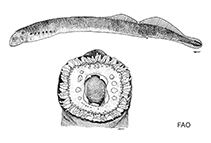 Occidentis hubbsi
Male Bild av FAO
Bilder | Google image
Male Bild av FAO
Klassificering / Namn Populärnamn | synonymer | Catalog of Fishes(Släkte, Arter) | ITIS | CoL | WoRMS | Cloffa
> Petromyzontiformes (Lampreys) > Petromyzontidae (Northern lampreys) > Lampetrinae
Etymology: hubbsi: In honor of American ichthyologist Carl L. Hubbs (1894-1979), “distinguished friend and a keen student of lamprey taxonomy” [placed in Entosphenus by some workers] (See ETYFish).
Eponymy: Professor Carl Levitt (Leavitt) Hubbs (1894–1979) was a giant of American ichthyology. [...] (Ref. 128868), visit book page.
Etymology: hubbsi: In honor of American ichthyologist Carl L. Hubbs (1894-1979), “distinguished friend and a keen student of lamprey taxonomy” [placed in Entosphenus by some workers] (See ETYFish).
Eponymy: Professor Carl Levitt (Leavitt) Hubbs (1894–1979) was a giant of American ichthyology. [...] (Ref. 128868), visit book page.
Miljö: miljö / Klimatzon / djupintervall / distributionsområde Ekologi
; sötvatten bottenlevande; ej vandrande. Temperate; 38°N - 36°N
Utbredning Territorier | FAO områden | Ekosystem | Förekomster | Prickkarta | Utplanteringar | Faunafri
North America: East side of San Joaquin Valley in lower Merced, Kaweah, Kings, and San Joaquin rivers in California, USA.
Storlek / Vikt / Ålder
Könsmognad: Lm ? range ? - ? cm
Max length : 14.2 cm TL hane/ej könsbestämd; (Ref. 89241); common length : 12.9 cm TL hane/ej könsbestämd; (Ref. 12193)
Max length : 14.2 cm TL hane/ej könsbestämd; (Ref. 89241); common length : 12.9 cm TL hane/ej könsbestämd; (Ref. 12193)
Kort beskrivning Bestämningsnycklar | Morfologi | Morfometri
Taggstrålar i ryggfenan (totalt) : 0; Taggstrålar i analfenan: 0. Characterized by having expanded oral disc narrower than head, usually 52-56 trunk myomeres, 2 supraoral teeth, usually 1-1-1-1 lateral circumoral teeth, 9-12 unicuspid posterior circumoral teeth, 5 infraoral teeth and coloration consisting of gray to brown above, white below, black specks on dorsal and caudal fins, and no black on lateral-line pores (Ref. 86798). Adults: 8.1-14.2 cm TL; body proportions (percentage of TL based on 127 specimens 8.1-14.2 cm TL): 7.8-14.4 prebranchial length, 8.5-12.8 branchial length, 44.6-56.9 trunk length, 24.3-30.8 tail length, 0.8-2.8 eye length and 3.7-8.7 disc length, 8.3-16.7 urogenital papilla length (percentage of branchial length in 9 spawning males 10.6-12.4 cm TL); trunk myomeres, 50-57. Adult dentition: supraoral lamina, 2 unicuspid teeth, rarely 3; infraoral lamina, 4-unicuspid teeth, usually 5; 4 endolaterals on each side, rarely 3; endolateral formula, typically 1-1-1-1, the first endolateral may also be bicuspid, the second and third endolaterals bi- or tricuspid, and the fourth bicuspid, however, no endolateral formula of 2-3-3-2 was encountered in 40 individuals examined; 2 row of anterials, 3-9 unicuspid teeth in total, three of these in the first row; exolaterals absent; 1 row of posterials, 8-12 unicuspid teeth in a continuous (complete) row or discontinuous (incomplete) row of only six unicuspid teeth; transverse lingual lamina, cusps too poorly developed to count, however, the median one not enlarged; longitudinal lingual laminae, cusps too poorly developed to count. Velar tentacles in adults, 3-5, with tubercles; median velar tentacle shorter than the lateral ones immediately next to it; no velar wings; body coloration (preserved), gray-brown on dorsal and lateral aspects, whitish on ventral aspect; extent of caudal fin pigmentation, 1% to <25%; caudal fin shape, rounded (Ref. 89241).
Body shape (shape guide): eel-like.
Body shape (shape guide): eel-like.
Inhabits silty backwaters of rivers and spawns in gravel riffles (Ref. 86798). Both the larval and adult stages were originally collected from the Friant-Kern Canal, which is 85% concrete lined and has a discharge greater than 57 m3/sec; an artificial habitat. Occurs in the Merced River, which should be considered typical habitat. Adults nonparasitic (Ref. 89241).
Livscykel och parningsbeteende Könsmognad | Reproduktion | Lek | Ägg | Fekunditet | Larver
Huvudreferens
Ladda upp dina referenser | referenser | Koordinator | Medarbetare
Page, L.M. and B.M. Burr, 1991. A field guide to freshwater fishes of North America north of Mexico. Houghton Mifflin Company, Boston. 432 p. (Ref. 5723)
Status på IUCN:s rödlista (Ref. 130435: Version 2025-2)
Sårbar (VU) (B1ab(iii)+2ab(iii)); Date assessed: 21 February 2012
CITES
Not Evaluated
Hot mot människor
Harmless
Mänskliga användningsområden
Fiskeri: saknar intresse
FAO - Publication: search | FishSource |
Ytterligare information
Trofisk ekologi
Livsmedelsartiklar (preys)
Födosammansättning
Födointag
Matransoner
Predatorer
Livsmedelsartiklar (preys)
Födosammansättning
Födointag
Matransoner
Predatorer
Ekologi
Ekologi
Ekologi
Populationsdynamik
Tillväxtparametrar
Max. åldrar / storlekar
Längd-vikt rel.
Längd-längd rel.
Längd-frekvenser
Massakonvertering
Rekrytering
Abundans
Tillväxtparametrar
Max. åldrar / storlekar
Längd-vikt rel.
Längd-längd rel.
Längd-frekvenser
Massakonvertering
Rekrytering
Abundans
Livscykel
Reproduktion
Könsmognad
Mognad/Gills rel.
Fekunditet
Lek
Lekande aggregat
Ägg
Utveckling av ägg
Larver
Larvdynamik
Reproduktion
Könsmognad
Mognad/Gills rel.
Fekunditet
Lek
Lekande aggregat
Ägg
Utveckling av ägg
Larver
Larvdynamik
Anatomi
Gälyta
Hjärna
Otolit
Gälyta
Hjärna
Otolit
Fysiologi
Kroppssammansättning
Näringsämnen
Syreförbrukning
Typ av simning
Simhastighet
Visuella pigment
Ljud från fisk
Sjukdomar & Parasiter
Toxicitet (LC50)
Kroppssammansättning
Näringsämnen
Syreförbrukning
Typ av simning
Simhastighet
Visuella pigment
Ljud från fisk
Sjukdomar & Parasiter
Toxicitet (LC50)
Genetik
Genom
Genetik
Heterozygositet
Ärftlighet
Genetisk mångfald
Genom
Genetik
Heterozygositet
Ärftlighet
Genetisk mångfald
Människorelaterad
Vattenbrukssystem
Vattenbruksprofiler
Avelslinjer
Ciguatera-fall
Frimärken, mynt, diverse.
Vattenbrukssystem
Vattenbruksprofiler
Avelslinjer
Ciguatera-fall
Frimärken, mynt, diverse.
Verktyg
E-bok | Fälthandbok | Bestämningsnycklar | Längdfördelnings-verktyg | Livshistorie-verktyg | Prickkarta |
Fångst-MSY |
Särskilda rapporter
Kontrollera för underhåll av akvarium | Kontrollera om det finns faktablad om arter | Kontrollera om det finns faktablad om vattenbruk
Ladda ner XML
Internet-källor
AFORO (otoliths) | Aquatic Commons | BHL | Cloffa | Websites from users | Check FishWatcher | CISTI | Catalog of Fishes: Släkte, Arter | DiscoverLife | ECOTOX | FAO - Publication: search | Faunafri | Fishipedia | Fishtrace | GloBI | Google Books | Google Scholar | Google | IGFA World Record | OneZoom | Open Tree of Life | Otolith Atlas of Taiwan Fishes | PubMed | Reef Life Survey | Socotra Atlas | TreeBase | Tree of Life | Wikipedia: Go, sök | World Records Freshwater Fishing | Zoologiskt register
Uppskattningar baserade på modeller
Index för fylogenetisk mångfald (Ref. 82804): PD50 = 0.6250 [Uniqueness, from 0.5 = low to 2.0 = high].
Bayesian length-weight: a=0.00138 (0.00062 - 0.00310), b=2.97 (2.78 - 3.16), in cm total length, based on LWR estimates for this (Sub)family-body shape (Ref. 93245).
Trofisk nivå (Ref. 69278): 3.8 ±0.8 se; based on size and trophs of closest relatives
Resiliens (Ref. 120179): Låg, lägsta populationsfördubblingstid 4,5-14 år (Semelparous species, assuming tm (= tmax) > 4).