-

- Über diese Seite
- Sprachen
- Rückmeldungen der Nutzer
- Zitat
- Uploads
-
Verwandte Arten
- Arten in
Plecoglossus - Arten in
Plecoglossidae - - Klassifizierung -
- Plecoglossidae
- Osmeriformes
- Teleostei
- Chordata
- Animalia
- Arten in
-



Plecoglossus altivelis (Temminck & Schlegel, 1846)
Ayu sweetfish
Beobachtung melden im Fish Watcher
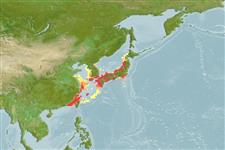
| Native range | All suitable habitat | Point map | Year 2050 |
|
| This map was computer-generated and has not yet been reviewed. |
| Plecoglossus altivelis AquaMaps Data sources: GBIF OBIS |
Hochladen Photos und videos
Bilder | Briefmarken, Münzen, Verschiedenes. | Google Bild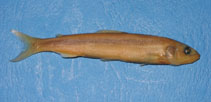 Plecoglossus altivelis
Photo von Islam, Md. S.
Bilder | Briefmarken, Münzen, Verschiedenes. | Google Bild
Photo von Islam, Md. S.
Klassifizierung / Names Namen | Synonyme | Catalog of Fishes(Gattung, Arten) | ITIS | CoL | WoRMS | Cloffa
> Osmeriformes (Freshwater smelts) > Plecoglossidae (Ayu fish)
Etymology: Plecoglossus: Greek, pleko, plekein = to fold + Greek, glossa = tongue (Ref. 45335).
More on authors: Temminck & Schlegel.
Etymology: Plecoglossus: Greek, pleko, plekein = to fold + Greek, glossa = tongue (Ref. 45335).
More on authors: Temminck & Schlegel.
Issue
All subspecies of Plecoglossus altivelis (Temminck & Schlegel, 1846) are synonymised under the species in Eschmeyer (CofF ver. Jul. 2010: Ref. 84883). Please send references, or more studies are needed.
Umwelt: Milieu / Klimazone / Tiefenbereich / Verbreitungsgebiet Ökologie
seewasser; süßwasser; brackwasser demersal; amphidrom (Ref. 138124); tiefenbereich 10 - ? m. Subtropical; 44°N - 23°N
Verbreitung Territorien | FAO Gebiete | Ökosysteme | Vorkommen | Punkt Karte | Einführungen | Faunafri
Northwest Pacific: western Hokkaido in Japan southward to the Korean Peninsula, Taiwan and China.
Länge bei der ersten Reifung / Größe / Gewicht / Alter
Geschlechtsreife: Lm 27.5, range 30 - 40 cm
Max length : 70.0 cm TL Männchen/unbestimmt; (Ref. 12218); common length : 15.0 cm SL Männchen/unbestimmt; (Ref. 35840); max. veröff. Alter: 3.00 Jahre (Ref. 12218)
Max length : 70.0 cm TL Männchen/unbestimmt; (Ref. 12218); common length : 15.0 cm SL Männchen/unbestimmt; (Ref. 35840); max. veröff. Alter: 3.00 Jahre (Ref. 12218)
Kurzbeschreibung Bestimmungsschlüssel | Morphologie | Morphometrie
Rückenflossenstacheln (insgesamt) : 0; Rückenflossenweichstrahlen (insgesamt) : 10 - 11; Afterflossenweichstrahlen: 14 - 15; Wirbelzahl: 60 - 63. Pyloric caeca 350-400.
Body shape (shape guide): elongated.
Body shape (shape guide): elongated.
Typical amphidromous fish; appears in near shore from late autumn to spring (Ref. 11230). Found in lakes and rivers, preferring clean river water and can be found the entire river long, from the head to the mouth (Ref. 12218). Ascends the river during March when the temperature is around 10°C (Ref. 12218). Adults spawn in the spring, in the lower reaches of rivers. After spawning, some adults die while others return to the sea. Larvae enter the sea immediately after hatching and remain there during winter, feeding on plankton. In springtime, the young (5-7 cm TL) move upstream to the middle reaches of rivers to feed on algae. Fish (about 6-9 cm) start schooling at the river mouth and are insectivores and eat algae
off small pebbles (Ref. 12218); this is assisted by small leaf-like teeth which are loosely attached to the jaw with two ligaments (Ref. 45181). Those that are ready to spawn (about 20 cm TL) move downstream to the lower reaches of the river. Spawning adults from the sea migrate upstream to the lower reaches as well. Some fish spawn two or three years in succession, others only once (Ref. 9987 & 559). River forms live usually only one year whereas lake forms can live two or three years (Ref. 12218). Reaches maturity at 30-40 cm (Ref. 12218). Highly esteemed food fish. Marketed fresh and consumed fresh, fried and broiled (Ref. 9987).
Lebenszyklus und Paarungsverhalten Geschlechtsreife | Fortpflanzung | Ablaichen | Eier | Fruchtbarkeit | Larven
During spawning some fish go up the river and some fish spawn on the river shoreline above pebbles. Spawns at night and excavates a 10cm (diameter or depth?) pit. Eggs are around 1 mm in size and adhere to the sand or pebbles for 14 to 20 days before hatching. This fish is semelparous and releases eggs many times over a short period each time releasing ~10,000 eggs. Sometimes females that want to spawn but cannot, save their strength, and go to a deep stagnant pool. These females wait until spring before going up the river with young fish. After hatching, the larvae are 6 mm and flow with the water current eating plankton. Juvenile fish will come again to the river in spring. These live in schools. When schools of Plecoglossus altivelis return to their river they guard their territory and eat food (Ref. 12218).
Reproductive mode varies between semelparity and iteroparity. Large females spawn once, while smaller females spawn twice during a two-week interval (Ref. 76896).
Hauptreferenz
Laden Sie Ihre Referenzen hoch | Referenzen | Koordinator | Partner
Masuda, H., K. Amaoka, C. Araga, T. Uyeno and T. Yoshino, 1984. The fishes of the Japanese Archipelago. Vol. 1. Tokai University Press, Tokyo, Japan. 437 p. (text). (Ref. 559)
IUCN Rote Liste Status (Ref. 130435: Version 2025-2)
Daten mangelhaft (DD) ; Date assessed: 03 September 2010
CITES
Not Evaluated
Bedrohung für Menschen
Harmless
Nutzung durch Menschen
Fischereien: hoch kommerziell; Aquakultur: kommerziell; Sportfisch: ja
FAO - Aquakultur-Systeme: produktion; Fischereien: landungen, Artbeschreibung; Publication: search | FishSource | Das Meer um uns herum
Mehr Information
Trophische Ökologie
Lebensmittel (Beutetiere)
Nahrungszusammensetzung
Nahrungsaufnahme
Lebensmittelrationen
Räuber
Lebensmittel (Beutetiere)
Nahrungszusammensetzung
Nahrungsaufnahme
Lebensmittelrationen
Räuber
Populationsdynamik
Wachstumsparameter
Max. Alter/Größen
Länge-Gewicht-Rel.
Länge-Länge-Verhältnis.
Längenhäufigkeiten
Massenkonvertierung
Rekrutierung
Dichte
Wachstumsparameter
Max. Alter/Größen
Länge-Gewicht-Rel.
Länge-Länge-Verhältnis.
Längenhäufigkeiten
Massenkonvertierung
Rekrutierung
Dichte
Lebenszyklus
Fortpflanzung
Geschlechtsreife
Reifung/Kiemen rel.
Fruchtbarkeit
Ablaichen
Laichaggregationen
Eier
Eientwicklung
Larven
Larven Pop.Dyn.
Fortpflanzung
Geschlechtsreife
Reifung/Kiemen rel.
Fruchtbarkeit
Ablaichen
Laichaggregationen
Eier
Eientwicklung
Larven
Larven Pop.Dyn.
Anatomie
Kiemenoberfläche
Gehirn
Otolith
Kiemenoberfläche
Gehirn
Otolith
Physiologie
Körperliche Zusammensetzung
Nährstoffe
Sauerstoffverbrauch
Schwimmart
Schwimmgeschwindigkeit
Visuelle Pigmente
Fischgeräusche
Krankheiten und Parasiten
Toxizität (LC50s)
Körperliche Zusammensetzung
Nährstoffe
Sauerstoffverbrauch
Schwimmart
Schwimmgeschwindigkeit
Visuelle Pigmente
Fischgeräusche
Krankheiten und Parasiten
Toxizität (LC50s)
Menschenbezogen
Aquakultur-Systeme
Aquakultur Profile
Zuchtlinien
Ciguatera-Fälle
Briefmarken, Münzen, Verschiedenes.
Aquakultur-Systeme
Aquakultur Profile
Zuchtlinien
Ciguatera-Fälle
Briefmarken, Münzen, Verschiedenes.
Tools
Zusatzinformationen
Download XML
Zusammenfassung | Punktdaten | Namen | Photos
Internet Quellen
AFORO (otoliths) | Alien/Invasive Species database | Aquatic Commons | BHL | Cloffa | Websites from users | FishWatcher Einträge suchen | CISTI | Catalog of Fishes: Gattung, Arten | DiscoverLife | ECOTOX | FAO - Aquakultur-Systeme: produktion; Fischereien: landungen, Artbeschreibung; Publication: search | Faunafri | Fishipedia | Fishtrace | GloBI | Google Books | Google Scholar | Google | IGFA World Record | Nationale Datenbanken | OneZoom | Open Tree of Life | Otolith Atlas of Taiwan Fishes | PubMed | Reef Life Survey | Socotra Atlas | TreeBase | Tree of Life | Wikipedia: Gehe zu, Suchen | World Records Freshwater Fishing | Zoologischer Rekord
Schätzungen auf der Grundlage von Modellen
Bevorzugte Temperatur (Ref. 123201): 13 - 22.6, mean 19.7 °C (based on 42 cells).
Phylogenetischer Diversitätsindex (Ref. 82804): PD50 = 1.5000 [Uniqueness, from 0.5 = low to 2.0 = high].
Bayesian length-weight: a=0.00427 (0.00166 - 0.01096), b=3.06 (2.83 - 3.29), in cm total length, based on LWR estimates for this (Sub)family-body shape (Ref. 93245).
Trophische Ebene (Ref. 69278): 2.8 ±0.16 se; based on food items.
Widerstandsfähigkeit (Ref. 120179): hoch, Verdopplung der Population dauert weniger als 15 Monate. (tm=1; tmax=3; Fec=50,000-100,000).
Nährstoffe (Ref. 124155): Calcium = 78 [36, 203] mg/100g; Iron = 1.19 [0.62, 2.98] mg/100g; Protein = 16.2 [13.8, 18.2] %; Omega3 = 0.445 [0.196, 1.234] g/100g; Selenium = 73.2 [35.2, 156.1] μg/100g; VitaminA = 4.44 [1.39, 14.45] μg/100g; Zinc = 0.804 [0.513, 1.253] mg/100g (wet weight);