-

- Über diese Seite
- Sprachen
- Rückmeldungen der Nutzer
- Zitat
- Uploads
- Verwandte Arten
-



Aplocheilichthys spilauchen (Duméril, 1861)
Banded lampeye
Hochladen Photos und videos
Google Bild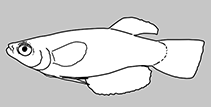 No image available for this species;
drawing shows typical species in Procatopodidae.
Google Bild
drawing shows typical species in Procatopodidae.
Klassifizierung / Names Namen | Synonyme | Catalog of Fishes(Gattung, Arten) | ITIS | CoL | WoRMS | Cloffa
> Cyprinodontiformes (Rivulines, killifishes and live bearers) > Procatopodidae (African lampeyes) > Aplocheilichthyinae
Etymology: Aplocheilichthys: Greek, aploe, -es = simplicity + Greek, cheilos = lip + Greek, ichthys = fish (Ref. 45335).
More on author: Duméril.
Etymology: Aplocheilichthys: Greek, aploe, -es = simplicity + Greek, cheilos = lip + Greek, ichthys = fish (Ref. 45335).
More on author: Duméril.
Umwelt: Milieu / Klimazone / Tiefenbereich / Verbreitungsgebiet Ökologie
; süßwasser; brackwasser benthopelagisch; pH range: 7.5 - 8.5; dH range: 12 - ?; standorttreu. Tropical; 24°C - 32°C (Ref. 1672)
Verbreitung Territorien | FAO Gebiete | Ökosysteme | Vorkommen | Punkt Karte | Einführungen | Faunafri
Africa: from mouth of Senegal River in Senegal (Ref. 47311, 57259) to Cuanza River in Angola (Ref. 120641).
Größe / Gewicht / Alter
Geschlechtsreife: Lm ? range ? - ? cm
Max length : 8.0 cm TL Männchen/unbestimmt; (Ref. 57259); 5.5 cm TL (female)
Max length : 8.0 cm TL Männchen/unbestimmt; (Ref. 57259); 5.5 cm TL (female)
Kurzbeschreibung Bestimmungsschlüssel | Morphologie | Morphometrie
Rückenflossenstacheln (insgesamt) : 0; Rückenflossenweichstrahlen (insgesamt) : 6 - 8; Afterflossenstacheln: 0; Afterflossenweichstrahlen: 11 - 14. Diagnosis: Larger and deep-bodied ‘Lampeye’ species, slight lateral compression; dorsal fin rounded, anal fin trapezoid, caudal fin truncated; dorsal fin with 6-8 rays, anal fin with 11-14 rays, displacement between dorsal and anal fins 1/7-8; scales on the mid-lateral series 25-28 (Ref. 57259).
Colouration: Male colouration: the basic colour is pale grey-green to olive with a light blue iridescence on the sides; also present on the sides are 10-15 dark grey crossbars which, towards the front break up into spots; the dorsal and anal fins are yellow-green, with grey and silver spots at the base and some grey spots in the posterior parts, arranged into curved bands; the caudal fin is lemon yellow to pale orange with dark grey and silver spots at the upper and lower parts, followed by a narrow orange to red border; the central part of this fin has some curved grey crossbars (Ref. 57259). Female colouration: the body is a translucent silver-grey with a silver abdominal region and lacking the grey crossbars present on the male; all unpaired fins are colourless to pale yellow (Ref. 57259).
Body shape (shape guide): fusiform / normal.
Body shape (shape guide): fusiform / normal.
Found in brackish water, only rarely entering fresh or marine water (Ref. 57259). Found in coastal swamps, river mouths, lagoons, estuaries and mangrove swamps near beaches (Ref. 3788, 57259). Not a seasonal killifish. Is difficult to maintain in aquarium (Ref. 27139).
Lebenszyklus und Paarungsverhalten Geschlechtsreife | Fortpflanzung | Ablaichen | Eier | Fruchtbarkeit | Larven
Hauptreferenz
Laden Sie Ihre Referenzen hoch | Referenzen | Koordinator | Partner
Huber, J.H., 1996. Killi-Data 1996. Updated checklist of taxonomic names, collecting localities and bibliographic references of oviparous Cyprinodont fishes (Atherinomorpha, Pisces). Société Française d'Ichtyologie, Muséum National d'Histoire Naturelle, Paris, France, 399 p. (Ref. 27139)
IUCN Rote Liste Status (Ref. 130435: Version 2025-2)
nicht bedroht (LC) ; Date assessed: 01 November 2019
CITES
Not Evaluated
Bedrohung für Menschen
Harmless
Nutzung durch Menschen
Aquarium: Kommerziell
FAO - Publication: search | FishSource |
Mehr Information
Trophische Ökologie
Lebensmittel (Beutetiere)
Nahrungszusammensetzung
Nahrungsaufnahme
Lebensmittelrationen
Räuber
Lebensmittel (Beutetiere)
Nahrungszusammensetzung
Nahrungsaufnahme
Lebensmittelrationen
Räuber
Populationsdynamik
Wachstumsparameter
Max. Alter/Größen
Länge-Gewicht-Rel.
Länge-Länge-Verhältnis.
Längenhäufigkeiten
Massenkonvertierung
Rekrutierung
Dichte
Wachstumsparameter
Max. Alter/Größen
Länge-Gewicht-Rel.
Länge-Länge-Verhältnis.
Längenhäufigkeiten
Massenkonvertierung
Rekrutierung
Dichte
Lebenszyklus
Fortpflanzung
Geschlechtsreife
Reifung/Kiemen rel.
Fruchtbarkeit
Ablaichen
Laichaggregationen
Eier
Eientwicklung
Larven
Larven Pop.Dyn.
Fortpflanzung
Geschlechtsreife
Reifung/Kiemen rel.
Fruchtbarkeit
Ablaichen
Laichaggregationen
Eier
Eientwicklung
Larven
Larven Pop.Dyn.
Anatomie
Kiemenoberfläche
Gehirn
Otolith
Kiemenoberfläche
Gehirn
Otolith
Physiologie
Körperliche Zusammensetzung
Nährstoffe
Sauerstoffverbrauch
Schwimmart
Schwimmgeschwindigkeit
Visuelle Pigmente
Fischgeräusche
Krankheiten und Parasiten
Toxizität (LC50s)
Körperliche Zusammensetzung
Nährstoffe
Sauerstoffverbrauch
Schwimmart
Schwimmgeschwindigkeit
Visuelle Pigmente
Fischgeräusche
Krankheiten und Parasiten
Toxizität (LC50s)
Menschenbezogen
Aquakultur-Systeme
Aquakultur Profile
Zuchtlinien
Ciguatera-Fälle
Briefmarken, Münzen, Verschiedenes.
Aquakultur-Systeme
Aquakultur Profile
Zuchtlinien
Ciguatera-Fälle
Briefmarken, Münzen, Verschiedenes.
Tools
E-Book | Feldführer | Bestimmungsschlüssel | Längenhäufigkeits Tool | Lebensdaten Tool | Punkt Karte |
Catch-MSY |
Zusatzinformationen
Download XML
Zusammenfassung | Punktdaten | Namen | Photos
Internet Quellen
AFORO (otoliths) | Aquatic Commons | BHL | Cloffa | Websites from users | FishWatcher Einträge suchen | CISTI | Catalog of Fishes: Gattung, Arten | DiscoverLife | ECOTOX | FAO - Publication: search | Faunafri | Fishipedia | Fishtrace | GloBI | Google Books | Google Scholar | Google | IGFA World Record | OneZoom | Open Tree of Life | Otolith Atlas of Taiwan Fishes | PubMed | Reef Life Survey | Socotra Atlas | TreeBase | Tree of Life | Wikipedia: Gehe zu, Suchen | World Records Freshwater Fishing | Zoologischer Rekord
Schätzungen auf der Grundlage von Modellen
Phylogenetischer Diversitätsindex (Ref. 82804): PD50 = 1.0000 [Uniqueness, from 0.5 = low to 2.0 = high].
Bayesian length-weight: a=0.00977 (0.00325 - 0.02939), b=3.14 (2.90 - 3.39), in cm total length, based on LWR estimates for this (Sub)family-body shape (Ref. 93245).
Trophische Ebene (Ref. 69278): 3.3 ±0.4 se; based on size and trophs of closest relatives