-

- À propos de cette page
- Langues
- Commentaires des utilisateurs
- Citation
- Téléchargements
- Espèces associées
-



Horadandia atukorali Deraniyagala, 1943
Green carplet
Envoyez vos Photos et vidéos
Images | Images Google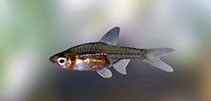 Horadandia atukorali
Photo de Ramani Shirantha
Images | Images Google
Photo de Ramani Shirantha
Classification / Noms Noms communs | Synonymes | Catalog of Fishes(Genre, Espèce) | ITIS | CoL | WoRMS | Cloffa
> Cypriniformes (Carps) > Danionidae (Danios) > Rasborinae
Eponymy: Mr Vicky ‘Athu’ Atukorale (fl. 1965) was a Sri Lankan naturalist who first drew Deraniyagala’s attention to this fish. He wrote: Notes on Birds Collected at Kumana Sanctuary on 17th May, 1949 for the Dehiwela Zoo (1949). An amphibian is named after him. (Ref. 128868), visit book page.
Eponymy: Mr Vicky ‘Athu’ Atukorale (fl. 1965) was a Sri Lankan naturalist who first drew Deraniyagala’s attention to this fish. He wrote: Notes on Birds Collected at Kumana Sanctuary on 17th May, 1949 for the Dehiwela Zoo (1949). An amphibian is named after him. (Ref. 128868), visit book page.
Environnement : milieu / zone climatique / profondeur / gamme de distribution Écologie
; eau douce; saumâtre pélagique; pH range: 6.0 - 6.5; dH range: ? - 12. Tropical; 24°C - 26°C (Ref. 2059)
Distribution Territoires | Zones FAO | Écosystèmes | Occurrences | Carte par point | Introductions | Faunafri
Asia: Sri Lanka.
Taille / Poids / Âge
Maturité: Lm ? range ? - ? cm
Max length : 3.0 cm TL mâle / non sexé; (Ref. 6028); common length : 1.5 cm TL mâle / non sexé; (Ref. 6028)
Max length : 3.0 cm TL mâle / non sexé; (Ref. 6028); common length : 1.5 cm TL mâle / non sexé; (Ref. 6028)
Description synthétique Clés d'identification | Morphologie | Morphométrie
Rayons mous dorsaux (Total) : 10; Rayons mous anaux: 8; Vertèbres: 24 - 26. Horadandia atukorali differs from its congener H. brittani by having a more slender body (depth 24.6-29.8 % SL, vs. 27.7-31.9); dorsal profile of head slightly concave (vs. straight) behind level of eye; a greater eye diameter (37-41 % HL, vs. 27-37); origin of dorsal fin slightly posterior to (vs. distinctly behind) origin of pelvic fin; pelvic fin reaching beyond anal-fin origin (vs. just reaching anal-fin origin); origin of dorsal fin located halfway between snout tip and hypural notch (vs. closer to hypural notch); one (vs. none) lateral process on each side of kinethmoid; anterior end of kinethmoid narrow (vs. wide); palatine process of maxilla acute (vs. obtuse); and supraorbital length ~50 % of orbit diameter (vs. ~44 %) (Ref. 94541).
Body shape (shape guide): fusiform / normal.
Body shape (shape guide): fusiform / normal.
Inhabits still or slow-moving water, frequenting swamps, rice fields and similar still waters. Found in weedy ponds of coastal plains (Ref. 4832). Common in less saline mangrove swamps and in less polluted canals. Often encountered together with Aplocheilus. Feeds on insects.
Cycle de vie et comportement reproducteur Maturité | Reproduction | Frai | Œufs | Fécondité | Larves
Référence principale
Téléchargez vos références | Références | Coordinateur | Collaborateurs
Pethiyagoda, R., 1991. Freshwater fishes of Sri Lanka. The Wildlife Heritage Trust of Sri Lanka, Colombo. 362 p. (Ref. 6028)
Statut dans la liste rouge de l'IUCN (Ref. 130435: Version 2025-2)
Vulnérable (VU) (B1ab(iii)+2ab(iii)); Date assessed: 07 August 2019
CITES
Not Evaluated
Menace pour l'homme
Harmless
Utilisations par l'homme
Pêcheries: sans intérêt
FAO - Publication: search | FishSource |
Plus d'informations
Écologie trophique
Aliments (proies)
Composition du régime alimentaire
Consommation alimentaire
Rations alimentaires
Prédateurs
Aliments (proies)
Composition du régime alimentaire
Consommation alimentaire
Rations alimentaires
Prédateurs
Dynamique des populations
Paramètres de croissance
Âges / tailles maximales
Longueur-poids rel.
Rel. longueur-longueur.
Fréquences de longueurs
Conversion de masse
Recrutement
Abondance
Paramètres de croissance
Âges / tailles maximales
Longueur-poids rel.
Rel. longueur-longueur.
Fréquences de longueurs
Conversion de masse
Recrutement
Abondance
Cycle de vie
Reproduction
Maturité
Maturité/épines rel.
Fécondité
Frai
Agrégats de frai
Œufs
Développement de l'œuf
Larves
Dynamique des populations larvaires
Reproduction
Maturité
Maturité/épines rel.
Fécondité
Frai
Agrégats de frai
Œufs
Développement de l'œuf
Larves
Dynamique des populations larvaires
Anatomie
Surface branchiale
Cerveau
Otolithe
Surface branchiale
Cerveau
Otolithe
Physiologie
Composition corporelle
Nutriments
Consommation d'oxygène
Type de natation
Vitesse de nage
Pigments visuels
Son de poisson
Maladies et parasites
Toxicité (CL50)
Composition corporelle
Nutriments
Consommation d'oxygène
Type de natation
Vitesse de nage
Pigments visuels
Son de poisson
Maladies et parasites
Toxicité (CL50)
Génétique
génôme
Génétique
Hétérozygotie
Héritabilité
Diversité génétique
génôme
Génétique
Hétérozygotie
Héritabilité
Diversité génétique
Liées à l'homme
Systèmes d'aquaculture
Profils d'aquaculture
Souches
Cas de ciguatera
Timbres, pièces de monnaie, divers
Systèmes d'aquaculture
Profils d'aquaculture
Souches
Cas de ciguatera
Timbres, pièces de monnaie, divers
Outils
Quiz bio | E-book | Guide de terrain | Générateur de fréquences de longueur | Outil de dynamique de population | Carte par point |
Capture-MSY |
Articles particuliers
Télécharger en XML
Sources Internet
AFORO (otoliths) | Aquatic Commons | BHL | Cloffa | Websites from users | FishWatcher | CISTI | Catalog of Fishes: Genre, Espèce | DiscoverLife | ECOTOX | FAO - Publication: search | Faunafri | Fishipedia | Fishtrace | GloBI | Google Books | Google Scholar | Google | IGFA World Record | OneZoom | Open Tree of Life | Otolith Atlas of Taiwan Fishes | PubMed | Reef Life Survey | Socotra Atlas | TreeBase | Arbre de Vie | Wikipedia: aller à, chercher | World Records Freshwater Fishing | Zoobank | Zoological Record
Estimations basées sur des modèles
Indice de diversité phylogénétique (Réf. 82804): PD50 = 0.7500 [Uniqueness, from 0.5 = low to 2.0 = high].
Bayesian length-weight: a=0.00891 (0.00390 - 0.02036), b=3.02 (2.82 - 3.22), in cm total length, based on LWR estimates for this (Sub)family-body shape (Ref. 93245).
Niveau trophique (Réf. 69278): 3.2 ±0.40 se; based on food items.
Résilience (Réf. 120179): Haut, temps minimum de doublement de population inférieur à 15 mois (Preliminary K or Fecundity.).