This website uses cookies to enhance your browsing experience and ensure the functionality of our site. For more detailed information about the types of cookies we use and how we protect your privacy, please visit our Privacy Information page.
×
Cookie Settings
This website uses different types of cookies to enhance your experience. Please select your preferences below:
Issue This species was not reported since 1902 in the Mediterranean sea. An award will be granted by the CIESM to any documented, reliable / verifiable evidence (published paper / Ph.D thesis / photo) reporting the species after that year (Ref. 116564).
Milieu: milieu / Klimaatzone / Diepte / verspreidingsgebied Ecologie
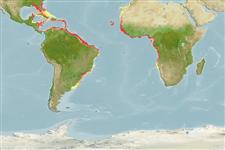
marien; zoet water; brak water demersaal; amfidroom (Ref. 51243); diepte 10 - 88 m (Ref. 114953). Subtropical; 16°C - 30°C
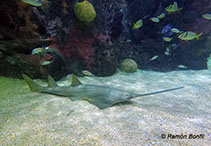
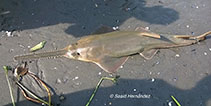
Diagnosis: Pristis pectinata is easily separable from Pristis perotteti by the following characters: its first dorsal fin originates about over the origin of its pelvic fins vs. considerably in front of origin of pelvic fins in P. perotteti; its caudal fin is much shorter, but broader relative to the length of the fin, with lower lobe only faintly indicated; its rostral teeth are numerous, 23 or more on each side vs. not more than 20 in P. perotteti; its saw is relatively somewhat shorter; its second dorsal fin has the posterior margin much less deeply concave; and its pectoral fins are smaller (Ref. 6902, 81624). Pristis pectinata agrees with Pristis pristis in the shape of its caudal fin and in the position of the first dorsal fin relative to the pelvic fins, but it can be separated from P. pristis by its more numerous rostral teeth, 23 or more on each side vs. less than 20 (Ref. 6902, 81624).
Body shape (shape guide): elongated; Cross section: compressed.
Inshore and intertidal species, but may cross deep water to reach offshore islands; also ascends rivers and can tolerate fresh water (Ref. 9859). Commonly seen in bays, lagoons, estuaries, and river mouths. Also found in rivers and lakes (Ref. 12951). Feeds on fishes and shellfishes (Ref. 58784). Ovoviviparous (Ref. 50449). Gravid females reportedly carry as many as 20 embryos, which require a year of gestation (Ref. 27549). Uses its saw to stir the bottom when feeding on bottom invertebrates and to kill pelagic fishes (Ref. 9859). Utilized as a food fish; oil is used to make medicine, soap and in leather tanning (Ref. 6871). Adults stuffed for decoration (Ref. 6871). Reported to be aggressive towards sharks when kept in tanks (Ref. 12951). This species is currently protected in several areas as populations are under severe threat (Ref. 81624).
Ovoviviparous, with gravid females containing about 15-20 embryos (Ref. 3163). Embryos feed solely on yolk (Ref. 50449). Gives birth in shallow bays and estuaries (Ref. 12951). Size at birth 61 cm (Ref. 12951).
Gewenste temperatuur (Ref. 123201): 22.9 - 28, mean 27.1 °C (based on 776 cells).
Fylogenetische diversiteitsindex (Ref. 82804): PD50 = 0.5234 [Uniqueness, from 0.5 = low to 2.0 = high].
Bayesian length-weight: a=0.00407 (0.00162 - 0.01023), b=3.02 (2.80 - 3.24), in cm total length, based on LWR estimates for this species & (Sub)family-body (Ref. 93245).
Trofisch niveau (Ref. 69278): 4.5 ±0.80 se; based on food items.
Generation time: 32.3 ( na - na) years. Estimated as median ln(3)/K based on 2 growth studies.
Weerstandsvermogen (Ref. 120179): laag, minimale populatieverdubbelingstijd 4,5-14 jaar (Fec=15).
Kwetsbaarheid van de visserij (Ref. 59153): Very high vulnerability (84 of 100). 🛈