Teleostei (teleosts) >
Carangiformes (Jacks) >
Carangidae (Jacks and pompanos) > Caranginae
Etymology: Selene: Greek, selene = moon (Ref. 45335).
Eponymy: Dr Patrick Browne (1720–1790) was an Irish physician, botanist and historian. [...] (Ref. 128868), visit book page.
More on author: Cuvier.
Issue
Author may probably be Cuvier 1816.
Environment: milieu / climate zone / depth range / distribution range
Ecology
Marine; demersal. Tropical
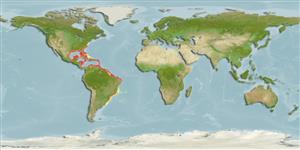
Western Atlantic Ocean.
Size / Weight / Age
Maturity: Lm ? range ? - ? cm
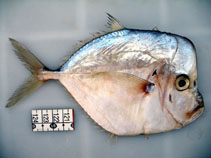
Max length : 34.1 cm TL male/unsexed; (Ref. 122735); common length : 20.0 cm TL male/unsexed; (Ref. 5217); max. published weight: 119.30 g (Ref. 118626)
Adults occur over continental shelves (Ref. 5217). No real fishery (Ref. 51310). Edibility not known (Ref. 51310).
Life cycle and mating behavior
Maturity | Reproduction | Spawning | Eggs | Fecundity | Larvae
Smith-Vaniz, W.F., 2003. Carangidae. Jacks and scads (bumpers, pompanos, leatherjacks, amberjacks, pilotfishes, rudderfishes). p. 1426-1468. In K.E. Carpenter (ed.) FAO species identification guide for fishery purposes. The living marine resources of the Western Central Atlantic. Vol. 3: Bony fishes part 2 (Opistognathidae to Molidae), sea turtles and marine mammals. (Ref. 51310)
IUCN Red List Status (Ref. 130435: Version 2025-2)
Threat to humans
Harmless
Human uses
Fisheries: subsistence fisheries
Tools
Special reports
Download XML
Internet sources