This website uses cookies to enhance your browsing experience and ensure the functionality of our site. For more detailed information about the types of cookies we use and how we protect your privacy, please visit our Privacy Information page.
×
Cookie Settings
This website uses different types of cookies to enhance your experience. Please select your preferences below:
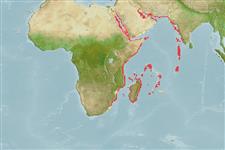
Western Indian Ocean: Red Sea, along East African coast to southern Kwazulu-Natal, Mauritius, Seychelles, Comoros and St. Brandon Shoals; not recorded in Gulf of Oman.
Storlek / Vikt / Ålder
Könsmognad: Lm? range ? - ? cm Max length : 2.5 cm SL hane/ej könsbestämd; (Ref. 88983)
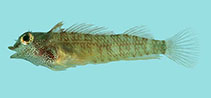
Taggstrålar i ryggfenan (totalt) : 14 - 16; Mjukstrålar i ryggfenan (totalt) : 9 - 10; Taggstrålar i analfenan: 1; Mjukstrålar i analfenan: 17 - 18; Ryggkotor: 34 - 36. This species is distinguished by the following characters: low first dorsal fin, brown and green radii around the eye, males with yellow body and melanophores on head to base of pectoral fins, females with yellow-green body, brown stripe on nose and orange bar below eye; further, D III + XI-XIII + 9-10 (usually III + XII + 10); A I, 17-18 (usually 18 rays); pectoral fin 15: usually 3, 5, 7; lateral line with pored scales12-14, notched scales 20-23 (usually 22); longitudinal scale series 31; dentary pores 3 + 1 + 3 ; head 3.2-3.8 in SL; eye 2.9-3.7 in HL; nape partially scaled, abdomen no scales, single row of scales at base of caudal fin; supratemporal sensory canal crescent-shaped; supraorbital cirrus small and pointed; first dorsal fin about equal in height to second in males, lower in females (Ref. 57774, 88983). Body shape (shape guide): fusiform / normal.
Adults occur in shallow, sheltered waters, on hard corals; found on the upper part of coral reefs, usually along the reef margin in depths of about 1 m, often on corals covered by low algae. Also found in bays or sheltered lagoons (Ref. 88983). Eggs are hemispherical and covered with numerous sticky threads that anchor them in the algae on the nesting sites (Ref. 240). Larvae are planktonic which occur primarily in shallow, nearshore waters (Ref. 94114).
Holleman, W. and S.V. Bogorodsky, 2012. A review of the blennioid fish family Tripterygiidae (Perciformes) in the Red Sea, with description of Enneapterygius qirmiz, and reinstatement of Enneapterygius altipinnis Clark, 1980. Zootaxa 3152:36-60. (Ref. 88983)
Status på IUCN:s rödlista (Ref. 130435: Version 2025-2)
Önskad temperatur (Ref. 123201): 24.8 - 29.1, mean 27.5 °C (based on 669 cells).
Index för fylogenetisk mångfald (Ref. 82804): PD50 = 0.5000 [Uniqueness, from 0.5 = low to 2.0 = high].
Bayesian length-weight: a=0.00794 (0.00346 - 0.01822), b=3.08 (2.88 - 3.28), in cm total length, based on LWR estimates for this (Sub)family-body shape (Ref. 93245).
Trofisk nivå (Ref. 69278): 3.1 ±0.3 se; based on size and trophs of closest relatives
Resiliens (Ref. 120179): Hög, lägsta populationsfördubblingstid mindre än 15 månader (Preliminary K or Fecundity.).
Sårbarhet i fisket (Ref. 59153): Low vulnerability (10 of 100). 🛈