-

- Acerca de esta página
- Idiomas
- Opiniones de los usuarios
- Citación
- Carga
- Especies relacionadas
-



Nematalosa erebi (Günther, 1868)
Australian river gizzard shad
Sube tu fotos y Vídeos
Imágenes | Google image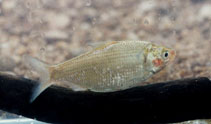 Nematalosa erebi
Juvenile Foto de Aland, G.
Imágenes | Google image
Juvenile Foto de Aland, G.
Clasificación / Nombres Nombres comunes | Sinónimos | Catalog of Fishes(Género, Especie) | ITIS | CoL | WoRMS | Cloffa
> Clupeiformes (Herrings) > Dorosomatidae (Gizzard shads and sardinellas)
Etymology: Nematalosa: Greek, nema, -atos = filament + Latin, alausa = a fish cited by Ausonius and Latin, halec = pickle, dealing with the Greek word hals = salt; it is also the old Saxon name for shad = "alli" ; 1591 (Ref. 45335).
Eponymy: ‘HMS Erebus’ was a British warship used in surveying and exploring and from which the holotype was collected. (Ref. 128868), visit book page.
More on author: Günther.
Etymology: Nematalosa: Greek, nema, -atos = filament + Latin, alausa = a fish cited by Ausonius and Latin, halec = pickle, dealing with the Greek word hals = salt; it is also the old Saxon name for shad = "alli" ; 1591 (Ref. 45335).
Eponymy: ‘HMS Erebus’ was a British warship used in surveying and exploring and from which the holotype was collected. (Ref. 128868), visit book page.
More on author: Günther.
Entorno: milieu / zona climática / rango de profundidad / gama de distribución Ecología
; agua dulce; salobre pelágico; potamodromo (Ref. 51243); rango de profundidad 0 - 3 m (Ref. 6390). Subtropical; 15°C - 25°C (Ref. 2060); 11°S - 37°S
Distribución Territorios | Áreas FAO | Ecosistemas | Ocurrencias, apariciones | Mapa de puntos | Introducciones | Faunafri
Oceania and Asia: Rivers of Australia and southwestern Papua New Guinea (from Fortescue River near Dampier Archipelago in Western Australia, eastward in rivers through the Northern Territory and Queensland south to the Murray-Darling system; also the Finke River, affluent to Lake Eyre; Bensbach River (Ref. 6993) and Digoel River in New Guinea.
Longitud en la primera madurez / Tamaño / Peso / Edad
Descripción breve Claves de identificación | Morfología | Morfometría
Espinas dorsales (total) : 0; Espinas anales: 0; Radios blandos anales: 17 - 26. Belly with 14 to 18 (usually 16 to 17) - 11 to 14 (usually 12 or 13), total 25 to 31 (usually 20 to 30) scutes. Anterior arm of pre-operculum with fleshy triangular area above, not covered by third infra-orbital bone (see N. come). Edge of lower jaw strongly flared outward. Pectoral axillary scale rudimentary or absent. Hind edge of scales not toothed. A dark spot behind gill opening.
Body shape (shape guide): fusiform / normal; Cross section: compressed.
Body shape (shape guide): fusiform / normal; Cross section: compressed.
Occur often far up rivers, but also in estuaries and in Lakes Alexandrina and Albert near mouth of a river (Ref. 188). Most commonly inhabit streams coursing through relatively dry eucalyptus-scrub or desert areas, preferring sluggish or quiet waters (Ref. 5259, 44894). Also found in saline lakes (slightly less salty than sea water). Tolerant of water temperatures between 9° and 38°C and pH 4.8-8.6. Although these fish have a wide tolerance of temperature and pH, they are susceptible to oxygen depletion and are usually the first to perish when ephemeral habitats begin to dry up. Common length is 15-20 cm (Ref. 44894). Frequently noted in large shoals that feed on benthic algae; also feed on insects and small crustaceans. Spawning may occur repeatedly in the north with a peak during the wet season; probably annual in the south (Ref. 5259, 44894).
Ciclo vital y comportamiento de apareamiento Madurez | Reproducción | Puesta | Huevos | Fecundidad | Larva
In more northerly part of its range, spawning may take place several times over the year but is probably annual in southern localities.
Referencia principal
Suba sus referencias | Referencias | Coordinador | Colaboradores
Whitehead, P.J.P., 1985. FAO Species Catalogue. Vol. 7. Clupeoid fishes of the world (suborder Clupeoidei). An annotated and illustrated catalogue of the herrings, sardines, pilchards, sprats, shads, anchovies and wolf-herrings. FAO Fish. Synop. 125(7/1):1-303. Rome: FAO. (Ref. 188)
Situación en la Lista Roja de la UICN (Ref. 130435: Version 2025-2)
Least Concern (LC) ; Date assessed: 14 February 2019
CITES
Not Evaluated
Amenaza para el ser humano
Harmless (Ref. 6390)
Usos humanos
Pesquerías: comercial; carnada: usually
FAO - Publication: search | FishSource |
Más información
Ecología Trófica
Alimentos (presas)
Composición de la dieta
consumo de alimento
Raciones de comida
Despredadores
Alimentos (presas)
Composición de la dieta
consumo de alimento
Raciones de comida
Despredadores
Dinámica de la población
Coeficiente del crecimiento para
Edades / tallas máximas
Longitud-peso rel.
Longitud-longitud rel.
Longitud-frecuencias
Conversión de masas
Reclutamiento
Abundancia
Coeficiente del crecimiento para
Edades / tallas máximas
Longitud-peso rel.
Longitud-longitud rel.
Longitud-frecuencias
Conversión de masas
Reclutamiento
Abundancia
Ciclo de vida
Reproducción
Madurez
Madurez/Gills rel.
Fecundidad
Puesta
Agregaciones de desove
Huevos
Desarrollo de los huevos
Larva
Dinámica larvaria
Reproducción
Madurez
Madurez/Gills rel.
Fecundidad
Puesta
Agregaciones de desove
Huevos
Desarrollo de los huevos
Larva
Dinámica larvaria
Distribución
Territorios
Áreas FAO
Ecosistemas
Ocurrencias, apariciones
Introducciones
BRUVS - Vídeos
Territorios
Áreas FAO
Ecosistemas
Ocurrencias, apariciones
Introducciones
BRUVS - Vídeos
Anatomía
Superficie branquial
Cerebro
Otolito
Superficie branquial
Cerebro
Otolito
Fisiología
Composición corporal
Nutrientes
Consumo del oxígeno
Tipo de natación
Velocidad de natación
Pigmentos visuales
Sonido de peces
Enfermedades y parásitos
Toxicidad (CL50)
Composición corporal
Nutrientes
Consumo del oxígeno
Tipo de natación
Velocidad de natación
Pigmentos visuales
Sonido de peces
Enfermedades y parásitos
Toxicidad (CL50)
Genética
Genoma
Genética
Heterocigosidad
heritabilidad
Diversidad genética
Genoma
Genética
Heterocigosidad
heritabilidad
Diversidad genética
Relacionados con el ser humano
Sistemas de acuicultura
Perfiles de acuicultura
Razas
Ciguatera cases
Sellos, monedas, varios
Sistemas de acuicultura
Perfiles de acuicultura
Razas
Ciguatera cases
Sellos, monedas, varios
Herramientas
Libro electrónico | Guía de campo | Claves de identificación | Asistente para frecuencias de tallas | Herramienta de ciclo de vida | Mapa de puntos |
Catch-MSY |
Informes especiales
Comprobar el mantenimiento del acuario | Buscar fichas sobre especies | Consulte las hojas informativas sobre acuicultura
Descargar XML
Fuentes de Internet
AFORO (otoliths) | Aquatic Commons | BHL | Cloffa | Websites from users | Check FishWatcher | CISTI | Catalog of Fishes: Género, Especie | DiscoverLife | ECOTOX | FAO - Publication: search | Faunafri | Fishipedia | Fishtrace | GloBI | Google Books | Google Scholar | Google | IGFA World Record | OneZoom | Open Tree of Life | Otolith Atlas of Taiwan Fishes | PubMed | Reef Life Survey | Socotra Atlas | TreeBase | Árbol de la vida | Wikipedia: Go, búsqueda | World Records Freshwater Fishing | Expediente Zoológico
Estimaciones basadas en modelos
Índice de diversidad filogenética (Referencia 82804): PD50 = 0.5005 [Uniqueness, from 0.5 = low to 2.0 = high].
Bayesian length-weight: a=0.00708 (0.00403 - 0.01245), b=2.98 (2.83 - 3.13), in cm total length, based on LWR estimates for this species & (Sub)family-body (Ref. 93245).
Nivel trófico (Referencia 69278): 2.8 ±0.29 se; based on food items.
Generation time: 4.1 ( na - na) years. Estimated as median ln(3)/K based on 2 growth studies.
Resiliencia (Referencia 120179): Medio, población duplicada en un tiempo mínimo de 1.4-4.4 años (tm=2; tmax=10; Fec=33,000).