-

- Über diese Seite
- Sprachen
- Rückmeldungen der Nutzer
- Zitat
- Uploads
-
Verwandte Arten
- Arten in
Opisthonema - Arten in
Dorosomatidae - - Klassifizierung -
- Dorosomatidae
- Clupeiformes
- Teleostei
- Chordata
- Animalia
- Arten in
-



Opisthonema oglinum (Lesueur, 1818)
Atlantic thread herring
Beobachtung melden im Fish Watcher
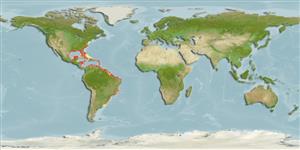
| Native range | All suitable habitat | Point map | Year 2050 |
|
| This map was computer-generated and has not yet been reviewed. |
| Opisthonema oglinum AquaMaps Data sources: GBIF OBIS |
Hochladen Photos und videos
Bilder | Laute | Google Bild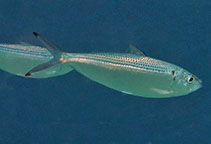 Opisthonema oglinum
Photo von Charteris, M.
Bilder | Laute | Google Bild
Photo von Charteris, M.
Klassifizierung / Names Namen | Synonyme | Catalog of Fishes(Gattung, Arten) | ITIS | CoL | WoRMS | Cloffa
> Clupeiformes (Herrings) > Dorosomatidae (Gizzard shads and sardinellas)
Etymology: Opisthonema: Greek, opisthe = behind + Greek,nema = filament (Ref. 45335).
More on author: Lesueur.
Etymology: Opisthonema: Greek, opisthe = behind + Greek,nema = filament (Ref. 45335).
More on author: Lesueur.
Umwelt: Milieu / Klimazone / Tiefenbereich / Verbreitungsgebiet Ökologie
seewasser riff-verbunden; tiefenbereich 1 - 50 m (Ref. 93252), usually 5 - ? m (Ref. 9710). Tropical; 41°N - 37°S, 98°W - 33°W (Ref. 188)
Verbreitung Territorien | FAO Gebiete | Ökosysteme | Vorkommen | Punkt Karte | Einführungen | Faunafri
Western Atlantic: Gulf of Maine (USA), Bermuda, throughout the Gulf of Mexico, Caribbean and West Indies southward to Santa Catarina, Brazil. Also found in Uruguay (Ref. 54736) and Argentina (Ref. 2806).
Länge bei der ersten Reifung / Größe / Gewicht / Alter
Geschlechtsreife: Lm 11.5, range 11 - ? cm
Max length : 38.0 cm TL Männchen/unbestimmt; (Ref. 5217); common length : 20.0 cm SL Männchen/unbestimmt; (Ref. 188); max. veröff. Gewicht: 375.00 g (Ref. 5217)
Max length : 38.0 cm TL Männchen/unbestimmt; (Ref. 5217); common length : 20.0 cm SL Männchen/unbestimmt; (Ref. 188); max. veröff. Gewicht: 375.00 g (Ref. 5217)
Kurzbeschreibung Bestimmungsschlüssel | Morphologie | Morphometrie
Rückenflossenstacheln (insgesamt) : 0; Rückenflossenweichstrahlen (insgesamt) : 19 - 21; Afterflossenstacheln: 0; Afterflossenweichstrahlen: 23 - 24. The filamentous last dorsal fin ray distinguishes this species from all other western Atlantic clupeoids except Dorosoma, which has an inferior mouth (Ref. 188). Otherwise, superficially resembles species of Sardinella (but i 8 pelvic fin rays in western Atlantic species, cf. i 7 in Opisthonema) and Harengula (but small toothed hypomaxilla in upper jaw) (Ref. 188). Lower gill rakers stable at 28 to 46 after 8 cm (Ref. 188). Silvery, with a bluish or greenish back, 6-7 lengthwise dark streaks on side. Dark spot above opercle, larger dark spot behind opercle, usually with a row of dark spots behind it. Lower profile deeply curved. Head pointed (Ref. 7251).
Body shape (shape guide): fusiform / normal; Cross section: compressed.
Body shape (shape guide): fusiform / normal; Cross section: compressed.
Inhabit harbors and shallow coastal areas (Ref. 9710). Pelagic (Ref. 27549). Form schools (but solitary individuals reported), probably not entering water of low salinity. Feed by filtering plankton (copepods), but also take small fishes, crabs and shrimps. Marketed fresh, frozen and salted; also used in the fishmeal industry. Occur in freshwater in St. Johns River, Florida (Ref. 26938).
Lebenszyklus und Paarungsverhalten Geschlechtsreife | Fortpflanzung | Ablaichen | Eier | Fruchtbarkeit | Larven
Possibly breeds in March-July off Venezuela.
Hauptreferenz
Laden Sie Ihre Referenzen hoch | Referenzen | Koordinator | Partner
Whitehead, P.J.P., 1985. FAO Species Catalogue. Vol. 7. Clupeoid fishes of the world (suborder Clupeoidei). An annotated and illustrated catalogue of the herrings, sardines, pilchards, sprats, shads, anchovies and wolf-herrings. FAO Fish. Synop. 125(7/1):1-303. Rome: FAO. (Ref. 188)
IUCN Rote Liste Status (Ref. 130435: Version 2025-2)
nicht bedroht (LC) ; Date assessed: 23 August 2012
CITES
Not Evaluated
Bedrohung für Menschen
Reports of ciguatera poisoning (Ref. 30911)
Nutzung durch Menschen
Fischereien: kommerziell; Köder: usually
FAO - Fischereien: landungen; Publication: search | FishSource | Das Meer um uns herum
Mehr Information
Trophische Ökologie
Lebensmittel (Beutetiere)
Nahrungszusammensetzung
Nahrungsaufnahme
Lebensmittelrationen
Räuber
Lebensmittel (Beutetiere)
Nahrungszusammensetzung
Nahrungsaufnahme
Lebensmittelrationen
Räuber
Populationsdynamik
Wachstumsparameter
Max. Alter/Größen
Länge-Gewicht-Rel.
Länge-Länge-Verhältnis.
Längenhäufigkeiten
Massenkonvertierung
Rekrutierung
Dichte
Wachstumsparameter
Max. Alter/Größen
Länge-Gewicht-Rel.
Länge-Länge-Verhältnis.
Längenhäufigkeiten
Massenkonvertierung
Rekrutierung
Dichte
Lebenszyklus
Fortpflanzung
Geschlechtsreife
Reifung/Kiemen rel.
Fruchtbarkeit
Ablaichen
Laichaggregationen
Eier
Eientwicklung
Larven
Larven Pop.Dyn.
Fortpflanzung
Geschlechtsreife
Reifung/Kiemen rel.
Fruchtbarkeit
Ablaichen
Laichaggregationen
Eier
Eientwicklung
Larven
Larven Pop.Dyn.
Anatomie
Kiemenoberfläche
Gehirn
Otolith
Kiemenoberfläche
Gehirn
Otolith
Physiologie
Körperliche Zusammensetzung
Nährstoffe
Sauerstoffverbrauch
Schwimmart
Schwimmgeschwindigkeit
Visuelle Pigmente
Fischgeräusche
Krankheiten und Parasiten
Toxizität (LC50s)
Körperliche Zusammensetzung
Nährstoffe
Sauerstoffverbrauch
Schwimmart
Schwimmgeschwindigkeit
Visuelle Pigmente
Fischgeräusche
Krankheiten und Parasiten
Toxizität (LC50s)
Menschenbezogen
Aquakultur-Systeme
Aquakultur Profile
Zuchtlinien
Ciguatera-Fälle
Briefmarken, Münzen, Verschiedenes.
Aquakultur-Systeme
Aquakultur Profile
Zuchtlinien
Ciguatera-Fälle
Briefmarken, Münzen, Verschiedenes.
Tools
E-Book | Feldführer | Bestimmungsschlüssel | Längenhäufigkeits Tool | Lebensdaten Tool | Punkt Karte |
Catch-MSY |
Zusatzinformationen
Download XML
Zusammenfassung | Punktdaten | Namen | Photos
Internet Quellen
AFORO (otoliths) | Aquatic Commons | BHL | Cloffa | Websites from users | FishWatcher Einträge suchen | CISTI | Catalog of Fishes: Gattung, Arten | DiscoverLife | ECOTOX | FAO - Fischereien: landungen; Publication: search | Faunafri | Fishipedia | Fishtrace | GloBI | GoMexSI (interaction data) | Google Books | Google Scholar | Google | IGFA World Record | Nationale Datenbanken | OceanAdapt | OneZoom | Open Tree of Life | Otolith Atlas of Taiwan Fishes | PubMed | Reef Life Survey | Socotra Atlas | TreeBase | Tree of Life | Wikipedia: Gehe zu, Suchen | World Records Freshwater Fishing | Zoologischer Rekord
Schätzungen auf der Grundlage von Modellen
Bevorzugte Temperatur (Ref. 123201): 22.7 - 28, mean 25.5 °C (based on 480 cells).
Phylogenetischer Diversitätsindex (Ref. 82804): PD50 = 0.5312 [Uniqueness, from 0.5 = low to 2.0 = high].
Bayesian length-weight: a=0.00871 (0.00776 - 0.00977), b=3.06 (3.03 - 3.09), in cm total length, based on LWR estimates for this species (Ref. 93245).
Trophische Ebene (Ref. 69278): 4.5 ±0.0 se; based on diet studies.
Widerstandsfähigkeit (Ref. 120179): mittel, Verdopplung der Population dauert 1,4 - 4,4 Jahre. (tm=1-3; tmax=8).
Prior r = 1.18, 95% CL = 0.78 - 1.77, Based on 4 data-limited stock assessments.
Nährstoffe (Ref. 124155): Calcium = 59.1 [28.2, 107.6] mg/100g; Iron = 0.805 [0.394, 1.446] mg/100g; Protein = 19.9 [18.5, 21.2] %; Omega3 = 0.242 [0.132, 0.455] g/100g; Selenium = 34.8 [18.7, 79.4] μg/100g; VitaminA = 95.7 [28.7, 303.9] μg/100g; Zinc = 0.856 [0.565, 1.280] mg/100g (wet weight);