-

- Aengenai halaman ini
- bahasa
- Umpan balik pengguna
- Kutipan
- Unggahan
- spesis berkaitan
-



Oreochromis korogwe (Lowe, 1955)
Korogwe tilapia
muatnaik fotos/gambar dan video
Gambar | imej Google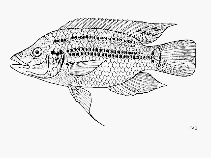 Oreochromis korogwe
foto/gambar oleh FAO
Gambar | imej Google
foto/gambar oleh FAO
klasifikasi / Nama Nama-nama umum | Sinonim (persamaan) | Catalog of Fishes(Marga, Jenis) | ITIS | CoL | WoRMS | Cloffa
> Cichliformes (Cichlids, convict blennies) > Cichlidae (Cichlids) > Pseudocrenilabrinae
Etymology: Oreochromis: Latin, aurum = gold + Greek, chromis = a fish, perhaps a perch (Ref. 45335).
Etymology: Oreochromis: Latin, aurum = gold + Greek, chromis = a fish, perhaps a perch (Ref. 45335).
Lingkungan: lingkungan / zona iklim / kisaran kedalaman / jangkauan distribusi Ekologi
; air tawar; payau bentopelagis. Tropical
Penyebaran Wilayah | Daerah-daerah FAO | Ekosistem | Kemunculan | peta titik | Introduksi | Faunafri
Africa: Lower part of Pangani River and neighbouring Zigi River in Tazania and Kenya (Ref. 2, 52331, 118630). Introduced in Mlingano dam, south of Pangani River, and probably other dams in coastal zone of Tanzania (Ref. 2, 54836). Also in Lake Rutamba, Lake Nambawala and Lake Mitupa near Lindi in southeast Tanzania (Ref. 118630, 118638).
Ukuran / Berat / umur
deskripsi pendek Kunci identifiaksi (pengenalan) | Morfologi | Morfometrik
Duri punggung (Keseluruhan (total)) : 16 - 18; duri punggung lunak (Keseluruhan (total)) : 9 - 11; Duri dubur: 3 - 4; Sirip dubur lunak: 9 - 11; vertebrata, bertulang belakang: 29 - 30. Diagnosis: A small bodied tilapia (Ref. 118638). About 50% of individuals have IV anal spines, the modal numbers of vertebrae (29), dorsal rays (27) and gill-rakers (15) are low, and the jaws of breeding males are enlarged (Ref. 2). Females, subadult males and juveniles with a silver/grey flank colour, light ventral colour, and characteristic melanin pattern of 7-9 broken vertical stripes on the dorsal side giving a spotted appearance; males darker, with a series of white spots/bars on the flanks; ripe males have red margins on dorsal and caudal, with a reddish tinge to the pectoral fins; males from southern populations showed a bluish sheen and less contrasting male colouration (Ref. 118638). In breeding males the throat and chest are black and broad dark vertical bars are conspicuous on the lower half of the body (Ref. 2, 4967, 54096).
Body shape (shape guide): short and / or deep; Cross section: compressed.
Body shape (shape guide): short and / or deep; Cross section: compressed.
A maternal mouthbrooder (Ref. 118638). There is evidence of hybridization with native Oreochromis jipe in northern Tanzania, and non-native O. niloticus in southern Tanzania (Ref. 118638). Of only minor importance to artisanal fisheries (Ref. 118638). Maximum standard length of 18 cm (Ref. 4967) is not confirmed (Ref. 2, G.F. Turner pers. comm.); maximum total length reported as 20.8 cm (Ref. 2, 118638).
Siklus hidup dan perilaku kawin Kematangan | Reproduksi, perkembang biakan | Pemijahan | telur-telur | Fekunditas | Larva
A maternal mouthbrooder (Ref. 118638).
rujukan utama
Unggah referensi Anda | Acuan | Koordinator : Kullander, Sven O. | mitra
Trewavas, E., 1983. Tilapiine fishes of the genera Sarotherodon, Oreochromis and Danakilia. British Mus. Nat. Hist., London, UK. 583 p. (Ref. 2)
Status IUCN Red List (Ref. 130435: Version 2025-2)
kurang bimbang (LC) ; Date assessed: 31 January 2006
CITES
Not Evaluated
ancaman kepada manusia
Harmless
penggunaan manusia
Budidaya air: kemungkinan penggunaan kedepan
FAO - Publication: search | FishSource |
informasi lanjut
Dinamika populasi
Parameter pertumbuhan
Maks. usia / ukuran
Panjang-berat rel.
Panjang-panjang rel.
ukuran frekuensi
Konversi massa
pemulihan
Kelimpahan
Parameter pertumbuhan
Maks. usia / ukuran
Panjang-berat rel.
Panjang-panjang rel.
ukuran frekuensi
Konversi massa
pemulihan
Kelimpahan
Siklus hidup
Reproduksi, perkembang biakan
Kematangan
Kedewasaan / insang rel.
Fekunditas
Pemijahan
Agregasi pemijahan
telur-telur
pekembangan telor
Larva
Dinamika larva
Reproduksi, perkembang biakan
Kematangan
Kedewasaan / insang rel.
Fekunditas
Pemijahan
Agregasi pemijahan
telur-telur
pekembangan telor
Larva
Dinamika larva
Anatomi
Area insang
Otak
Otolith
Area insang
Otak
Otolith
Fisiologi
Komposisi tubuh
Nutrisi
Konsumsi oksigen
Jenis renang
Kecepatan berenang
Pigmen visual
Suara ikan
Penyakit & Parasit
Toksisitas (LC50)
Komposisi tubuh
Nutrisi
Konsumsi oksigen
Jenis renang
Kecepatan berenang
Pigmen visual
Suara ikan
Penyakit & Parasit
Toksisitas (LC50)
Genetika
genom
Genetika
Heterozigositas
Diturunkan
Keanekaragaman Genetik
genom
Genetika
Heterozigositas
Diturunkan
Keanekaragaman Genetik
Yang berhubungan dengan manusia
Sistem akuakultur
profil budidaya air
Strain
Kasus Ciguatera
Perangko, koin, dll.
Sistem akuakultur
profil budidaya air
Strain
Kasus Ciguatera
Perangko, koin, dll.
Alat, peralatan
E-book | Penuntun lapangan | tanda freqkuenci panjang | peringkat sejarah hidup | peta titik |
Tangkap-MSY |
laporan khas
muat turun XML
Sumber internet
AFORO (otoliths) | Aquatic Commons | BHL | Cloffa | Websites from users | semak peneliti ikan | CISTI | Catalog of Fishes: Marga, Jenis | DiscoverLife | ECOTOX | FAO - Publication: search | Faunafri | Fishipedia | Fishtrace | GloBI | Google Books | Google Scholar | Google | IGFA World Record | OneZoom | Open Tree of Life | Otolith Atlas of Taiwan Fishes | PubMed | Reef Life Survey | Socotra Atlas | TreeBase | Tree of Life | Wikipedia: pergi, Cari | World Records Freshwater Fishing | Catatan Zoologi
Estimasi berdasarkan model
Indeks keanekaragaman filogenetik (Acuan 82804): PD50 = 0.5000 [Uniqueness, from 0.5 = low to 2.0 = high].
Bayesian length-weight: a=0.01862 (0.00830 - 0.04177), b=3.01 (2.82 - 3.20), in cm total length, based on LWR estimates for this (Sub)family-body shape (Ref. 93245).
Tingkat Trofik (Acuan 69278): 3.2 ±0.40 se; based on food items.
Daya lenting (Acuan 120179): Tinggi, Waktu penggandaan populasi minimum kurang dari 15 bulan (Preliminary K or Fecundity.).