-

- Om denna sida
- Språk
- Återkoppling från användare
- Referens
- Uppladdningar
- Relaterade arter
-



Oreochromis shiranus Boulenger, 1897
Shire tilapia
Ladda upp din foton och Videor
Bilder | Google image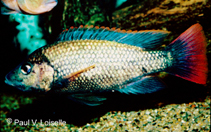 Oreochromis shiranus
Male Bild av Loiselle, P.V.
Bilder | Google image
Male Bild av Loiselle, P.V.
Klassificering / Namn Populärnamn | synonymer | Catalog of Fishes(Släkte, Arter) | ITIS | CoL | WoRMS | Cloffa
> Cichliformes (Cichlids, convict blennies) > Cichlidae (Cichlids) > Pseudocrenilabrinae
Etymology: Oreochromis: Latin, aurum = gold + Greek, chromis = a fish, perhaps a perch (Ref. 45335).
More on author: Boulenger.
Etymology: Oreochromis: Latin, aurum = gold + Greek, chromis = a fish, perhaps a perch (Ref. 45335).
More on author: Boulenger.
Miljö: miljö / Klimatzon / djupintervall / distributionsområde Ekologi
; sötvatten; brackvatten bentopelagisk. Tropical; 23°C - 42°C (Ref. 670); 13°S - 17°S
Utbredning Territorier | FAO områden | Ekosystem | Förekomster | Prickkarta | Utplanteringar | Faunafri
Africa: Two subspecies are recognized: Oreochromis shiranus shiranus from Shiré River above the Murchison rapids and Lake Malawi, together with their tributaries in Tanzania, Malawi and Mozambique (Ref. 5166, 118630); Oreochromis shiranus chilwae from Lake Chilwa and its basin in Malawi and Mozambique (Ref. 5166, 118638).
Längd vid första mognad / Storlek / Vikt / Ålder
Kort beskrivning Bestämningsnycklar | Morfologi | Morfometri
Taggstrålar i ryggfenan (totalt) : 15 - 18; Mjukstrålar i ryggfenan (totalt) : 10 - 13; Taggstrålar i analfenan: 3 - 5; Mjukstrålar i analfenan: 9 - 11; Ryggkotor: 29 - 30. Diagnosis: A large, deep-bodied species with 4, rarely 3 or 5, anal fin spines (Ref. 118638). Females and immatures from the Lake Malawi catchment have a dark olive-coloured body, yellow-gold below; other populations, such as those from Lakes Chilwa and Chiuta and the Ruvuma system show a more silvery colour; unusually for Oreochromis, the horizontal stripes are often more prominent than the vertical bars; adult males develop very large jaws and a concave head profile, they are black, with red margins to the dorsal and caudal fins (Ref. 118638). Underwater or in aquaria, males show numerous white spots on the upper half of the flanks, but these fade quickly under stress, so that they appear uniformly black when removed from the water (Ref. 118638).
Body shape (shape guide): fusiform / normal; Cross section: compressed.
Body shape (shape guide): fusiform / normal; Cross section: compressed.
Found in very shallow waters around Lake Malawi that are densely vegetated, but also in lagoons (Ref. 5595). It can occur at temperatures ranging from 23.0-42.0 °C (Ref. 670). It feeds on detritus and phytoplankton (Ref. 5595). A maternal mouthbrooder (Ref. 118638). A large species heavily exploited in Lake Nyasa [= Lake Malawi] and its catchment; males in particular are fast-growing and the species is cultured commercially in Malawi in cages and ponds (Ref. 118638).
Livscykel och parningsbeteende Könsmognad | Reproduktion | Lek | Ägg | Fekunditet | Larver
A maternal mouthbrooder (Ref. 118638). Builds basin-shaped nests in shallow water from 0.15 m to 1.5 m deep, in sand overlaid with mud, in the vicinity of rooted aquatic vegetation; females brood eggs and young in the mouth until the young reach a length of about 10 mm (Ref. 670).
Huvudreferens
Ladda upp dina referenser | referenser | Koordinator : Kullander, Sven O. | Medarbetare
Trewavas, E. and G.G. Teugels, 1991. Oreochromis. p. 307-346. In J. Daget, J.-P. Gosse, G.G. Teugels and D.F.E. Thys van den Audenaerde (eds.) Checklist of the freshwater fishes of Africa (CLOFFA). ISNB, Brussels; MRAC, Tervuren; and ORSTOM, Paris. Vol. 4. (Ref. 5166)
Status på IUCN:s rödlista (Ref. 130435: Version 2025-2)
Least Concern (LC) ; Date assessed: 23 May 2018
CITES
Not Evaluated
Hot mot människor
Harmless
Mänskliga användningsområden
Fiskeri: kommersiell; Vattenbruk: kommersiell; Akvarium: Kommersiell
FAO - Publication: search | FishSource |
Ytterligare information
Populationsdynamik
Tillväxtparametrar
Max. åldrar / storlekar
Längd-vikt rel.
Längd-längd rel.
Längd-frekvenser
Massakonvertering
Rekrytering
Abundans
Tillväxtparametrar
Max. åldrar / storlekar
Längd-vikt rel.
Längd-längd rel.
Längd-frekvenser
Massakonvertering
Rekrytering
Abundans
Livscykel
Reproduktion
Könsmognad
Mognad/Gills rel.
Fekunditet
Lek
Lekande aggregat
Ägg
Utveckling av ägg
Larver
Larvdynamik
Reproduktion
Könsmognad
Mognad/Gills rel.
Fekunditet
Lek
Lekande aggregat
Ägg
Utveckling av ägg
Larver
Larvdynamik
Anatomi
Gälyta
Hjärna
Otolit
Gälyta
Hjärna
Otolit
Fysiologi
Kroppssammansättning
Näringsämnen
Syreförbrukning
Typ av simning
Simhastighet
Visuella pigment
Ljud från fisk
Sjukdomar & Parasiter
Toxicitet (LC50)
Kroppssammansättning
Näringsämnen
Syreförbrukning
Typ av simning
Simhastighet
Visuella pigment
Ljud från fisk
Sjukdomar & Parasiter
Toxicitet (LC50)
Genetik
Genom
Genetik
Heterozygositet
Ärftlighet
Genetisk mångfald
Genom
Genetik
Heterozygositet
Ärftlighet
Genetisk mångfald
Människorelaterad
Vattenbrukssystem
Vattenbruksprofiler
Avelslinjer
Ciguatera-fall
Frimärken, mynt, diverse.
Vattenbrukssystem
Vattenbruksprofiler
Avelslinjer
Ciguatera-fall
Frimärken, mynt, diverse.
Verktyg
Särskilda rapporter
Kontrollera för underhåll av akvarium | Kontrollera om det finns faktablad om arter | Kontrollera om det finns faktablad om vattenbruk
Ladda ner XML
Internet-källor
AFORO (otoliths) | Alien/Invasive Species database | Aquatic Commons | BHL | Cloffa | Websites from users | Check FishWatcher | CISTI | Catalog of Fishes: Släkte, Arter | DiscoverLife | ECOTOX | FAO - Publication: search | Faunafri | Fishipedia | Fishtrace | GloBI | Google Books | Google Scholar | Google | IGFA World Record | OneZoom | Open Tree of Life | Otolith Atlas of Taiwan Fishes | Offentliga akvarier | PubMed | Reef Life Survey | Socotra Atlas | TreeBase | Tree of Life | Wikipedia: Go, sök | World Records Freshwater Fishing | Zoobank | Zoologiskt register
Uppskattningar baserade på modeller
Index för fylogenetisk mångfald (Ref. 82804): PD50 = 0.5000 [Uniqueness, from 0.5 = low to 2.0 = high].
Bayesian length-weight: a=0.01230 (0.00729 - 0.02077), b=2.99 (2.85 - 3.13), in cm total length, based on LWR estimates for this species & Genus-body shape (Ref. 93245).
Trofisk nivå (Ref. 69278): 2.0 ±0.00 se; based on food items.
Resiliens (Ref. 120179): Mellan, lägsta populationsfördubblingstid 1,4-4,4 år (K=0.27-0.32).
Näringsämnen (Ref. 124155): Calcium = 23.3 [8.7, 108.4] mg/100g; Iron = 1.17 [0.57, 2.60] mg/100g; Protein = 17.9 [16.3, 19.6] %; Omega3 = 0.216 [0.110, 0.458] g/100g; Selenium = 60 [31, 117] μg/100g; VitaminA = 8.08 [1.97, 29.53] μg/100g; Zinc = 1.86 [1.09, 4.32] mg/100g (wet weight);