-

- Om denna sida
- Språk
- Återkoppling från användare
- Referens
- Uppladdningar
-
Relaterade arter
- Arter i
Pangasius - Arter i
Pangasiidae - - Klassificering -
- Pangasiidae
- Siluriformes
- Teleostei
- Chordata
- Animalia
- Arter i
-



Ladda upp din foton och Videor
Bilder | Google image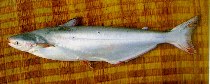 Pangasius krempfi
Bild av Roberts, T.R.
Bilder | Google image
Bild av Roberts, T.R.
Klassificering / Namn Populärnamn | synonymer | Catalog of Fishes(Släkte, Arter) | ITIS | CoL | WoRMS | Cloffa
> Siluriformes (Catfishes) > Pangasiidae (Shark catfishes)
Etymology: Pangasius: The Vietnamese name of a fish (Ref. 45335).
Eponymy: Dr Armand-Alfred-Antoine Krempf (d: 1879) was a French marine biologist, who first went to Vietnam (1903) as part of a scientific expedition to Hanoi. [...] (Ref. 128868), visit book page.
Etymology: Pangasius: The Vietnamese name of a fish (Ref. 45335).
Eponymy: Dr Armand-Alfred-Antoine Krempf (d: 1879) was a French marine biologist, who first went to Vietnam (1903) as part of a scientific expedition to Hanoi. [...] (Ref. 128868), visit book page.
Miljö: miljö / Klimatzon / djupintervall / distributionsområde Ekologi
marina; sötvatten; brackvatten bentopelagisk; flodvandrande (Ref. 51243). Tropical
Utbredning Territorier | FAO områden | Ekosystem | Förekomster | Prickkarta | Utplanteringar | Faunafri
Asia.
Storlek / Vikt / Ålder
Könsmognad: Lm ? range ? - ? cm
Max length : 120 cm SL hane/ej könsbestämd; (Ref. 30857); publicerad maxvikt: 14.0 kg (Ref. 9497)
Max length : 120 cm SL hane/ej könsbestämd; (Ref. 30857); publicerad maxvikt: 14.0 kg (Ref. 9497)
Kort beskrivning Bestämningsnycklar | Morfologi | Morfometri
Taggstrålar i ryggfenan (totalt) : 1; Mjukstrålar i ryggfenan (totalt) : 6 - 7; Taggstrålar i analfenan: 4; Mjukstrålar i analfenan: 31 - 34. Body depth 4.5-5.0 times in SL (Ref. 43281). Dorsum sky blue; submarginal caudal-fin stripes absent; no humeral spot; vomerine teeth separate at midline, joined to palatine teeth on each side forming long crescentic patches; 18-22 gill rakers in first arch (Ref. 12693). Body dark blackish gray on top and sides, silver gray on abdomen and fins lightly yellow (Ref. 45563).
Body shape (shape guide): elongated.
Body shape (shape guide): elongated.
Facultative air-breathing (Ref. 126274); Migrating but the direction is unknown. Dietary habits have not been studied. Taxonomy of this species may be problematic (Ref. 12693). Unique among pangasiid species in the Mekong in spending a major part of its life in marine coastal waters. Migrates into the Mekong River (but not into any other rivers) in order to breed (Ref. 12369). Regarded to be anadromous (Ref. 12369). It was hypothesized that at least two populations in the Mekong undertake migration (Ref. 37770). One population migrates during May-September from just south of Khone Falls upstream to spawning grounds along the mainstream Mekong all the way to Chiang Khong near the Lao-Thai-Myanmar border. The other population migrates downstream from around Stung Treng to unknown spawning grounds somewhere between Stung Treng and Kompong Cham in Cambodia during the spawning season between May and August. When water level starts to fall in October, the fish moves back to the main river to initiate an upstream dispersal migration, reaching the stretch just below the Khone Falls. Stays in deep pools within the mainstream during the dry season (Ref. 37770). Only two specimens of the fish were collected on April 5, 1956 and September 10, 1957 in Beihai City, Guangxi (Ref. 45563). Another on November 22, 1963 at Shanwei City of Guangdong Province (Ref. 45563).
Livscykel och parningsbeteende Könsmognad | Reproduktion | Lek | Ägg | Fekunditet | Larver
Huvudreferens
Ladda upp dina referenser | referenser | Koordinator | Medarbetare
Roberts, T.R. and C. Vidthayanon, 1991. Systematic revision of the Asian catfish family Pangasiidae, with biological observations and descriptions of three new species. Proc. Acad. Nat. Sci. Philad. 143:97-144. (Ref. 7432)
Status på IUCN:s rödlista (Ref. 130435: Version 2025-2)
Sårbar (VU) (A2d); Date assessed: 24 February 2011
CITES
Not Evaluated
Hot mot människor
Harmless
Mänskliga användningsområden
Fiskeri: kommersiell
FAO - Publication: search | FishSource |
Ytterligare information
Populationsdynamik
Tillväxtparametrar
Max. åldrar / storlekar
Längd-vikt rel.
Längd-längd rel.
Längd-frekvenser
Massakonvertering
Rekrytering
Abundans
Tillväxtparametrar
Max. åldrar / storlekar
Längd-vikt rel.
Längd-längd rel.
Längd-frekvenser
Massakonvertering
Rekrytering
Abundans
Livscykel
Reproduktion
Könsmognad
Mognad/Gills rel.
Fekunditet
Lek
Lekande aggregat
Ägg
Utveckling av ägg
Larver
Larvdynamik
Reproduktion
Könsmognad
Mognad/Gills rel.
Fekunditet
Lek
Lekande aggregat
Ägg
Utveckling av ägg
Larver
Larvdynamik
Anatomi
Gälyta
Hjärna
Otolit
Gälyta
Hjärna
Otolit
Fysiologi
Kroppssammansättning
Näringsämnen
Syreförbrukning
Typ av simning
Simhastighet
Visuella pigment
Ljud från fisk
Sjukdomar & Parasiter
Toxicitet (LC50)
Kroppssammansättning
Näringsämnen
Syreförbrukning
Typ av simning
Simhastighet
Visuella pigment
Ljud från fisk
Sjukdomar & Parasiter
Toxicitet (LC50)
Genetik
Genom
Genetik
Heterozygositet
Ärftlighet
Genetisk mångfald
Genom
Genetik
Heterozygositet
Ärftlighet
Genetisk mångfald
Människorelaterad
Vattenbrukssystem
Vattenbruksprofiler
Avelslinjer
Ciguatera-fall
Frimärken, mynt, diverse.
Vattenbrukssystem
Vattenbruksprofiler
Avelslinjer
Ciguatera-fall
Frimärken, mynt, diverse.
Verktyg
Särskilda rapporter
Kontrollera för underhåll av akvarium | Kontrollera om det finns faktablad om arter | Kontrollera om det finns faktablad om vattenbruk
Ladda ner XML
Internet-källor
AFORO (otoliths) | Aquatic Commons | BHL | Cloffa | Websites from users | Check FishWatcher | CISTI | Catalog of Fishes: Släkte, Arter | DiscoverLife | ECOTOX | FAO - Publication: search | Faunafri | Fishipedia | Fishtrace | GloBI | Google Books | Google Scholar | Google | IGFA World Record | OneZoom | Open Tree of Life | Otolith Atlas of Taiwan Fishes | PubMed | Reef Life Survey | Socotra Atlas | TreeBase | Tree of Life | Wikipedia: Go, sök | World Records Freshwater Fishing | Zoobank | Zoologiskt register
Uppskattningar baserade på modeller
Index för fylogenetisk mångfald (Ref. 82804): PD50 = 0.5000 [Uniqueness, from 0.5 = low to 2.0 = high].
Bayesian length-weight: a=0.00457 (0.00216 - 0.00967), b=3.09 (2.91 - 3.27), in cm total length, based on LWR estimates for this (Sub)family-body shape (Ref. 93245).
Trofisk nivå (Ref. 69278): 2.0 ±0.00 se; based on food items.
Näringsämnen (Ref. 124155): Calcium = 21.4 [8.8, 59.4] mg/100g; Iron = 0.416 [0.152, 1.286] mg/100g; Protein = 14.6 [13.0, 16.4] %; Omega3 = 0.119 [0.059, 0.245] g/100g; Selenium = 93.9 [40.2, 228.6] μg/100g; VitaminA = 13.1 [2.6, 67.8] μg/100g; Zinc = 2.72 [0.96, 5.04] mg/100g (wet weight);