-

- Об этой странице
- Языки
- Отзывы пользователей
- Цитировать
- Загрузка
- Близкие виды
-



Oreochromis mortimeri (Trewavas, 1966)
Kariba tilapia
Загрузить свой Фото и Видео
Изображение на Google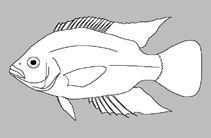 No image available for this species;
drawing shows typical species in Cichlidae.
Изображение на Google
drawing shows typical species in Cichlidae.
Классификация / Имена народные названия | синонимы | Catalog of Fishes(род, виды) | ITIS | CoL | WoRMS | Cloffa
> Cichliformes (Cichlids, convict blennies) > Cichlidae (Cichlids) > Pseudocrenilabrinae
Etymology: Oreochromis: Latin, aurum = gold + Greek, chromis = a fish, perhaps a perch (Ref. 45335); mortimeri: Named for M.A.E. Mortimer, a fish culturist who conducted a great deal of productive fish culture research in Zambia between 1951 and 1965 (Ref. 13337).
Eponymy: M A E Mortimer was a Research and Administrative Officer of the Zambian Department of Game and Fisheries. [...] (Ref. 128868), visit book page.
More on author: Trewavas.
Etymology: Oreochromis: Latin, aurum = gold + Greek, chromis = a fish, perhaps a perch (Ref. 45335); mortimeri: Named for M.A.E. Mortimer, a fish culturist who conducted a great deal of productive fish culture research in Zambia between 1951 and 1965 (Ref. 13337).
Eponymy: M A E Mortimer was a Research and Administrative Officer of the Zambian Department of Game and Fisheries. [...] (Ref. 128868), visit book page.
More on author: Trewavas.
Окружающая среда: среда / климатическая зона / пределы глубины / диапазон распространения экология
; пресноводный донно-пелагический. Tropical; 10°S - 19°S
распространение Территории | регионы FAO | Экосистемы | места находок | карта точек | интродукции | Faunafri
Africa: Middle Zambezi and its tributaries, including Luangwa River (except probably the upper reaches of its tributaries Lunsemfwa and Mulungwishi above the escarpment), Hunyani River and Lake Kariba (Ref. 5166). Introduced to Kipopo and the Lufira River (upper Congo River basin) in Democratic Republic of the Congo (Ref. 1978).
Длина при первой зрелости / Размер / Вес / Возраст
половая зрелость: Lm 22.0 range ? - ? cm
Max length : 48.0 cm TL самец/пол неопределен; (Ref. 5309); наибольший вес (опубликованные данные): 4.1 kg (Ref. 13337); наибольший возраст (опубликованны данные): 8 годы (Ref. 2)
Max length : 48.0 cm TL самец/пол неопределен; (Ref. 5309); наибольший вес (опубликованные данные): 4.1 kg (Ref. 13337); наибольший возраст (опубликованны данные): 8 годы (Ref. 2)
Краткое описание определительные ключи | морфология | морфометрия
колючие лучи спинного плавника (общее число) : 16 - 17; членистые (мягкие) лучи спинного плавника (общее число) : 10 - 13; колючие лучи анального плавника: 3; членистые (мягкие) лучи анального плавника: 10 - 12; позвонки: 29 - 30. Diagnosis: jaws greatly enlarged in mature males; scales in 2-3 rows on cheek; caudal peduncle relatively shorter than in O. mossambicus (Ref. 2). In life greenish grey (Ref. 2), green-blue (Ref. 52307) or grey-blue with a darker spot on each scale (Ref. 2, 52307). Females and immature males often with 1-3 dark mid-lateral blotches (Ref. 2, 52307), which may appear only as the fish dies (Ref. 2). Breeding males: predominantly iridescent blue-green to bronze (Ref. 2, 52307), with iridescent spots on dorsal and caudal fins (Ref. 2), a dorsal fin with a red edge that is not as pronounced as in O. mossambicus, and a narrow (as opposed to wide) red band at posterior end of caudal fin (Ref. 12524, 13337).
Body shape (shape guide): short and / or deep; Cross section: compressed.
Body shape (shape guide): short and / or deep; Cross section: compressed.
Forms schools (Ref. 2, 54048). Is mainly diurnal; salt-tolerant (Ref. 2). Feeds mainly on (filamentous) algae (Ref. 2, 12524, 13337, 52307, 54048) and diatoms, as well as higher plants (Ref. 2, 52307), dipterous larvae, cladocerans, copepods (Ref. 2), aquatic and terrestrial insects, shrimps, worms (Ref. 12524, 13337, 54048) and mollusks (Ref. 54048). Mouthbrooder; spawns several times per year (Ref. 12524, 13337, 54048).
Жизненный цикл и брачное поведение половая зрелость | размножение | нерест | икра | Плодовитость | личинки
Nest a saucer-shaped depression with a raised mound in the middle (Ref. 12524, 13337), made by the male in a breeding arena in shallow water down to about 4m (Ref. 54048). Females are lured to these through male courtship displays; female collects eggs in mouth after spawning and fertilisation, and moves off; mouthbrooding females may shoal together and do not feed at this time; eggs hatch after about ten days but remain in the mouth for a further few days; juveniles make short feeding sorties once the storage yolk is used up, but seldom stray far and dart into her mouth when danger threatens; after about another 10 days young are released in warm shallow water in the margins (nursery areas), where they feed independently in small shoals (Ref. 54048). Young released from mouthbrooding female are about 1cm long (Ref. 2). Female returns to the breeding arena where she spawns again (Ref. 54048).
Основная ссылка
Загрузите свои рекомендации | ссылки | координатор : Kullander, Sven O. | соавторы
Trewavas, E., 1983. Tilapiine fishes of the genera Sarotherodon, Oreochromis and Danakilia. British Mus. Nat. Hist., London, UK. 583 p. (Ref. 2)
Статус Красного Списка МСОП (Ref. 130435: Version 2025-2)
В критическом состоянии (CR) (A2ae); Date assessed: 01 March 2007
CITES
Not Evaluated
Угроза для людей
Harmless
Использование человеком
рыболовство: коммерческий; аквакультура (рыбоводство): экспериментальный; объект спортивного рыболовства: да
FAO - Publication: search | FishSource |
дополнительная информация
Трофическая экология
Пищевые предметы (добыча)
состав пищи
потребление пищи
Продовольственные пайки
хищники
Пищевые предметы (добыча)
состав пищи
потребление пищи
Продовольственные пайки
хищники
Динамика численности населения
Параметры роста
Макс. возраст / размер
Отношение длины к весу.
Отношение длины к длине.
Размерный состав
Преобразование массы
пополнение
численность
Параметры роста
Макс. возраст / размер
Отношение длины к весу.
Отношение длины к длине.
Размерный состав
Преобразование массы
пополнение
численность
Жизненный цикл
размножение
половая зрелость
Зрелость/Жиры относительно.
Плодовитость
нерест
Нерестовые скопления
икра
Развитие икры
личинки
динамика численности личинок
размножение
половая зрелость
Зрелость/Жиры относительно.
Плодовитость
нерест
Нерестовые скопления
икра
Развитие икры
личинки
динамика численности личинок
Анатомия
жаберная область
Мозг
Отолит
жаберная область
Мозг
Отолит
Физиология
Состав тела
Питательные вещества
Потребление кислорода
Тип плавания
Скорость плавания
Зрительные пигменты
Звук рыбы
Болезни и паразиты
Токсичность (LC50s)
Состав тела
Питательные вещества
Потребление кислорода
Тип плавания
Скорость плавания
Зрительные пигменты
Звук рыбы
Болезни и паразиты
Токсичность (LC50s)
генетика
Геном
генетика
Гетерозиготность
наследуемость
Генетическое разнообразие
Геном
генетика
Гетерозиготность
наследуемость
Генетическое разнообразие
Связанные с человеком
Системы аквакультуры
особенности рыбоводства
степень растяжения
Случаи заболевания сигуатерой
Марки, монеты и прочее.
Системы аквакультуры
особенности рыбоводства
степень растяжения
Случаи заболевания сигуатерой
Марки, монеты и прочее.
инструменты
Электронная книга | полевой определитель | определительные ключи | Длина-Частота | онтогенез | карта точек |
Catch-MSY |
Специальные отчеты
Проверить содержание в аквариумах | Проверить опубликованные видовые данные | Проверить опубликованные данные по аквакультуре
Скачать в формате XML
ресурсы в Интернет
AFORO (otoliths) | Alien/Invasive Species database | Aquatic Commons | BHL | Cloffa | Websites from users | Проверить FishWatcher | CISTI | Catalog of Fishes: род, виды | DiscoverLife | ECOTOX | FAO - Publication: search | Faunafri | Fishipedia | Fishtrace | GloBI | Google Books | Google Scholar | Google | IGFA World Record | OneZoom | Open Tree of Life | Otolith Atlas of Taiwan Fishes | PubMed | Reef Life Survey | Socotra Atlas | TreeBase | Tree of Life | Wikipedia: Вперёд, поиск | World Records Freshwater Fishing | Зоологическая летопись
Оценки, основанные на моделях
Индекс филогенетического разнообразия (ссылка 82804): PD50 = 0.5000 [Uniqueness, from 0.5 = low to 2.0 = high].
Bayesian length-weight: a=0.01995 (0.00960 - 0.04145), b=3.02 (2.84 - 3.20), in cm total length, based on LWR estimates for this species & (Sub)family-body (Ref. 93245).
Трофический уровень (ссылка 69278): 2.2 ±0.0 se; based on diet studies.
Generation time: 4.3 ( na - na) years. Estimated as median ln(3)/K based on 1 growth studies.
устойчивость к внешним воздействиям (ссылка 120179): средний (среднего размера), минимальное время удвоения популяции 1.4-4.4 года (tmax=8).