Teleostei (teleosts) >
Gobiiformes (Gobies) >
Gobiidae (Gobies) > Gobiinae
Etymology: Cryptocentrus: Greek, kryptos = hidden + Greek, kentron = sting (Ref. 45335).
More on author: Günther.
Environment: milieu / climate zone / depth range / distribution range
Ecology
Marine; reef-associated; depth range 2 - 25 m (Ref. 90102). Tropical
Western Pacific. Reported to extend to the Andaman Sea and Samoa (Ref. 9710).
Size / Weight / Age
Maturity: Lm ? range ? - ? cm
Max length : 7.5 cm SL male/unsexed; (Ref. 48637)
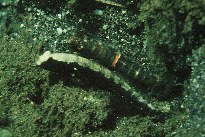
Dorsal spines (total): 6 - 7; Dorsal soft rays (total): 10 - 11; Anal spines: 1; Anal soft rays: 9 - 10. Characterized by dark brown body color; lips, snout and top of head white in color; presence of several white saddles on back; united pelvic fins, presence of frenum; longitudinal scale series 90; head without scales; greatest depth of body 5.2-6.6 in SL; rounded caudal fin, longer than head (Ref. 90102).
Body shape (shape guide): elongated; Cross section: circular.
Found on open sand bottoms of clear seaward reefs to at least 20 m (Ref. 9710). Lives in a burrow with symbiotic alpheid shrimps. Occurs on sheltered protected reefs, along edges with coarse sand and fine rubble (Ref. 48637). Also Ref. 2334. Also found in sand bottoms of lagoons (Ref 90102).
Life cycle and mating behavior
Maturity | Reproduction | Spawning | Eggs | Fecundity | Larvae
Randall, J.E., G.R. Allen and R.C. Steene, 1990. Fishes of the Great Barrier Reef and Coral Sea. University of Hawaii Press, Honolulu, Hawaii. 506 p. (Ref. 2334)
IUCN Red List Status (Ref. 130435: Version 2025-2)
Threat to humans
Harmless
Human uses
Tools
Special reports
Download XML
Internet sources