-

- Over deze pagina
- Talen
- Feedback van gebruikers
- Citatie
- Uploads
-
Verwante soorten
- Soort(en) in
Cypselurus - Soort(en) in
Exocoetidae - - Classificatie -
- Exocoetidae
- Beloniformes
- Teleostei
- Chordata
- Animalia
- Soort(en) in
-



Cypselurus angusticeps Nichols & Breder, 1935
Narrowhead flyingfish
Waarneming toevoegen in Fish Watcher
| Native range | All suitable habitat | Point map | Year 2050 |

|
| This map was computer-generated and has not yet been reviewed. |
| Cypselurus angusticeps AquaMaps Data sources: GBIF OBIS |
Uploaden van uw Foto's en video's
Afbeeldingen | Google afbeelding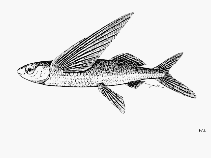 Cypselurus angusticeps
Afbeelding van FAO
Afbeeldingen | Google afbeelding
Afbeelding van FAO
Classificatie / Namen Lokale namen | Synoniemen | Catalog of Fishes(Genus, Soort(en)) | ITIS | CoL | WoRMS | Cloffa
> Beloniformes (Needle fishes) > Exocoetidae (Flyingfishes)
Etymology: Cypselurus: Greek, kypselos, ou = swift + Greek,oura = tail (Ref. 45335).
More on authors: Nichols & Breder.
Etymology: Cypselurus: Greek, kypselos, ou = swift + Greek,oura = tail (Ref. 45335).
More on authors: Nichols & Breder.
Milieu: milieu / Klimaatzone / Diepte / verspreidingsgebied Ecologie
marien pelagic-oceanic; oceanodroom (Ref. 51243); diepte 0 - 20 m (Ref. 27313). Tropical; 34°N - 23°S, 43°E - 79°W
Verspreiding Gebieden | FAO regio's | Ecosystemen | Voorkomen | Verspreidingskaart | Introducties | Faunafri
Indo-Pacific: East Africa to Hawaii and the Tuamoto Islands. Probably absent from the inland seas of southeast Asia. Eastern Pacific: isolated population at Soccoro Islands, Mexico, including Revillagigedo Islands.
Grootte / Gewicht / Leeftijd
Korte beschrijving Determinatiesleutels | Morfologie | Morfometrie
Dorsale zachte stralen (totaal) : 13; Anale zachte stralen: 8 - 9. Pectoral fins almost uniformly grayish, varying in tone but neither hyaline nor blackish, with a narrow pale posterior edge broadening at the tip and toward the axil of the fin. Predorsal scales 28-30. Ventral origin equidistant from about or behind the middle of opercle and base of caudal. Head narrow and pointed for this genus, the snout equal to or slightly longer than eye. Teeth tricuspid. Interobital slightly concave; eye slightly infralateral.
Coloration: Dark above to below midline of side, pale below; dorsal very pale grayish; anal white; caudal uniform dusky; ventrals pale becoming slightly dusky in the center of their base.
Body shape (shape guide): elongated.
Body shape (shape guide): elongated.
Epipelagic in coastal and oceanic waters. Often near oceanic islands. May leap out of the water and glide over considerable distances above the surface. Also caught using dipnet and light method (Ref. 9839).
Levenscyclus en paargedrag Maturiteit | Voortplanting | Paaien | Eieren | Fecunditeit | Larven
Hoofdreferentie
Upload uw referenties | Referenties | Coördinator : Parin, Nikolay V. | Medewerkers
Nichols, J.T. and C.M. Breder Jr., 1935. New Pacific flying-fishes collected by Templeton Crocker. Am. Mus. Novit. 821:1-4. (Ref. 98576)
CITES
Not Evaluated
Gevaar voor de mens
Harmless
Gebruik door de mens
Visserij: van minder commercieel belang
FAO - Publication: search | FishSource |
Meer informatie
Trofische ecologie
Voedsel (prooien)
Dieetsamenstelling
Voedselconsumptie
Voedselrantsoenen
Predatoren
Voedsel (prooien)
Dieetsamenstelling
Voedselconsumptie
Voedselrantsoenen
Predatoren
Populatiedynamica
Groeiparameters
Max. leeftijden / maten
Lengte-gewicht rel.
Lengte-lengte rel.
Lengtefrequenties
Massaconversie
Rekrutering
Abundantie
Groeiparameters
Max. leeftijden / maten
Lengte-gewicht rel.
Lengte-lengte rel.
Lengtefrequenties
Massaconversie
Rekrutering
Abundantie
Levenscyclus
Voortplanting
Maturiteit
Rijpheid/kieuwen rel.
Fecunditeit
Paaien
Paaibestanden
Eieren
Ontwikkeling van de eieren
Larven
Larvale populatiedynamiek
Voortplanting
Maturiteit
Rijpheid/kieuwen rel.
Fecunditeit
Paaien
Paaibestanden
Eieren
Ontwikkeling van de eieren
Larven
Larvale populatiedynamiek
Fysiologie
Lichaamssamenstelling
Voedingsstoffen
Zuurstofverbruik
Type zwemmen
Zwemsnelheid
Visuele pigmenten
Vis geluid
Ziekten en parasieten
Toxiciteit (LC50)
Lichaamssamenstelling
Voedingsstoffen
Zuurstofverbruik
Type zwemmen
Zwemsnelheid
Visuele pigmenten
Vis geluid
Ziekten en parasieten
Toxiciteit (LC50)
Genetica
genoom
Genetica
Heterozygositeit
Erfelijkheid
Genetische diversiteit
genoom
Genetica
Heterozygositeit
Erfelijkheid
Genetische diversiteit
Menselijk gerelateerd
Aquacultuursystemen
Aquacultuurprofielen
Kweeklijnen
Ciguatera gevallen
Postzegels, munten, diversen.
Aquacultuursystemen
Aquacultuurprofielen
Kweeklijnen
Ciguatera gevallen
Postzegels, munten, diversen.
Tools
E-boek | Veldgids | Determinatiesleutels | Lengtefrequentie Tool | Levenscyclus tool | Verspreidingskaart |
Vangst-MSY |
Speciale rapporten
Bekijk gegevens voor het houden in een aquarium | Bekijk Fact Sheets voor de soort | Bekijk Aquacultuur Fact Sheets
Download XML
Internetbronnen
AFORO (otoliths) | Aquatic Commons | BHL | Cloffa | Websites from users | Bekijk FishWatcher | CISTI | Catalog of Fishes: Genus, Soort(en) | DiscoverLife | ECOTOX | FAO - Publication: search | Faunafri | Fishipedia | Fishtrace | GloBI | Google Books | Google Scholar | Google | IGFA World Record | Nationale databanken | OneZoom | Open Tree of Life | Otolith Atlas of Taiwan Fishes | PubMed | Reef Life Survey | Socotra Atlas | TreeBase | Tree of Life | Wikipedia: ga naar, zoek | World Records Freshwater Fishing | Zoobank | Zoological Record
Schattingen op basis van modellen
Gewenste temperatuur (Ref. 123201): 24.4 - 29.3, mean 27.7 °C (based on 32228 cells).
Fylogenetische diversiteitsindex (Ref. 82804): PD50 = 0.5002 [Uniqueness, from 0.5 = low to 2.0 = high].
Bayesian length-weight: a=0.00631 (0.00288 - 0.01384), b=3.05 (2.85 - 3.25), in cm total length, based on LWR estimates for this (Sub)family-body shape (Ref. 93245).
Trofisch niveau (Ref. 69278): 4.0 ±0.6 se; based on size and trophs of closest relatives
Weerstandsvermogen (Ref. 120179): Hoog, minimale populatieverdubbelingstijd minder dan 15 maanden (Preliminary K or Fecundity.).