-

- इस पृष्ठ के बारे में
- बोली
- उपयोगकर्ता प्रतिक्रियाएँ
- उद्धरण
- अपलोड
- संबंधित प्रजातियां
-



Labracinus cyclophthalmus (Müller & Troschel, 1849)
Fire-tail devil
अपना अवलोकन जोड़ें Fish Watcher
| Native range | All suitable habitat | Point map | Year 2050 |
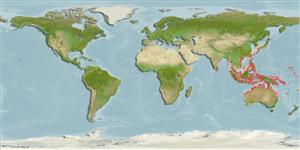
|
| This map was computer-generated and has not yet been reviewed. |
| Labracinus cyclophthalmus AquaMaps Data sources: GBIF OBIS |
अपना अपलोड करें तस्वीरें और वीडियो
तस्वीरे | वीडियो | टिकट, सिक्के, विविध. | Google image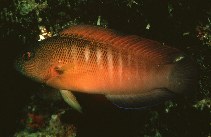 Labracinus cyclophthalmus
चित्र स्रोत: AP Randall, J.E.
तस्वीरे | वीडियो | टिकट, सिक्के, विविध. | Google image
चित्र स्रोत: AP Randall, J.E.
वर्गीकरण / नाम आम नाम | उपशब्द | Catalog of Fishes(वर्ग, प्रजाति) | ITIS | CoL | WoRMS | Cloffa
> Ovalentaria/misc (Various families in series Ovalentaria) > Pseudochromidae (Dottybacks) > Pseudochrominae
Etymology: Labracinus: Greek, labrax, -akos = a fish, Dicentrarchus labrax (Ref. 45335); cyclophthalmus: Name from Greek 'kyklos' meaning circle and 'ophthalmos' for eye, referring to the dark curved marking around the midposterior rim of the orbit.
More on authors: Müller & Troschel.
Etymology: Labracinus: Greek, labrax, -akos = a fish, Dicentrarchus labrax (Ref. 45335); cyclophthalmus: Name from Greek 'kyklos' meaning circle and 'ophthalmos' for eye, referring to the dark curved marking around the midposterior rim of the orbit.
More on authors: Müller & Troschel.
पर्यावरण: पर्यावरण / जलवायु क्षेत्र / गहराई सीमा / वितरण सीमा पारिस्थितिकी
समुद्री प्रवाल-भित्ति संयुक्त; गहराई सीमा 2 - 20 m (Ref. 9710), usually 10 - 15 m (Ref. 27115). Tropical; 22°C - 26°C (Ref. 27115)
वितरण प्रदेशों | ऐफ ऐ ओ क्षेत्र | पारिस्थितिकी प्रणालियों | संयोग | बिन्दु नक्शा | भूमिका | Faunafri
Western Pacific: widely distributed throughout the Indo-Malayan Archipelago, from southern Japan, south to the Northwest Shelf of Australia, and east to New Ireland, Papua New Guinea.
आकार / वज़न / आयु
संक्षिप्त वर्णन पहचान कुंजी | आकृति विज्ञान | मौरफोमैटरिक्स
पृष्ठीय रीढ़ (सम्पूर्ण) : 2; पृष्ठीय सौफट रेज़ (सम्पूर्ण) : 24 - 26; गुदा कांटा: 3; ऐनल सौफट रेज़: 14 - 15. Lower lip uninterrupted at symphysis. Vomerine teeth relatively large, arranged in a chevron. Caudal fin rounded; upper part with 5 - 6 procurrent rays and 9 principal rays. Lateral line with anterodorsal series of 43 - 62 (usually 48 - 62) tubed scales extending from gill opening, and a peduncular series of 12 - 14 (usually 18 - 22) tubed scales. Dorsal and anal fins with distinct scaly sheaths (Ref. 37748).
Body shape (shape guide): short and / or deep; Cross section: compressed.
Body shape (shape guide): short and / or deep; Cross section: compressed.
Found near shelter of coral or rock of shallow reefs (Ref. 9710), with moderate surge or currents, in spread-out groups of mixed sexes. Also in tidal pools, reef flats and reef slopes, often in relatively silty areas at depths ranging to 20 m (Ref. 81967). Moves about activity through the gutters and passages (Ref. 48635). Feeds on small fishes (Ref. 559). Frequently seen in the aquarium fish trade, and has been bred in captivity (Ref. 35416, 37748).
जीवन चक्र और संभोग व्यवहार परिपक्व अवधि | पुनरुत्पत्ति | मछलीऔ का अंडे देना | अंडे | उपजाऊपन | लार्वा
मुख्य संदर्भ
अपने संदर्भ अपलोड करें | संदर्भ | संयोजक | सहयोगीयो
Kailola, P.J., 1987. The fishes of Papua New Guinea: a revised and annotated checklist. Vol. II Scorpaenidae to Callionymidae. Research Bulletin No. 41, Research Section, Dept. of Fisheries and Marine Resources, Papua New Guinea. (Ref. 6192)
आईयूसीएन रेड लिस्ट स्थिति (Ref. 130435: Version 2025-2)
Least Concern (LC) ; Date assessed: 22 July 2021
CITES
Not Evaluated
मनुष्यों के लिए ख़तरा
Harmless
मानव उपयोग
मात्स्यिकी: व्यापारिक; जलजीवालय: व्यापारिक
FAO - Publication: search | FishSource |
अधिक जानकारी
जनसंख्या गतिशीलता
विकास मापदंड
अधिकतम आयु/आकार
लंबाई-वजन संबंध
लंबाई-लंबाई संबंध
लंबाई-आवृत्तियाँ
सामूहिक रूपांतरण
भर्ती
बहुतायत
विकास मापदंड
अधिकतम आयु/आकार
लंबाई-वजन संबंध
लंबाई-लंबाई संबंध
लंबाई-आवृत्तियाँ
सामूहिक रूपांतरण
भर्ती
बहुतायत
जीवन चक्र
पुनरुत्पत्ति
परिपक्व अवधि
परिपक्वता/गिल्स संबंध
उपजाऊपन
मछलीऔ का अंडे देना
स्पॉनिंग एकत्रीकरण
अंडे
अंडे का विकास
लार्वा
लारवल गतिकी
पुनरुत्पत्ति
परिपक्व अवधि
परिपक्वता/गिल्स संबंध
उपजाऊपन
मछलीऔ का अंडे देना
स्पॉनिंग एकत्रीकरण
अंडे
अंडे का विकास
लार्वा
लारवल गतिकी
शरीर रचना
गिल क्षेत्र
दिमाग
ओटोलिथ
गिल क्षेत्र
दिमाग
ओटोलिथ
फिजियोलॉजी
शारीरिक संरचना
पोषक तत्व
प्राणवायु की खपत
तैराकी का प्रकार
तैराकी की गति
दृश्य वर्णक
मछली की आवाज
रोग एवं परजीवी
विषाक्तता (LC50s)
शारीरिक संरचना
पोषक तत्व
प्राणवायु की खपत
तैराकी का प्रकार
तैराकी की गति
दृश्य वर्णक
मछली की आवाज
रोग एवं परजीवी
विषाक्तता (LC50s)
आनुवंशिकी
जीनोम
आनुवंशिकी
विषमयुग्मजी
हैरेटिबिलटी
आनुवंशिक विविधता
जीनोम
आनुवंशिकी
विषमयुग्मजी
हैरेटिबिलटी
आनुवंशिक विविधता
साधन
बायो क्विज़ | ई-पुस्तक | कार्यक्षेत्र पथप्रदर्शक | पहचान कुंजी | लंबाई आवृति इंद्रजालिक | जीवन-इतिहास उपकरण | बिन्दु नक्शा |
कैच-एमएसवाई |
विशेष रिपोर्ट
एक्वेरियम के रखरखाव की जांच करें | प्रजातियों के तथ्य पत्रक की जाँच करें | जलीय कृषि तथ्य पत्रक की जाँच करें
XML डाउनलोड करें
सारांश पृष्ठ | बिंदु डेटा | आम नाम | तस्वीरें
इंटरनेट स्रोत
AFORO (otoliths) | Aquatic Commons | BHL | Cloffa | Websites from users | Check FishWatcher | CISTI | Catalog of Fishes: वर्ग, प्रजाति | DiscoverLife | ECOTOX | FAO - Publication: search | Faunafri | Fishipedia | Fishtrace | GloBI | Google Books | Google Scholar | Google | IGFA World Record | राष्ट्रीय आंकड़ासंचय | OneZoom | Open Tree of Life | Otolith Atlas of Taiwan Fishes | सार्वजनिक लजीवालय | PubMed | Reef Life Survey | Socotra Atlas | TreeBase | Tree of Life | Wikipedia: Go, खोज | World Records Freshwater Fishing | प्राणीशास्त्रीय अभिलेख
मॉडल पर आधारित अनुमान
पसंदीदा तापमान (संदर्भ 123201): 26 - 29.3, mean 28.7 °C (based on 1882 cells).
जातिवृति विविधता सूचकांक (संदर्भ 82804): PD50 = 0.6250 [Uniqueness, from 0.5 = low to 2.0 = high].
Bayesian length-weight: a=0.01995 (0.00906 - 0.04395), b=3.01 (2.83 - 3.19), in cm total length, based on all LWR estimates for this body shape (Ref. 93245).
ट्रॉफिक स्तर (संदर्भ 69278): 3.9 ±0.4 se; based on diet studies.
लौटाव (संदर्भ 120179): माध्यम, न्यूनतम जनसंख्या दुगनी होने का समय 1.4 - 4.4 वर्ष। (Preliminary K or Fecundity.).
पोषक तत्व (Ref. 124155): Calcium = 65.3 [32.3, 100.0] mg/100g; Iron = 0.654 [0.379, 1.062] mg/100g; Protein = 18.6 [17.5, 19.8] %; Omega3 = 0.109 [0.065, 0.178] g/100g; Selenium = 23.1 [12.3, 45.1] μg/100g; VitaminA = 126 [38, 396] μg/100g; Zinc = 1.04 [0.69, 1.51] mg/100g (wet weight);