This website uses cookies to enhance your browsing experience and ensure the functionality of our site. For more detailed information about the types of cookies we use and how we protect your privacy, please visit our Privacy Information page.
×
Cookie Settings
This website uses different types of cookies to enhance your experience. Please select your preferences below:
> Cyprinodontiformes (Rivulines, killifishes and live bearers) > Aplocheilidae (Killifishes)
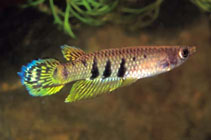
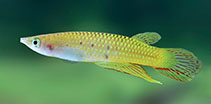
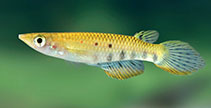
Etymology: Aplocheilus:Greek, aploe, -es = simplicity + Greek, cheilos = lip (Ref. 45335). Eponymy: Dr Francis Day CIE (1829–1889) was Inspector-General of Fisheries in India (1871–1877) and Burma and an ichthyologist. [...] (Ref. 128868), visit book page. More on author: Steindachner.
Asia: endemic to Sri Lanka. Reported from India and Malay Peninsula (Ref. 4833).
Storlek / Vikt / Ålder
Könsmognad: Lm? range ? - ? cm Max length : 9.0 cm TL hane/ej könsbestämd; (Ref. 27139); common length : 7.0 cm hane/ej könsbestämd; (Ref. 4833)
Usually inhabits shallow, heavily shaded forest streams with a silt substrate. Also occurs in brackish mangrove swamps, often together with Aplocheilus parvus. Feeds on small insects, insect larvae and fish fry. Cultivated as a larvicidal fish (Ref. 4833). 10 cm max TL (Ref. 6028).Not a seasonal killifish. Is easy to maintain in the aquarium (Ref. 27139).
Huber, J.H., 1996. Killi-Data 1996. Updated checklist of taxonomic names, collecting localities and bibliographic references of oviparous Cyprinodont fishes (Atherinomorpha, Pisces). Société Française d'Ichtyologie, Muséum National d'Histoire Naturelle, Paris, France, 399 p. (Ref. 27139)
Status på IUCN:s rödlista (Ref. 130435: Version 2025-2)
Endangered (EN) (B1ab(iii)+2ab(iii)); Date assessed: 01 August 2019
Index för fylogenetisk mångfald (Ref. 82804): PD50 = 0.5079 [Uniqueness, from 0.5 = low to 2.0 = high].
Bayesian length-weight: a=0.00389 (0.00180 - 0.00842), b=3.12 (2.94 - 3.30), in cm total length, based on all LWR estimates for this body shape (Ref. 93245).
Trofisk nivå (Ref. 69278): 3.5 ±0.43 se; based on food items.
Sårbarhet i fisket (Ref. 59153): Low vulnerability (10 of 100). 🛈