-

- Om denna sida
- Språk
- Återkoppling från användare
- Referens
- Uppladdningar
-
Relaterade arter
- Arter i
Maccullochella - Arter i
Percichthyidae - - Klassificering -
- Percichthyidae
- Centrarchiformes
- Teleostei
- Chordata
- Animalia
- Arter i
-



Maccullochella peelii (Mitchell, 1838)
Murray cod
Ladda upp din foton och Videor
Bilder | Frimärken, mynt, diverse. | Google image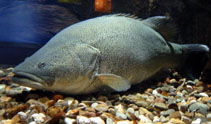 Maccullochella peelii
Bild av Truong, K.
Bilder | Frimärken, mynt, diverse. | Google image
Bild av Truong, K.
Klassificering / Namn Populärnamn | synonymer | Catalog of Fishes(Släkte, Arter) | ITIS | CoL | WoRMS | Cloffa
> Centrarchiformes (Basses) > Percichthyidae (Temperate perches)
Eponymy: Allan Riverstone McCulloch (1885–1925) was a noted Australian ichthyologist. [...] Despite appearing to be an eponym, this is actually a toponym referring to the Peel River, New South Wales, where the species was first caught (by Europeans). The river was named after Sir Robert Peel (1788–1850). (Ref. 128868), visit book page.
Eponymy: Allan Riverstone McCulloch (1885–1925) was a noted Australian ichthyologist. [...] Despite appearing to be an eponym, this is actually a toponym referring to the Peel River, New South Wales, where the species was first caught (by Europeans). The river was named after Sir Robert Peel (1788–1850). (Ref. 128868), visit book page.
Miljö: miljö / Klimatzon / djupintervall / distributionsområde Ekologi
; sötvatten bottenlevande; flodvandrande (Ref. 51243); djupintervall ? - 5 m (Ref. 6390). Temperate; 21°S - 37°S
Utbredning Territorier | FAO områden | Ekosystem | Förekomster | Prickkarta | Utplanteringar | Faunafri
Oceania: throughout most of the Murray-Darling River system of South Australia, Victoria, New South Wales, and Queensland, except for the upper reaches of the southern tributaries (Ref. 6390). Introduced into many lakes and dams throughout Victoria and New South Wales. Their abundance has been drastically reduced across their natural range and they are now considered rare in many Victorian tributaries (Ref. 27498).
Längd vid första mognad / Storlek / Vikt / Ålder
Könsmognad: Lm 55.0, range 48 - 62 cm
Max length : 180 cm SL hane/ej könsbestämd; (Ref. 5259); common length : 60.0 cm SL hane/ej könsbestämd; (Ref. 5259); publicerad maxvikt: 113.5 kg (Ref. 27446); rapporterad maxålder: 48 år (Ref. 6987)
Max length : 180 cm SL hane/ej könsbestämd; (Ref. 5259); common length : 60.0 cm SL hane/ej könsbestämd; (Ref. 5259); publicerad maxvikt: 113.5 kg (Ref. 27446); rapporterad maxålder: 48 år (Ref. 6987)
The Murray cod is one of the world's largest freshwater fish (Ref. 6390). They live in a wide range of habitats, from clear, rocky streams to slow flowing, turbid rivers and billabongs (Ref. 27498). They are generally found in waters to 5 m deep, in sheltered areas with cover from rocks, timber or overhanging banks. Adult fish are carnivorous, having a diet of invertebrates, fish, amphibians and occasionally reptiles, birds and aquatic mammals (Ref. 27498). The young feed on zooplankton. Spawning takes place from spring to early summer. Murray cod are territorial, their 'territory' associated with a specific hole, snag (large woody debris) or area of a river or lake (Ref. 27498). Juveniles may undertake migrations (Ref. 6390). Threatened due to over harvesting and habitat loss (Ref. 58490).
Livscykel och parningsbeteende Könsmognad | Reproduktion | Lek | Ägg | Fekunditet | Larver
Cod form pairs & only one male spawn with each female (Ref. 27498). The spawning site can be in water as shallow as 30 cm (Ref. 27498). The male protect and probably fans the eggs during incubation (Ref. 27498).
Egg masses are laid on the bottom and adhere to the substrate (Ref. 6390).
Huvudreferens
Ladda upp dina referenser | referenser | Koordinator : Arratia, Gloria | Medarbetare
Allen, G.R., 1989. Freshwater fishes of Australia. T.F.H. Publications, Inc., Neptune City, New Jersey. (Ref. 5259)
Status på IUCN:s rödlista (Ref. 130435: Version 2025-2)
Least Concern (LC) ; Date assessed: 13 February 2019
CITES
Not Evaluated
Hot mot människor
Harmless
Mänskliga användningsområden
Fiskeri: kommersiell; Vattenbruk: kommersiell; sportfisk: ja
FAO - Vattenbrukssystem: produktion; ; Publication: search | FishSource |
Ytterligare information
Populationsdynamik
Tillväxtparametrar
Max. åldrar / storlekar
Längd-vikt rel.
Längd-längd rel.
Längd-frekvenser
Massakonvertering
Rekrytering
Abundans
Tillväxtparametrar
Max. åldrar / storlekar
Längd-vikt rel.
Längd-längd rel.
Längd-frekvenser
Massakonvertering
Rekrytering
Abundans
Livscykel
Reproduktion
Könsmognad
Mognad/Gills rel.
Fekunditet
Lek
Lekande aggregat
Ägg
Utveckling av ägg
Larver
Larvdynamik
Reproduktion
Könsmognad
Mognad/Gills rel.
Fekunditet
Lek
Lekande aggregat
Ägg
Utveckling av ägg
Larver
Larvdynamik
Anatomi
Gälyta
Hjärna
Otolit
Gälyta
Hjärna
Otolit
Fysiologi
Kroppssammansättning
Näringsämnen
Syreförbrukning
Typ av simning
Simhastighet
Visuella pigment
Ljud från fisk
Sjukdomar & Parasiter
Toxicitet (LC50)
Kroppssammansättning
Näringsämnen
Syreförbrukning
Typ av simning
Simhastighet
Visuella pigment
Ljud från fisk
Sjukdomar & Parasiter
Toxicitet (LC50)
Genetik
Genom
Genetik
Heterozygositet
Ärftlighet
Genetisk mångfald
Genom
Genetik
Heterozygositet
Ärftlighet
Genetisk mångfald
Människorelaterad
Vattenbrukssystem
Vattenbruksprofiler
Avelslinjer
Ciguatera-fall
Frimärken, mynt, diverse.
Vattenbrukssystem
Vattenbruksprofiler
Avelslinjer
Ciguatera-fall
Frimärken, mynt, diverse.
Verktyg
Organisk frågesport | E-bok | Fälthandbok | Längdfördelnings-verktyg | Livshistorie-verktyg | Prickkarta |
Fångst-MSY |
Särskilda rapporter
Kontrollera för underhåll av akvarium | Kontrollera om det finns faktablad om arter | Kontrollera om det finns faktablad om vattenbruk
Ladda ner XML
Internet-källor
AFORO (otoliths) | Alien/Invasive Species database | Aquatic Commons | BHL | Cloffa | Websites from users | Check FishWatcher | CISTI | Catalog of Fishes: Släkte, Arter | DiscoverLife | ECOTOX | FAO - Vattenbrukssystem: produktion; ; Publication: search | Faunafri | Fishipedia | Fishtrace | GloBI | Google Books | Google Scholar | Google | IGFA World Record | OneZoom | Open Tree of Life | Otolith Atlas of Taiwan Fishes | PubMed | Reef Life Survey | Socotra Atlas | TreeBase | Tree of Life | Wikipedia: Go, sök | World Records Freshwater Fishing | Zoologiskt register
Uppskattningar baserade på modeller
Index för fylogenetisk mångfald (Ref. 82804): PD50 = 0.5625 [Uniqueness, from 0.5 = low to 2.0 = high].
Bayesian length-weight: a=0.01047 (0.00400 - 0.02738), b=3.01 (2.79 - 3.23), in cm total length, based on LWR estimates for this (Sub)family-body shape (Ref. 93245).
Trofisk nivå (Ref. 69278): 4.2 ±0.62 se; based on food items.
Resiliens (Ref. 120179): Låg, lägsta populationsfördubblingstid 4,5-14 år (tm=3-6; tmax=48).