This website uses cookies to enhance your browsing experience and ensure the functionality of our site. For more detailed information about the types of cookies we use and how we protect your privacy, please visit our Privacy Information page.
×
Cookie Settings
This website uses different types of cookies to enhance your experience. Please select your preferences below:
Teleostei (teleosts) > Perciformes/Uranoscopoidei (Sand dwellers) > Pinguipedidae (Sandperches)
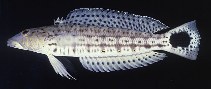
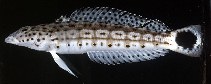
Etymology: Parapercis:Greek, para = the side of + Greek, perke = perch (Ref. 45335); xanthogramma:Named for the yellow bands on the cheek region of the males.
Environment: milieu / climate zone / depth range / distribution range Ecology
Marine; benthopelagic; depth range 0 - 6 m (Ref. 75058). Tropical
Central Pacific: Fiji, Tonga and Western Samoa; including the Solomon Is.
Size / Weight / Age
Maturity: Lm? range ? - ? cm Max length : 17.4 cm SL male/unsexed; (Ref. 75058); 15.8 cm SL (female)
Short description Identification keys | Morphology | Morphometrics
Dorsalspines (total): 5; Dorsalsoft rays (total): 21; Analspines: 1; Analsoft rays: 17. This species is distinguished by the following characters: pectoral fin rays, usually 18; cheek region with 4-7 oblique, pale (yellow when fresh) entire bands; lower portion of the body in males with 3-4 ocelli and a series of several blackish and brownish spots; cheek region with B5 spot, 6-8 ocelli and brownish spots or patches between ocelli in females and juveniles (Ref. 75058). Body shape (shape guide): elongated; Cross section: oval.
Life cycle and mating behavior Maturity | Reproduction | Spawning | Eggs | Fecundity | Larvae
Imamura, H. and T. Yoshino, 2007. Three new species of the genus Parapercis from the Western Pacific, with Rediscription of Parapercis hexophtalma (Perciformes:Pinguipedidae). Bull. Natl. Mus. Nat. Sci. Ser. A, Suppl. 1:81-100. (Ref. 75058)
IUCN Red List Status (Ref. 130435: Version 2025-2)