This website uses cookies to enhance your browsing experience and ensure the functionality of our site. For more detailed information about the types of cookies we use and how we protect your privacy, please visit our Privacy Information page.
×
Cookie Settings
This website uses different types of cookies to enhance your experience. Please select your preferences below:
Teleostei (teleosts) > Blenniiformes (Blennies) > Blenniidae (Combtooth blennies) > Blenniinae
Etymology: Meiacanthus:Greek, meion = less = lessen + Greek, akantha = thorn (Ref. 45335); oualanensis:Named for the island of Ovalau (Fiji); should have been ovalauensis (Ref.54980). More on author: Günther.
Environment: milieu / climate zone / depth range / distribution range Ecology
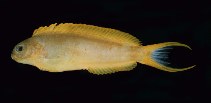
Dorsalspines (total): 4 - 5; Dorsalsoft rays (total): 25 - 28; Analspines: 2; Analsoft rays: 16 - 18. Lunate caudal fin with elongated lobes in large adults; body coloration bright yellow, head somewhat greenish dorsally; dorsal fin with faint greenish stripe; axil of pectoral fin with dark spot; caudal fin transparent at centroposterior area with translucent dusky rays. Doral rays IV-V (rarely V), 25-28 but typically 27; segmented caudal rays 11-12 (typically 11); with lateral line (Ref. 54980). Body shape (shape guide): elongated.
Oviparous. Eggs are demersal and adhesive (Ref. 205), and are attached to the substrate via a filamentous, adhesive pad or pedestal (Ref. 94114). Larvae are planktonic, often found in shallow, coastal waters (Ref. 94114).
Life cycle and mating behavior Maturity | Reproduction | Spawning | Eggs | Fecundity | Larvae
Phylogenetic diversity index (Ref. 82804): PD50 = 0.5000 [Uniqueness, from 0.5 = low to 2.0 = high].
Bayesian length-weight: a=0.00575 (0.00253 - 0.01308), b=3.06 (2.86 - 3.26), in cm total length, based on LWR estimates for this (Sub)family-body shape (Ref. 93245).
Trophic level (Ref. 69278): 3.5 ±0.5 se; based on size and trophs of closest relatives
Resilience (Ref. 120179): High, minimum population doubling time less than 15 months (Preliminary K or Fecundity.).
Fishing Vulnerability (Ref. 59153): Low vulnerability (10 of 100). 🛈