Teleostei (teleosts) >
Eupercaria/misc (Various families in series Eupercaria) >
Caesionidae (Fusiliers) > Caesioninae
Etymology: Caesio: Latin, caesius, bluish-grey, 1835; it is the same name given to the silvery metal (Cs) (Ref. 45335).
More on author: Rüppell.
Environment: milieu / climate zone / depth range / distribution range
Ecology
Marine; reef-associated; non-migratory; depth range 2 - 30 m (Ref. 9710). Tropical; 31°N - 11°N, 32°E - 45°E (Ref. 402)
Western Indian Ocean: Red Sea to the Arabian Sea.
Size / Weight / Age
Maturity: Lm ? range ? - ? cm
Max length : 25.0 cm TL male/unsexed; (Ref. 402); common length : 24.0 cm TL male/unsexed; (Ref. 5450)
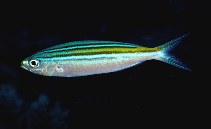
Dorsal spines (total): 10; Dorsal soft rays (total): 14 - 16; Anal spines: 3; Anal soft rays: 12. Body light bluish to greenish dorsally, white ventrally. 3-4 scales on cheek; 19-25 predorsal scales; scaled dorsal and anal fins; Supra-temporal band of scales continuous at dorsal midline. Upper peduncular scale rows usually 11 (11-12); lower peduncular scale rows usually 15 (14-15). A small process on basioccipital for attachment of Baudelot's ligament. Post maxillary process single; posterior end of maxilla blunt.
Body shape (shape guide): fusiform / normal; Cross section: compressed.
Inhabits coastal areas, primarily around coral reefs. Forms aggregations in midwater and feeds on zooplankton. Oviparous, with numerous, small pelagic eggs (Ref. 402).
Life cycle and mating behavior
Maturity | Reproduction | Spawning | Eggs | Fecundity | Larvae
Carpenter, K.E., 1987. Revision of the Indo-Pacific fish family Caesionidae (Lutjanoidea), with descriptions of five new species. Indo-Pac. Fish. (15):56 p. (Ref. 1723)
IUCN Red List Status (Ref. 130435: Version 2025-2)
Threat to humans
Harmless
Human uses
Fisheries: subsistence fisheries
Tools
Special reports
Download XML
Internet sources