Teleostei (teleosts) >
Gadiformes (Cods) >
Macrouridae (Grenadiers or rattails)
Etymology: Coelorinchus: Greek, koilos = a hollow + Greek, rhyngchos = jaw (Ref. 45335).
Eponymy: Professor Dr August Bernhard Brauer (1863–1917) was a German herpetologist and ichthyologist. [...] (Ref. 128868), visit book page.
More on author: Barnard.
Environment: milieu / climate zone / depth range / distribution range
Ecology
Marine; bathydemersal; non-migratory; depth range 400 - 1200 m (Ref. 11953). Deep-water; - 38°S
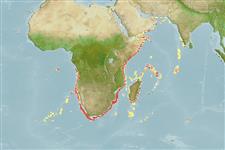
Southeast Atlantic and Southwest Indian Ocean: Angola to Mozambique.
Size / Weight / Age
Maturity: Lm ? range ? - ? cm
Max length : 40.0 cm TL male/unsexed; (Ref. 1371)
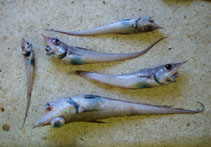
Dorsal spines (total): 2; Dorsal soft rays (total): 112 - 114; Anal spines: 0; Anal soft rays: 105. The head is large; the eyes also large; the snout conical. Head ridges strongly demarcated with coarse scute-like scales; underside of the head scaled. The body tapers posteriorly from the first dorsal-fin spine insertion. Light organ short, narrow, extending to about midway between anal fin origin and pelvic fin insertion. Swim bladder weakly bilobate anteriorly, with 4 retia mirabilia. Caudal fin absent. Overall color is pale brown, the fins are darker; mouth and gill cavity linings gray to blackish.
Body shape (shape guide): elongated; Cross section: oval.
Life cycle and mating behavior
Maturity | Reproduction | Spawning | Eggs | Fecundity | Larvae
Iwamoto, T. and E. Anderson, 1994. Review of the grenadiers (Teleostei: Gadiformes) of southern Africa, with descriptions of four new species. Ichthyol. Bull. J.L.B. Smith Inst. Ichthyol. (61):1-28. (Ref. 11953)
IUCN Red List Status (Ref. 130435: Version 2025-2)
Threat to humans
Harmless
Human uses
Fisheries: of no interest
Tools
Special reports
Download XML
Internet sources