



Cambeva luteoreticulata Costa, Feltrin & Katz, 2024
Upload your photos and videos
Google image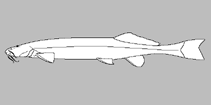 No image available for this species;
drawing shows typical species in Trichomycteridae.
Google image
drawing shows typical species in Trichomycteridae.
Classification / Names Common names | Synonyms | Catalog of Fishes(genus, species) | ITIS | CoL | WoRMS | Cloffa
Teleostei (teleosts) > Siluriformes (Catfishes) > Trichomycteridae (Pencil or parasitic catfishes) > Trichomycterinae
Etymology: Cambeva: Probably derived from the Tupi-Guarani, is a popular name for trichomycterid fishes in southern and south-eastern Brazil (Ref. 119381); luteoreticulata: Name 'luteoreticulata' from the Latin words 'luteus' and 'reticulata', meaning 'yellow' and 'reticulated', in reference to the flank colour pattern of adult specimens.
Etymology: Cambeva: Probably derived from the Tupi-Guarani, is a popular name for trichomycterid fishes in southern and south-eastern Brazil (Ref. 119381); luteoreticulata: Name 'luteoreticulata' from the Latin words 'luteus' and 'reticulata', meaning 'yellow' and 'reticulated', in reference to the flank colour pattern of adult specimens.
Environment: milieu / climate zone / depth range / distribution range Ecology
Freshwater; demersal. Subtropical
Distribution Territories | FAO areas | Ecosystems | Occurrences | Point map | Introductions | Faunafri
South America: Brazil.
Size / Weight / Age
Short description Identification keys | Morphology | Morphometrics
Dorsal spines (total): 2; Dorsal soft rays (total): 7; Anal spines: 2; Anal soft rays: 5; Vertebrae: 38 - 40. This species is distinguished from its congeners by the following set of characters: unique rounded, stapula-shaped caudal fin in specimens above about 40 mm SL; short barbels, with the nasal barbel not reaching the orbit in specimens above 60 mm SL and maxillary and rictal barbels not reaching the interopercular patch of odontodes; anterior segment of the infraorbital series absent; procurrent caudal-fin rays 21 or 22 dorsal and 15 or 16 ventral; opercular odontodes 10-12; hypertrophied papillae on the head surface absent; narrow nasal barbel; unique pattern of ontogenetic colouration change consisting of flank pale yellow with irregularly shaped and arranged; dark brown to black blotches in specimens below about 40 mm SL, dark brown, with small, irregularly shaped pale yellow marks forming reticulate pattern in larger specimens; 7 pectoral-fin rays; anterior infraorbital absent; posterior margin of the caudal fin convex; pectoral-fin filament absent; 9 or 10 opercular odontodes; 29-32 interopercular odontodes; 15 or 16 ventral procurrent caudal-fin rays; dorsal-fin origin at a vertical through the centrum of the 21st or 22nd vertebra; jaw teeth incisiform, teeth arranged in rows; and 38-–40 vertebrae (Ref. 137708).
Body shape (shape guide): elongated; Cross section: oval.
Body shape (shape guide): elongated; Cross section: oval.
Life cycle and mating behavior Maturity | Reproduction | Spawning | Eggs | Fecundity | Larvae
Main reference
Upload your references | References | Coordinator : Pinna, Mário de | Collaborators
Costa, W.J.E.M., C.R.M Feltrin, J.L.O Mattos and A.M. Katz, 2024. Top mountain areas of subtropical southern Brazil sheltering four new small-ranged catfishes (Siluriformes, Trichomycteridae): relationships and taxonomy. Evolutionary Systematics. 8:199-218. (Ref. 137708)
CITES
Not Evaluated
Threat to humans
Harmless
Human uses
Fisheries: of no interest
FAO - Publication: search | FishSource |
More information
Trophic ecology
Food items (preys)
Diet composition
Food consumption
Food rations
Predators
Food items (preys)
Diet composition
Food consumption
Food rations
Predators
Ecology
Ecology
Ecology
Population dynamics
Growth parameters
Max. ages / sizes
Length-weight rel.
Length-length rel.
Length-frequencies
Mass conversion
Recruitment
Abundance
Growth parameters
Max. ages / sizes
Length-weight rel.
Length-length rel.
Length-frequencies
Mass conversion
Recruitment
Abundance
Life cycle
Reproduction
Maturity
Maturity/Gills rel.
Fecundity
Spawning
Spawning aggregations
Eggs
Egg development
Larvae
Larval dynamics
Reproduction
Maturity
Maturity/Gills rel.
Fecundity
Spawning
Spawning aggregations
Eggs
Egg development
Larvae
Larval dynamics
Anatomy
Gill area
Brain
Otolith
Gill area
Brain
Otolith
Physiology
Body composition
Nutrients
Oxygen consumption
Swimming type
Swimming speed
Visual pigments
Fish sound
Diseases & Parasites
Toxicity (LC50s)
Body composition
Nutrients
Oxygen consumption
Swimming type
Swimming speed
Visual pigments
Fish sound
Diseases & Parasites
Toxicity (LC50s)
Genetics
Genome
Genetics
Heterozygosity
Heritability
Genetic Diversity
Genome
Genetics
Heterozygosity
Heritability
Genetic Diversity
Human related
Aquaculture systems
Aquaculture profiles
Strains
Ciguatera cases
Stamps, coins, misc.
Aquaculture systems
Aquaculture profiles
Strains
Ciguatera cases
Stamps, coins, misc.
Tools
Special reports
Download XML
Internet sources
AFORO (otoliths) | Aquatic Commons | BHL | Cloffa | Websites from users | Check FishWatcher | CISTI | Catalog of Fishes: genus, species | DiscoverLife | ECOTOX | FAO - Publication: search | Faunafri | Fishipedia | Fishtrace | GloBI | Google Books | Google Scholar | Google | IGFA World Record | OneZoom | Open Tree of Life | Otolith Atlas of Taiwan Fishes | PubMed | Reef Life Survey | Socotra Atlas | TreeBase | Tree of Life | Wikipedia: Go, Search | World Records Freshwater Fishing | Zoobank | Zoological Record
Estimates based on models
Phylogenetic diversity index (Ref. 82804): PD50 = 0.5000 [Uniqueness, from 0.5 = low to 2.0 = high].
Bayesian length-weight: a=0.00759 (0.00337 - 0.01709), b=3.00 (2.81 - 3.19), in cm total length, based on LWR estimates for this (Sub)family-body shape (Ref. 93245).
Trophic level (Ref. 69278): 3.2 ±0.4 se; based on size and trophs of closest relatives