Teleostei (teleosts) >
Atheriniformes (Silversides) >
Atherinidae (Silversides) > Atherinomorinae
Etymology: Atherinomorus: Greek, atherina, the Greek name for the eperlane + Greek, moros = silly, stupid (Ref. 45335).
More on authors: Quoy & Gaimard.
Environment: milieu / climate zone / depth range / distribution range
Ecology
Marine; brackish; reef-associated. Tropical; 19°N - 24°S
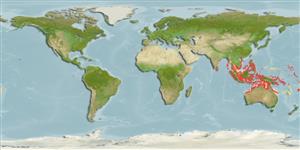
Western Central Pacific: Philippines and Micronesia to northern Australia and the Solomon Islands.
Size / Weight / Age
Maturity: Lm ? range ? - ? cm
Max length : 9.6 cm SL male/unsexed; (Ref. 137577)
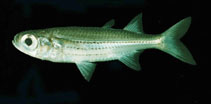
Dorsal spines (total): 5 - 7; Dorsal soft rays (total): 8 - 10; Anal spines: 1; Anal soft rays: 11 - 14. Pectoral blotch, when present, distinct; midlateral band silvery (Ref. 9760). Ramus of premaxilla not extending past vertical through anterior border of pupil; Free edge of lower jaw sloping backwards and upwards and with distinct tubercle at posterior end.
Body shape (shape guide): elongated; Cross section: oval.
Found in shallow coastal waters. Schools with A. lacunosus, A. ogilbyi, Craterocephalus mugiloides, and Hypoatherina temminckii, in the coasts of northern Australia.
Life cycle and mating behavior
Maturity | Reproduction | Spawning | Eggs | Fecundity | Larvae
Ivantsoff, W. and L.E.L.M. Crowley, 1991. Review of the Australian silverside fishes of the genus Atherinomorus (Atherinidae). Aust. J. Mar. Freshwat. Res. 42(5):479-505. (Ref. 2909)
IUCN Red List Status (Ref. 130435: Version 2025-2)
Threat to humans
Harmless
Human uses
Fisheries: of no interest
Tools
Special reports
Download XML
Internet sources