-

- About this page
- Languages
- User feedbacks
- Citation
- Uploads
- Related species
-



Pomadasys commersonnii (Lacepède, 1801)
Smallspotted grunter
Add your observation in Fish Watcher
| Native range | All suitable habitat | Point map | Year 2050 |

|
| This map was computer-generated and has not yet been reviewed. |
| Pomadasys commersonnii AquaMaps Data sources: GBIF OBIS |
Upload your photos and videos
Pictures | Stamps, coins, misc. | Google image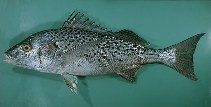 Pomadasys commersonnii
Picture by Randall, J.E.
Pictures | Stamps, coins, misc. | Google image
Picture by Randall, J.E.
Classification / Names Common names | Synonyms | Catalog of Fishes(genus, species) | ITIS | CoL | WoRMS | Cloffa
Teleostei (teleosts) > Eupercaria/misc (Various families in series Eupercaria) > Haemulidae (Grunts) > Haemulinae
Etymology: Pomadasys: Greek, poma, -atos = cover, operculum + Greek, dasys = with hair (Ref. 45335).
Eponymy: Dr Philibert Commerson (1727–1773) was known as ‘doctor, botanist and naturalist of the King’. [...] (Ref. 128868), visit book page.
More on author: Lacepède.
Etymology: Pomadasys: Greek, poma, -atos = cover, operculum + Greek, dasys = with hair (Ref. 45335).
Eponymy: Dr Philibert Commerson (1727–1773) was known as ‘doctor, botanist and naturalist of the King’. [...] (Ref. 128868), visit book page.
More on author: Lacepède.
Environment: milieu / climate zone / depth range / distribution range Ecology
Marine; brackish; reef-associated; oceanodromous (Ref. 51243); depth range 0 - 49 m (Ref. 122701). Tropical; 31°N - 37°S, 18°E - 77°E
Distribution Territories | FAO areas | Ecosystems | Occurrences | Point map | Introductions | Faunafri
Southeast Atlantic and Western Indian Ocean: Western and Eastern Cape, South Africa, East Africa, Persian Gulf, Socotra, Seychelles, Madagascar to northwest coast of India.
Length at first maturity / Size / Weight / Age
Short description Identification keys | Morphology | Morphometrics
Dorsal spines (total): 10 - 11; Dorsal soft rays (total): 14 - 15; Anal spines: 3; Anal soft rays: 9 - 10. Juveniles without spots on body (Ref. 2799).
Body shape (shape guide): fusiform / normal.
Body shape (shape guide): fusiform / normal.
Found in coastal waters, estuaries, and tidal fissures; can tolerate freshwater. It can jet a stream of water into the mud to expose crustaceans, worms and small bivalves which it feeds on (Ref. 11441); including fish (Ref. 5213). Tasty food fish (Ref. 2799). Maximum depth range from Ref. 122702.
Life cycle and mating behavior Maturity | Reproduction | Spawning | Eggs | Fecundity | Larvae
Oviparous, distinct pairing during breeding (Ref. 205).
Main reference
Upload your references | References | Coordinator | Collaborators
Smith, M.M. and R.J. McKay, 1986. Haemulidae. p. 564-571. In M.M. Smith and P.C. Heemstra (eds.) Smiths' sea fishes. Springer-Verlag, Berlin. (Ref. 2799)
CITES
Not Evaluated
Threat to humans
Harmless
Human uses
Fisheries: commercial; gamefish: yes
FAO - Publication: search | FishSource |
More information
Population dynamics
Growth parameters
Max. ages / sizes
Length-weight rel.
Length-length rel.
Length-frequencies
Mass conversion
Recruitment
Abundance
Growth parameters
Max. ages / sizes
Length-weight rel.
Length-length rel.
Length-frequencies
Mass conversion
Recruitment
Abundance
Life cycle
Reproduction
Maturity
Maturity/Gills rel.
Fecundity
Spawning
Spawning aggregations
Eggs
Egg development
Larvae
Larval dynamics
Reproduction
Maturity
Maturity/Gills rel.
Fecundity
Spawning
Spawning aggregations
Eggs
Egg development
Larvae
Larval dynamics
Anatomy
Gill area
Brain
Otolith
Gill area
Brain
Otolith
Physiology
Body composition
Nutrients
Oxygen consumption
Swimming type
Swimming speed
Visual pigments
Fish sound
Diseases & Parasites
Toxicity (LC50s)
Body composition
Nutrients
Oxygen consumption
Swimming type
Swimming speed
Visual pigments
Fish sound
Diseases & Parasites
Toxicity (LC50s)
Tools
Special reports
Download XML
Internet sources
AFORO (otoliths) | Aquatic Commons | BHL | Cloffa | Websites from users | Check FishWatcher | CISTI | Catalog of Fishes: genus, species | DiscoverLife | ECOTOX | FAO - Publication: search | Faunafri | Fishipedia | Fishtrace | GloBI | Google Books | Google Scholar | Google | IGFA World Record | OneZoom | Open Tree of Life | Otolith Atlas of Taiwan Fishes | PubMed | Reef Life Survey | Socotra Atlas | TreeBase | Tree of Life | Wikipedia: Go, Search | World Records Freshwater Fishing | Zoological Record
Estimates based on models
Preferred temperature (Ref. 123201): 22 - 27.9, mean 26.8 °C (based on 146 cells).
Phylogenetic diversity index (Ref. 82804): PD50 = 0.5000 [Uniqueness, from 0.5 = low to 2.0 = high].
Bayesian length-weight: a=0.01905 (0.01223 - 0.02969), b=2.95 (2.82 - 3.08), in cm total length, based on LWR estimates for this species & Genus-body shape (Ref. 93245).
Trophic level (Ref. 69278): 3.5 ±0.2 se; based on diet studies.
Generation time: 5.8 ( na - na) years. Estimated as median ln(3)/K based on 2 growth studies.
Resilience (Ref. 120179): Low, minimum population doubling time 4.5 - 14 years (K=0.07-0.42).
Nutrients (Ref. 124155): Calcium = 31 [11, 60] mg/100g; Iron = 0.547 [0.284, 0.949] mg/100g; Protein = 19.9 [18.0, 21.6] %; Omega3 = 0.135 [0.076, 0.229] g/100g; Selenium = 37.4 [22.7, 67.5] μg/100g; VitaminA = 39.3 [14.1, 108.1] μg/100g; Zinc = 1.06 [0.74, 1.61] mg/100g (wet weight);