-

- About this page
- Languages
- User feedbacks
- Citation
- Uploads
- Related species
-



Sebastes norvegicus (Ascanius, 1772)
Golden redfish
Add your observation in Fish Watcher
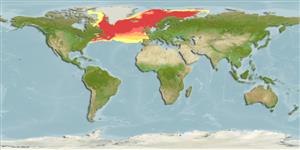
| Native range | All suitable habitat | Point map | Year 2050 |
|
| This map was computer-generated and has not yet been reviewed. |
| Sebastes norvegicus AquaMaps Data sources: GBIF OBIS |
Upload your photos and videos
Pictures | Stamps, coins, misc. | Google image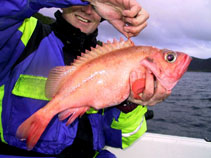 Sebastes norvegicus
Picture by Tveskov, E.
Pictures | Stamps, coins, misc. | Google image
Picture by Tveskov, E.
Classification / Names Common names | Synonyms | Catalog of Fishes(genus, species) | ITIS | CoL | WoRMS | Cloffa
Teleostei (teleosts) > Perciformes/Scorpaenoidei (Scorpionfishes) > Sebastidae (Rockfishes, rockcods and thornyheads) > Sebastinae
Etymology: Sebastes: Greek, sebastes = august, venerable (Ref. 45335).
Etymology: Sebastes: Greek, sebastes = august, venerable (Ref. 45335).
Environment: milieu / climate zone / depth range / distribution range Ecology
Marine; pelagic-oceanic; oceanodromous (Ref. 51243); depth range 100 - 1000 m, usually 100 - 500 m (Ref. 35388). Temperate; 3°C - 7°C (Ref. 35388); 79°N - 39°N, 75°W - 71°E
Distribution Territories | FAO areas | Ecosystems | Occurrences | Point map | Introductions | Faunafri
Eastern Atlantic: Kattegat and North Sea, northward to Spitsbergen, southern part of Barents Sea eastward to Kanin Banks and Novaya Zemlya, rare in White Sea, Iceland and eastern Greenland. Western Atlantic: Greenland and southeastern Labrador in Canada to New Jersey in USA (Ref. 7251).
Length at first maturity / Size / Weight / Age
Maturity: Lm 38.9, range 38 - 41 cm
Max length : 100.0 cm TL male/unsexed; (Ref. 4570); common length : 45.0 cm TL male/unsexed; (Ref. 4570); max. published weight: 15.0 kg (Ref. 35388); max. reported age: 60 years (Ref. 35388)
Max length : 100.0 cm TL male/unsexed; (Ref. 4570); common length : 45.0 cm TL male/unsexed; (Ref. 4570); max. published weight: 15.0 kg (Ref. 35388); max. reported age: 60 years (Ref. 35388)
Short description Identification keys | Morphology | Morphometrics
Body shape (shape guide): short and / or deep.
Found off the coast from 100-1000 m; juveniles found in fjords, bays and inshore waters. Normally trawled in deep water (Ref. 9988). Benthic (Ref. 5951). Feed mostly on euphausiids in summer; herrings in autumn and winter; capelins, herrings, euphausiids and ctenophores in spring. Gregarious throughout life. A slow growing species (Ref. 9988). Ovoviviparous, gonads of male and female do not mature at the same time. The spermatozoa are kept in the ovary of the female after copulation until such time that the eggs ripen paving the way for fertilization (Ref. 74488). Copulation takes place in late summer or early autumn (Ref. 35388, 34817); in winter females give birth to 50,000-350,000 pelagic larvae of 8 mm length (Ref. 35388). Utilized fresh and frozen; eaten fried, broiled, microwaved and baked (Ref. 9988).
Life cycle and mating behavior Maturity | Reproduction | Spawning | Eggs | Fecundity | Larvae
Gonads of male and female do not mature at the same time. The spermatozoa are kept in the ovary of the female after copulation until such time that the eggs ripen paving the way for fertilisation (Ref. 74488). Gives birth to 50,000-350,000 pelagic larvae of 8 mm length (Ref. 35388).
Main reference
Upload your references | References | Coordinator | Collaborators
Fernholm, B. and A. Wheeler, 1983. Linnaean fish specimens in the Swedish Museum of Natural History, Stockholm. Zool. J. Linn. Soc., 78(3):199-286. (Ref. 83993)
IUCN Red List Status (Ref. 130435: Version 2025-2)
Least Concern (LC) ; Date assessed: 27 March 2024
CITES
Not Evaluated
Threat to humans
Reports of ciguatera poisoning (Ref. 30911)
Human uses
Fisheries: highly commercial; gamefish: yes
FAO - Publication: search | FishSource | Sea Around Us
More information
Physiology
Body composition
Nutrients
Oxygen consumption
Swimming type
Swimming speed
Visual pigments
Fish sound
Diseases & Parasites
Toxicity (LC50s)
Body composition
Nutrients
Oxygen consumption
Swimming type
Swimming speed
Visual pigments
Fish sound
Diseases & Parasites
Toxicity (LC50s)
Genetics
Genome
Genetics
Heterozygosity
Heritability
Genetic Diversity
Genome
Genetics
Heterozygosity
Heritability
Genetic Diversity
Tools
E-book | Field guide | Identification keys | Length-frequency wizard | Life-history tool | Point map |
Catch-MSY |
Special reports
Download XML
Internet sources
AFORO (otoliths) | Aquatic Commons | BHL | Cloffa | Websites from users | Check FishWatcher | CISTI | Catalog of Fishes: genus, species | DiscoverLife | ECOTOX | FAO - Publication: search | Faunafri | Fishipedia | Fishtrace | GloBI | Google Books | Google Scholar | Google | IGFA World Record | National databases | OneZoom | Open Tree of Life | Otolith Atlas of Taiwan Fishes | Public aquariums | PubMed | Reef Life Survey | RFE Identification | Socotra Atlas | TreeBase | Tree of Life | Wikipedia: Go, Search | World Records Freshwater Fishing | Zoological Record
Estimates based on models
Preferred temperature (Ref. 123201): 0.6 - 9.3, mean 3.7 °C (based on 1514 cells).
Phylogenetic diversity index (Ref. 82804): PD50 = 0.5000 [Uniqueness, from 0.5 = low to 2.0 = high].
Bayesian length-weight: a=0.01380 (0.00638 - 0.02986), b=3.04 (2.86 - 3.22), in cm total length, based on LWR estimates for this Genus-body shape (Ref. 93245).
Trophic level (Ref. 69278): 4.0 ±0.68 se; based on food items.
Resilience (Ref. 120179): Low, minimum population doubling time 4.5 - 14 years (rm=0.23; K=0.06-0.08; tm=10-12; tmax=60; Fec= 19,000-350,000).
Prior r = 0.30, 95% CL = 0.20 - 0.45, Based on 5 full stock assessments.
Nutrients (Ref. 124155): Calcium = 12.3 [5.5, 33.4] mg/100g; Iron = 0.23 [0.10, 0.51] mg/100g; Protein = 18.3 [17.1, 19.5] %; Omega3 = 1.29 [0.51, 3.25] g/100g; Selenium = 44.8 [19.0, 116.1] μg/100g; VitaminA = 20.7 [6.3, 68.0] μg/100g; Zinc = 0.342 [0.187, 0.613] mg/100g (wet weight); based on nutrient studies.