This website uses cookies to enhance your browsing experience and ensure the functionality of our site. For more detailed information about the types of cookies we use and how we protect your privacy, please visit our Privacy Information page.
×
Cookie Settings
This website uses different types of cookies to enhance your experience. Please select your preferences below:
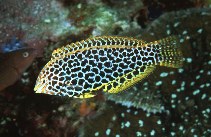
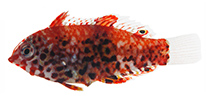
Dorsalspines (total): 9; Dorsalsoft rays (total): 11; Analspines: 3; Analsoft rays: 11; Vertebrae: 25. Color in life of young and females whitish to greenish with irregular black spots; males orange-red with greenish yellow spots (edged in blue and black, per scale); head spotted and banded. Anterior lateral line scales with 2-4 pores. Pelvic fins short, not reaching anus. Body shape (shape guide): fusiform / normal; Cross section: compressed.
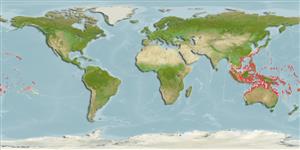
Inhabits subtidal reef flats and outer lagoon and seaward reefs (Ref. 1602). Usually in areas with mixed sand, rubble, and coral (Ref. 9710). Feeds mainly on gastropods, other hard-shelled prey (Ref. 9823), and foraminiferans (Ref. 37816). Rarely marketed.
Life cycle and mating behavior Maturity | Reproduction | Spawning | Eggs | Fecundity | Larvae
Oviparous, distinct pairing during breeding (Ref. 205).
Randall, J.E., 1978. A revision of the Indo-Pacific labrid fish genus Macropharyngodon, with descriptions of five new species. Bull. Mar. Sci. 28(4):742-770. (Ref. 2694)
IUCN Red List Status (Ref. 130435: Version 2025-2)
Preferred temperature (Ref. 123201): 24.7 - 28.9, mean 27.7 °C (based on 770 cells).
Phylogenetic diversity index (Ref. 82804): PD50 = 0.5002 [Uniqueness, from 0.5 = low to 2.0 = high].
Bayesian length-weight: a=0.00977 (0.00466 - 0.02049), b=3.07 (2.90 - 3.24), in cm total length, based on LWR estimates for this (Sub)family-body shape (Ref. 93245).
Trophic level (Ref. 69278): 3.1 ±0.4 se; based on diet studies.
Resilience (Ref. 120179): High, minimum population doubling time less than 15 months (Preliminary K or Fecundity.).
Fishing Vulnerability (Ref. 59153): Low vulnerability (10 of 100). 🛈