Teleostei (teleosts) >
Blenniiformes (Blennies) >
Chaenopsidae (Pike-, tube- and flagblennies)
Etymology: Acanthemblemaria: Greek, akantha = thorn + Greek, emblema, -atos, anything that is nailed, knocked in; also anything with bass or high relief (Ref. 45335).
Eponymy: Charles Clifford Gordon Chaplin (1906–1991) was a British ichthyologist born in India. [...] (Ref. 128868), visit book page.
Environment: milieu / climate zone / depth range / distribution range
Ecology
Marine; demersal; depth range 2 - 12 m (Ref. 26938). Tropical
Western Atlantic: southeastern Florida, USA and the Bahamas.
Size / Weight / Age
Maturity: Lm ? range ? - ? cm
Max length : 4.5 cm TL male/unsexed; (Ref. 7251)
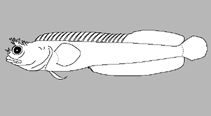
Anal spines: 2. Species distinguished by: dorsal fin consisting of spines and segmented rays; total dorsal-fin elements usually 39 or more; posterior third of supraorbital flange crenulate, without spines; fleshy lateral margins of interorbital region with row of 3 to 6 blunt papillae; spiny processes on head poorly developed, when present consisting of a few knobby projections; supraorbital cirrus moderately to strongly branched, cranial spines not short and blunt; patch of cranial spines on nape ends anterior to supratemporal commissural pore; inner rim of posterior infraorbital bone smooth; two or more rows of teeth on each palatine bone; no large, eye-diameter sized dark blotch on side of head posterior to eye. Common amongst Chaenopsids: small elongate fishes; largest species about 12 cm SL, most under 5 cm SL. Head usually with cirri or fleshy flaps on anterior nostrils, eyes, and sometimes laterally on nape; gill membranes continuous with each other across posteroventral surface of head. Each jaw with canine-like or incisor-like teeth anteriorly; teeth usually also present on vomer and often on palatines (roof of mouth). Dorsal-fin spines flexible, usually outnumbering the segmented soft rays (numbering 7 to 37), spinous and segmented-rayed portions forming a single, continuous fin; 2 flexible spines in anal fin; pelvic fins inserted anterior to position of pectoral fins, with 1 spine not visible externally and only 2 or 3 segmented (soft) rays; all fin rays, including caudal-fin rays, unbranched (simple). Lateral line absent. Scales absent (Ref.52855).
Body shape (shape guide): elongated.
Inhabits limestone slopes than patch reefs and these slopes are usually dotted with small corals and sea urchins, among others (Ref. 5521).
Life cycle and mating behavior
Maturity | Reproduction | Spawning | Eggs | Fecundity | Larvae
Robins, C.R. and G.C. Ray, 1986. A field guide to Atlantic coast fishes of North America. Houghton Mifflin Company, Boston, U.S.A. 354 p. (Ref. 7251)
IUCN Red List Status (Ref. 130435: Version 2025-2)
Threat to humans
Harmless
Human uses
Tools
Special reports
Download XML
Internet sources