-

- About this page
- Languages
- User feedbacks
- Citation
- Uploads
- Related species
-



Upload your photos and videos
Pictures | Google image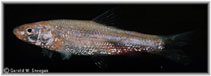 Ericymba buccata
Picture by Sneegas, G.W.
Pictures | Google image
Picture by Sneegas, G.W.
Classification / Names Common names | Synonyms | Catalog of Fishes(genus, species) | ITIS | CoL | WoRMS | Cloffa
Teleostei (teleosts) > Cypriniformes (Carps) > Leuciscidae (Minnows) > Pogonichthyinae
Etymology: buccata: Name from the words Eri, an intensifying prefix; cymba, meaning cavity; and buccata, cheek (Ref. 10294).
More on author: Cope.
Etymology: buccata: Name from the words Eri, an intensifying prefix; cymba, meaning cavity; and buccata, cheek (Ref. 10294).
More on author: Cope.
Environment: milieu / climate zone / depth range / distribution range Ecology
Freshwater; benthopelagic. Temperate; 43°N - 31°N
Distribution Territories | FAO areas | Ecosystems | Occurrences | Point map | Introductions | Faunafri
North America: Mississippi River, Ohio River, and Atlantic coastal tributaries north of the Cumberland River from Missouri to Virginia and Maryland.
Size / Weight / Age
Maturity: Lm ? range ? - ? cm
Max length : 9.8 cm TL male/unsexed; (Ref. 5723); common length : 3.8 cm TL male/unsexed; (Ref. 12193); max. reported age: 3.00 years (Ref. 12193)
Max length : 9.8 cm TL male/unsexed; (Ref. 5723); common length : 3.8 cm TL male/unsexed; (Ref. 12193); max. reported age: 3.00 years (Ref. 12193)
Short description Identification keys | Morphology | Morphometrics
Body shape (shape guide): fusiform / normal.
Inhabit shallow sandy riffles and raceways of creeks and small to medium rivers (Ref. 3814, 10294). Young and adult feed mainly on entomostracans (cladocerans, copepods, and ostracods); with adults also consuming increasing numbers of midge larvae (chironomids) at night. Life span, 3-4 years; sexual maturity reached in the second or late in the first summer of its life. Two spawning peaks, older individuals in the mid-spring spawning and the preceding year's young during the July spawning (Ref. 10294).
Life cycle and mating behavior Maturity | Reproduction | Spawning | Eggs | Fecundity | Larvae
Main reference
Upload your references | References | Coordinator | Collaborators
Stout, C., S. Schönhuth, R. Mayden, N.L. Garrison and J.W. Armbruster, 2022. Phylogenomics and classification of Notropis and related shiners (Cypriniformes: Leuciscidae) and the utility of exon capture on lower taxonomic groups. PeerJ 10 (art. e14072):1-23. (Ref. 131297)
IUCN Red List Status (Ref. 130435: Version 2025-2)
Least Concern (LC) ; Date assessed: 01 March 2012
CITES
Not Evaluated
Threat to humans
Harmless
Human uses
FAO - Publication: search | FishSource |
More information
Population dynamics
Growth parameters
Max. ages / sizes
Length-weight rel.
Length-length rel.
Length-frequencies
Mass conversion
Recruitment
Abundance
Growth parameters
Max. ages / sizes
Length-weight rel.
Length-length rel.
Length-frequencies
Mass conversion
Recruitment
Abundance
Life cycle
Reproduction
Maturity
Maturity/Gills rel.
Fecundity
Spawning
Spawning aggregations
Eggs
Egg development
Larvae
Larval dynamics
Reproduction
Maturity
Maturity/Gills rel.
Fecundity
Spawning
Spawning aggregations
Eggs
Egg development
Larvae
Larval dynamics
Anatomy
Gill area
Brain
Otolith
Gill area
Brain
Otolith
Physiology
Body composition
Nutrients
Oxygen consumption
Swimming type
Swimming speed
Visual pigments
Fish sound
Diseases & Parasites
Toxicity (LC50s)
Body composition
Nutrients
Oxygen consumption
Swimming type
Swimming speed
Visual pigments
Fish sound
Diseases & Parasites
Toxicity (LC50s)
Human related
Aquaculture systems
Aquaculture profiles
Strains
Ciguatera cases
Stamps, coins, misc.
Aquaculture systems
Aquaculture profiles
Strains
Ciguatera cases
Stamps, coins, misc.
Tools
Bio-Quiz | E-book | Field guide | Length-frequency wizard | Life-history tool | Point map |
Catch-MSY |
Special reports
Download XML
Internet sources
AFORO (otoliths) | Alien/Invasive Species database | Aquatic Commons | BHL | Cloffa | Websites from users | Check FishWatcher | CISTI | Catalog of Fishes: genus, species | DiscoverLife | ECOTOX | FAO - Publication: search | Faunafri | Fishipedia | Fishtrace | GloBI | Google Books | Google Scholar | Google | IGFA World Record | OneZoom | Open Tree of Life | Otolith Atlas of Taiwan Fishes | PubMed | Reef Life Survey | Socotra Atlas | TreeBase | Tree of Life | Wikipedia: Go, Search | World Records Freshwater Fishing | Zoobank | Zoological Record
Estimates based on models
Phylogenetic diversity index (Ref. 82804): PD50 = 0.6250 [Uniqueness, from 0.5 = low to 2.0 = high].
Bayesian length-weight: a=0.00794 (0.00452 - 0.01396), b=3.04 (2.89 - 3.19), in cm total length, based on LWR estimates for this species & Genus-body shape (Ref. 93245).
Trophic level (Ref. 69278): 3.1 ±0.30 se; based on food items.
Generation time: 1.2 ( na - na) years. Estimated as median ln(3)/K based on 1 growth studies.
Resilience (Ref. 120179): High, minimum population doubling time less than 15 months (K=0.89; tmax=3).