This website uses cookies to enhance your browsing experience and ensure the functionality of our site. For more detailed information about the types of cookies we use and how we protect your privacy, please visit our Privacy Information page.
×
Cookie Settings
This website uses different types of cookies to enhance your experience. Please select your preferences below:
Teleostei (teleosts) > Ophidiiformes (Cusk eels) > Dinematichthyidae (Viviparous brotula)
Etymology: Dermatopsoides:Greek, derma = skin + Greek, opsis = appearance (Ref. 45335). Eponymy: A toponym referring to the Kasouga River, South Africa. The holotype was caught near the mouth of this river. (Ref. 128868), visit book page. More on author: Smith.
Environment: milieu / climate zone / depth range / distribution range Ecology
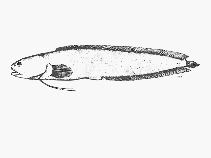
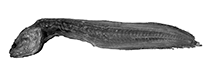
Dorsalspines (total): 0; Dorsalsoft rays (total): 100; Analspines: 0; Analsoft rays: 71; Vertebrae: 46 - 47. This species is characterized by having the following: vertebrae 14 + 32-33 = 46-47, dorsal fin
rays 93-100, anal fin rays 70-71; body scaled; pelvic fin extending beyond posterior end of pectoral fin; single pair of pseudoclaspers thin, straight, not quite as long as the penis (Ref. 57886). Body shape (shape guide): elongated.
Møller, P.R. and W. Schwarzhans, 2006. Review of the Dinematichthyini (Teleostei, Bythitidae) of the Indo-west Pacific, Part II. Dermatopsis, Dermatopsoides and Dipulus with description of six new species. The Beagle 22:39-76. (Ref. 57886)
IUCN Red List Status (Ref. 130435: Version 2025-2)
Phylogenetic diversity index (Ref. 82804): PD50 = 0.5625 [Uniqueness, from 0.5 = low to 2.0 = high].
Bayesian length-weight: a=0.00389 (0.00180 - 0.00842), b=3.12 (2.94 - 3.30), in cm total length, based on all LWR estimates for this body shape (Ref. 93245).
Trophic level (Ref. 69278): 3.2 ±0.5 se; based on size and trophs of closest relatives
Resilience (Ref. 120179): Low, minimum population doubling time 4.5 - 14 years (Assuming Fec < 100).
Fishing Vulnerability (Ref. 59153): Low vulnerability (10 of 100). 🛈