Teleostei (teleosts) >
Perciformes/Scorpaenoidei (Scorpionfishes) >
Platycephalidae (Flatheads)
Eponymy: Dr Arthur Donovan Welander (1908–1982) was a fisheries biologist at the School of Fisheries, University of Washington, his alma mater which had awarded his BS (1934), MS (1940) and PhD (1946). [...] (Ref. 128868), visit book page.
More on author: Schultz.
Environment: milieu / climate zone / depth range / distribution range
Ecology
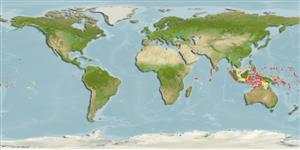
Marine; reef-associated; non-migratory; depth range 6 - 40 m (Ref. 9790). Tropical; 10°N - 15°S
Indo-Pacific: Reunion east to American Samoa, south to Australia.
Size / Weight / Age
Maturity: Lm ? range ? - ? cm
Max length : 13.0 cm TL male/unsexed; (Ref. 9790); common length : 8.0 cm TL male/unsexed; (Ref. 9790)
Dorsal spines (total): 9; Dorsal soft rays (total): 11; Anal spines: 0; Anal soft rays: 11. Preopercle with a small antrorse spine. Infraorbital and suborbital ridges bearing many fine serrations. Preocular spines 2-3. Lower side of head bicarinate. Iris lappet slightly bilobed. (Ref. 9790).
Body shape (shape guide): elongated.
Found in sandy areas of lagoons and seaward reefs. Usually caught with trawls in deeper water (Ref 90102).
Life cycle and mating behavior
Maturity | Reproduction | Spawning | Eggs | Fecundity | Larvae
Knapp, L.W., 1999. Platycephalidae. Flatheads. p. 2385-2421. In K.E. Carpenter and V.H. Niem (eds.) FAO species identification guide for fishery purposes. The living marine resources of the Western Central Pacific. Volume 4. Bony fishes part 2 (Mugilidae to Carangidae). FAO, Rome. (Ref. 9790)
IUCN Red List Status (Ref. 130435: Version 2025-2)
Threat to humans
Harmless
Human uses
Fisheries: of no interest
Tools
Special reports
Download XML
Internet sources