Teleostei (teleosts) >
Ovalentaria/misc (Various families in series Ovalentaria) >
Pomacentridae (Damselfishes) > Chrominae
Etymology: Chromis: Greek, chromis = a fish, perhaps a perch (Ref. 45335).
More on authors: Jordan & Metz.
Environment: milieu / climate zone / depth range / distribution range
Ecology
Marine; reef-associated; non-migratory; depth range 6 - 160 m (Ref. 9710), usually 18 - ? m (Ref. 9710). Tropical; 30°N - 15°N
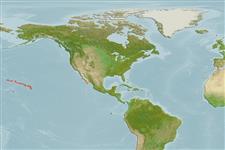
Eastern Central Pacific: Hawaiian and Johnston islands.
Size / Weight / Age
Maturity: Lm ? range ? - ? cm
Max length : 16.0 cm SL male/unsexed; (Ref. 7247)
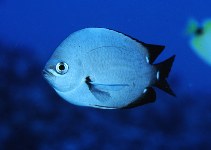
Dorsal spines (total): 14; Dorsal soft rays (total): 12 - 14; Anal spines: 2; Anal soft rays: 12 - 14. Overall color is black. With three pupil-size white spots: one at the rear base of the dorsal fin, one at the rear base of the anal fin, and the third at mid-base of the caudal fin.
Body shape (shape guide): short and / or deep; Cross section: compressed.
Adults form large aggregations high above the bottom in rocky areas around caves and ledges (Ref. 7247). Benthopelagic (Ref. 58302). Collected from 183 m. Spawn from December to June (Ref. 7247). Oviparous, distinct pairing during breeding (Ref. 205). Eggs are demersal and adhere to the substrate (Ref. 205). Males guard and aerate the eggs (Ref. 205).
Life cycle and mating behavior
Maturity | Reproduction | Spawning | Eggs | Fecundity | Larvae
Oviparous, distinct pairing during breeding (Ref. 205). Eggs are demersal and adhere to the substrate (Ref. 205). Males guard and aerate the eggs (Ref. 205).
Allen, G.R., 1991. Damselfishes of the world. Mergus Publishers, Melle, Germany. 271 p. (Ref. 7247)
IUCN Red List Status (Ref. 130435: Version 2025-2)
Threat to humans
Harmless
Human uses
Fisheries: commercial; aquarium: commercial
Tools
Special reports
Download XML
Internet sources