Environment: milieu / climate zone / depth range / distribution range
Ecology
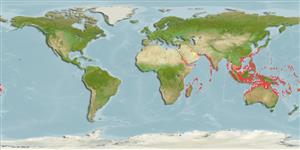
Marine; reef-associated; depth range 10 - 45 m (Ref. 90102), usually 20 - 42 m (Ref. 9710). Tropical; 23°C - 28°C (Ref. 27115)
Indo-West Pacific: Red Sea south to Natal, South Africa (Ref. 4392) and east to Bali, Indonesia.
Size / Weight / Age
Maturity: Lm ? range ? - ? cm
Max length : 13.0 cm TL male/unsexed; (Ref. 11441)
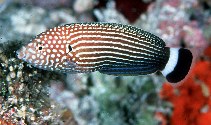
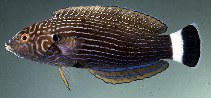
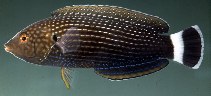
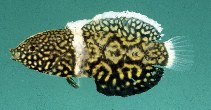
Dorsal spines (total): 9; Dorsal soft rays (total): 12; Anal spines: 3; Anal soft rays: 12. Body orange-brown, with pale longitudinal blue-green lines following scale rows; head with irregular light blue-green lines; opercular flap with a black spot; caudal fin white with a broad black bar on posterior part of fin (Ref. 4392). Red Sea form is slightly different. Females are distinguished by the white versus yellow band on the base of the tail and males by the lined versus spotted pattern on the body (Ref. 48636).
Body shape (shape guide): fusiform / normal.
Adults inhabit lagoon and seaward reefs, usually deeper than 20 m to at least 42 m (Ref. 9710). Juveniles are solitary and adults form small groups, each with several females and a dominant male (Ref. 48636). Oviparous, distinct pairing during breeding (Ref. 205). Minimum depth reported from Ref. 27115.
Life cycle and mating behavior
Maturity | Reproduction | Spawning | Eggs | Fecundity | Larvae
Oviparous, distinct pairing during breeding (Ref. 205).
Randall, J.E., 1986. Labridae. p. 683-706. In M.M. Smith and P.C. Heemstra (eds.) Smiths' sea fishes. Springer-Verlag, Berlin. (Ref. 4392)
IUCN Red List Status (Ref. 130435: Version 2025-2)
Threat to humans
Harmless
Human uses
Fisheries: commercial; aquarium: commercial
Tools
Special reports
Download XML
Internet sources